Key Events This Week:
1. May Industrial Production data - Monday
2. May Housing Starts data - Tuesday
3. May Retail Sales data - Wednesday
4. Fed Interest Rate Decision and Kevin Warsh's First Meeting as Fed Chair - Wednesday
5. June Philly Fed Manufacturing Index - Thursday
6. US Markets Closed for Juneteenth - Friday
All eyes are on the Fed this week.
Seeing a lot of people being mad about locates.
Locates go through similar cycles.
Players become bigger, they either graduate to bigger liquidity pool or blow up.
If a player stays in the space there is very very high likelihood of a blowup, upon which locates will be easier once more.
If you think you can make unlimited money in small caps shorting and seemingly winning on everything, you are looking at players leaning right against the fat tail distribution, in short they are borrowing profits against an exponentially increasing blowup risk.
It works very well until 1 takes you out.
This game is one that takes most players out in the end, especially those that rise through the ranks way faster than the rest.
Sound compounding is the only free great gift to humanity, try and trick it and you will get the bill eventually.
Coming from someone that has seen about 10 9fig traders trade as the top dog in small caps and seen most blow up or near blow up before the strategies got adjusted and strategies were deleted.
Each had their time, each thought they were different, almost all blew up 70%+ of their account on one trade, some ending completely wiped.
Getting off before the steamroller, if thats the path that is tried, is probably one of the hardest thing to do of all.
In good times there is no reason to stop, in bad times there only is reasons to continue.
Cuando ves que las small caps empiezan a complicarse, te das cuenta de que, al final, todo se reduce al contexto. Da igual si operas small caps, mid caps o cualquier otro mercado: el contexto termina siendo el factor más importante.
La clave para la longevidad no está en memorizar cuatro setups, sino en entender por qué funcionan, cuál es realmente nuestro edge y bajo qué condiciones ese edge tiene una ventaja estadística. Pensar que unos pocos setups van a mantenerse rentables durante años sin importar el entorno de mercado es una visión demasiado sesgada. Los mercados cambian constantemente, y lo que hoy funciona puede dejar de hacerlo durante meses o incluso años.
Muchos traders atraviesan grandes rachas positivas y, apoyados por una subida agresiva de size, llegan a generar retornos extraordinarios. Sin embargo, cuando sus setups entran en una fase de varianza negativa, la frustración aparece. Algunos dejan de ganar dinero y otros incluso terminan quebrando porque nunca entendieron realmente qué impulsaba sus resultados.
Por eso, más allá de buscar el próximo setup ganador, es fundamental comprender por qué ganamos dinero y qué condiciones hacen que nuestras estrategias tengan ventaja. Entender el contexto siempre será más valioso que depender de cuatro o cinco setups que creemos infalibles.
El verdadero edge está en la capacidad de adaptarse, identificar rápidamente cuándo el entorno deja de favorecer una estrategia y ser capaz de migrar hacia otras oportunidades. En lugar de depender de un único contexto de mercado, es mucho más eficiente construir una baraja de estrategias descorrelacionadas que nos permitan seguir siendo rentables a lo largo del tiempo. Esa adaptabilidad es lo que realmente genera una curva de rendimiento sólida y sostenible en el largo plazo.
Key Events This Week:
1. May Existing Home Sales data - Tuesday
2. May CPI Inflation data - Wednesday
3. May PPI Inflation data - Thursday
4. OPEC Monthly Report - Thursday
5. MI Inflation Expectations data - Friday
6. MI Consumer Sentiment data - Friday
All eyes are on inflation this week.
Will have this as part of my course eventually.
But tons of intraday scanners can help way better: find an intraday scanner software and run 3 basic filters
1. % up the most
2. % down the most
3. Doing most volume vs ADV
Those three catch a crazy amount for how simple it is.
Breadth is expanding
$IYT New Highs, $RSP New Highs, $KRE building out, and $XBI $ARKG huge bases.
Everyone chasing extended AI stocks while quietly under the hood we are seeing rotation and broadening out. Bullish!
Key Events This Week:
1. April Pending Home Sales data - Tuesday
2. Fed Meeting Minutes - Wednesday
3. Nvidia, $NVDA, Reports Earnings - Wednesday
4. May Philly Fed Manufacturing Index - Thursday
5. May UMich Consumer Sentiment data - Friday
6. May UMich Consumer Expectations data - Friday
The biggest earnings event of the quarter has arrived.
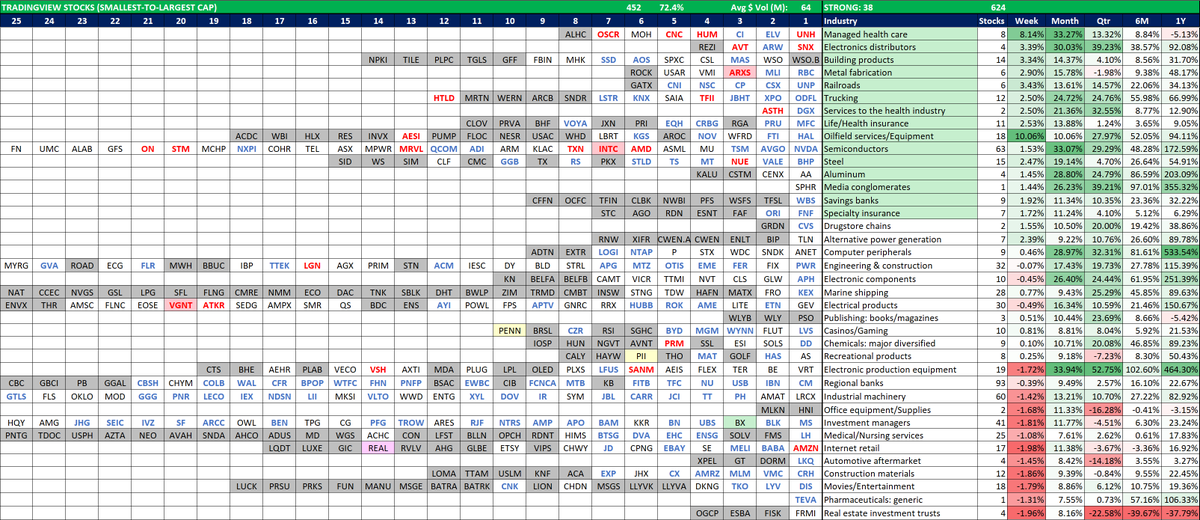
📈Leading Stocks In Leading Industries (TradingView)
The chart shows largest stocks in the strongest industry groups, based on "Week x Month" Relative Strength (RS)
🏭Industries: sorted ⬆️ strongest-weakest ⬇️
Stocks: sorted ⬅️smallest-to-largest ➡️market cap
“You want to own the leading stocks in the leading industry groups.” - William O'Neil
* Daily $ Vol >= $50M
BREAKING: Iran’s Speaker of the Parliament provides trading advice to investors trading US markets:
“Pre-market so-called ‘news’ or ‘Truth’ is often just a setup for profit-taking. Basically, it is a reverse indicator. Do the opposite: If they pump it, short it. If they dump it, go long. See something tomorrow? You know the drill.”
Key Events This Week:
1. US Market Futures Open, Iran War Day #30 - Today 6 PM ET
2. Fed Chair Powell Speaks - Monday
3. March Consumer Confidence data - Tuesday
4. February JOLTS Job Openings data - Tuesday
5. March ADP Nonfarm Employment data - Wednesday
6. March Retail Sales data - Wednesday
7. March Jobs Report - Friday
Buckle up for a big week ahead.
Key Events This Week:
1. Markets React to Trump's "48 Hour Warning" to Iran - Today 6 PM ET
2. March S&P Global Services PMI data - Tuesday
3. US Crude Oil Inventory data - Wednesday
4. Initial Jobless Claims data - Thursday
5. March MI Consumer Sentiment data - Friday
6. March MI Inflation Expectations data - Friday
We expect another chaotic futures open today.
Key Events This Week:
1. Markets React to US Strikes on Kharg Island - Today 6 PM ET
2. February Pending Home Sales data - Tuesday
3. February PPI Inflation data - Wednesday
4. Fed Interest Rate Decision and Statement - Wednesday
5. Philly Fed Manufacturing Index - Thursday
6. January New Home Sales data - Thursday
We have a huge week ahead.
These are the setups of the best traders I’ve interviewed:
Catalyst Gaps
Base Breakouts
Mean Reversion Long
Mean Reversion Short
Pullback/Undercut & Rally
They allow you to manage risk versus a key level/turning point where you can expect significant expansion from your entry
Key Events This Week:
1. US Stock Market and Oil Futures Open - 6 PM ET TODAY
2. February Existing Home Sales data - Tuesday
3. February CPI Inflation data - Wednesday
4. US Q4 2025 GDP Data - Friday
5. January PCE Inflation data - Friday
6. January JOLTS Job Openings data - Friday
All eyes are on oil prices tonight.
The million dollar question:
What happens to the stock market this week? Here's our view:
In the lead up to this weekend's events in Iran, we saw a large geopolitical risk premium priced into many parts of this market.
Oil prices are up +20% in 6 weeks and gold prices surged +13% in a month.
The question becomes: is this geopolitical risk premium "enough" for what's happening now? It's an "expectations versus reality" situation.
At the 6 PM ET futures open today, we expect to see an initial surge in commodity prices and drop in equities.
In our view, the Strait of Hormuz situation, and its potential closure, is the biggest risk to financial markets right now which will drive broader price action.
What happens in the Strait of Hormuz will largely depend on how long this conflict lasts:
Historically, President Trump has heavily favored swift military operations, such as the June 2025 Iran strikes and the capture of Venezuela's President Maduro.
If President Trump follows this historical path, we believe an initial surge in commodity markets and drop in equity markets could be rapidly undone, particularly if a "deal" is floated again.
Even any sort of indication of when the military campaign will "end" could reverse price action rapidly. Again, a substantial geopolitical risk premium is already priced in.
However, the catastrophic case for markets is one where the US and Israel enter a prolonged war with Iran lasting months or longer, resulting in a sustained closure of the Strait of Hormuz.
A full closure of the Strait of Hormuz would send oil prices above $100 per barrel, according our analysis, which would imply a spike in US CPI inflation to ~5%.
That said, do not forget that three of President Trump's top policy priorities are to be the "peace president," eliminate inflation, and lower US gas prices to $2.00 per gallon.
A prolonged war with Iran would work in the opposite direction of these key initiatives, particularly in the short-term during a crucial midterm election year.
We think Trump aims for a short and swift operation and markets prevail once again as the dust settles.