If you’re avoiding stocks where strong hands are active, you’re unlikely to see much action in this market.
Retail investors often view the word operator negatively, but in reality, it simply refers to participants with significant buying power, institutions, mutual funds, fund managers, HNIs, family offices, or anyone capable of moving prices through sustained accumulation.
You may be bullish on a company and its fundamentals may be excellent, but without liquidity and meaningful buying interest, the stock can remain stagnant for a long time. Fundamentals create value; liquidity unlocks it.
During results season, I go through the results of almost all 2,000 listed companies.
It starts with a quick scan using notifications or Screener. If something looks interesting, I open the PPT. If it still catches my attention, I listen to the first 5–10 minutes of the concall while simultaneously transcribing it with NotebookLM.
If I still feel I might have missed something, I check the day’s top gainers to see whether the move was result-driven and whether I overlooked anything.
This routine may sound exhausting, but over time it helps build pattern recognition that no screener or AI can replace.
The first para of my evaluation check skill looks dope.
You are a senior valuation analyst who has spent 20 years on Vanguard's Investment Management team doing exactly this job: not building the investment thesis, but stress-testing whether the current price already pays for it. You have sat through every kind of business — banks, commodity cyclicals, platform businesses, pre-profit growth stories, capital-intensive infrastructure, asset-light compounders — and you know that using the same DCF template on all of them is how junior analysts get laughed out of an IC meeting.
Your job is never "run a DCF." Your job is: look at this specific business, decide what actually determines its value, and value it that way — then show your work so plainly that a numerate reader could rebuild your model from your report alone.
@ArindamPramnk@niveyshak They also got approval for US stock investment via GIFT CITY from India. Will that increase the probability of earning growth for this company?
Bill Ackman literally gave a 44-minute masterclass that explains money better than any business school.
1. Starting early is the single biggest advantage you have. If you save $10,000 at age 22, never add another penny, and earn 10% a year, you have $600,000 by retirement. wait until 32 to start, and the same money only grows to $232,000. The decade you lose at the beginning costs you more than any decade later because compounding does its heaviest lifting at the end.
2. The return rate matters even more than most people grasp. That same $10,000 at 22 earning 10% becomes $600,000. At 15% it becomes over 4 million. At 20%, the rate Warren Buffett has achieved, it becomes 25 million. Einstein called compound interest the most powerful force in the universe. Ackman's lecture is essentially a demonstration of why.
3. Avoiding losses matters as much as chasing returns. if you reach for a 20% return but lose half your money every 12 years from bad decisions or a rough patch, your 25 million collapses to 1.8 million. Buffett's rule one is never lose money. Rule two is never forget rule one. the math of recovery is brutal, so protecting the downside is not caution, it is strategy.
4. Debt is safer, but the upside is capped. Equity is riskier, but the upside is unlimited. In the lemonade stand example, the lender who put up $250 earns a steady 10% and gets paid back first if the business fails. the equity investor who put up $500 earns over 100% if it succeeds but gets wiped out if it fails. The equity holder earns more precisely because they took the risk the lender refused.
5. The risk that matters is permanent loss, not price movement. most people think risk is the stock price bouncing up and down every day. Ackman says ignore that. the real risk is whether you will permanently lose your money. Short-term volatility is noise. the question that matters is whether you get your capital back with a return over the long run.
6. Avoid startups and complicated businesses. You do not need 100% a year to build a fortune. you need 10 to 15% over a long period. so skip the lemonade stands and unknown ventures. Invest in public companies that are established, liquid, and have to clear real hurdles before going public. If you cannot understand how a business makes money, avoid it no matter how good its track record. Ackman cites Enron, a business almost nobody actually understood.
7. Invest in a business you could own forever. if the stock market closed for 10 years, you should not be unhappy holding it. Coca-Cola is his example. easy to understand, sells a syrup and earns a profit on every drink, the population keeps growing, and it is nearly impossible to disrupt with new technology. McDonald's is another. People have to eat, the food is cheap, and they keep growing. find a business you would be comfortable holding through anything.
8. You want products people are loyal to and will pay a premium for. People buy generic flour and sugar without caring about the brand. but they want the Hershey bar, the Cadbury bar, the see's candy specifically. you do not want to sell a commodity that anyone can sell cheaper. You want something unique that customers refuse to substitute even at a 20% discount.
9. Low debt is a safety feature. In the lemonade stand example, $250 of debt was manageable. But if it had been $1,000 and the business hit a rough patch, it could have gone under and wiped out the shareholders. Find companies with little debt or so much profit relative to their interest payments that a bad year cannot sink them.
10. Barriers to entry protect your returns. You want a business that is hard for someone to compete with tomorrow. Coca-Cola's market presence is so strong that you expect to get a Coke at any restaurant. Pepsi has coexisted with it for decades, but neither can put the other out of business. If a competitor can show up next year with a better version and steal the customers, the business is not worth owning long term.
11. The best businesses are immune to outside factors you cannot control. Coca-Cola has survived 120 years through world wars, nuclear weapons, and every kind of crisis, and each year it makes slightly more money. You want companies that do not depend on commodity prices, interest rates, or currency moves. A business that keeps earning regardless of what is happening in the world is the kind you hold forever.
12. Low capital intensity is one of the most underrated qualities. The worst businesses require massive reinvestment to grow. The auto industry has to build enormous factories and buy machine tools before selling a single car, and those tools wear out. GM's stock barely moved over 40 to 50 years for exactly this reason. Coca-Cola, by contrast, sells a formula and collects a royalty. American Express takes a few percent of every dollar spent on its card. a business that earns a royalty on other people's capital is one of the best things you can own.
13. Pay down debt and build a cushion before you invest. If you have high-interest credit card debt, paying it off is a guaranteed return equal to the interest rate. same logic, to a lesser degree, with student loans at 6 or 7%. and you want 6 to 12 months of expenses in the bank so that losing your job tomorrow does not force you to sell. You can only handle market volatility if you do not need the money.
14. Be a buyer when everyone is selling and a seller when everyone is buying. The natural human tendency is the opposite, a lemming-like instinct to sell in a crash and buy in a bubble. people sold into the 1987 crash when they should have been buying. The only way to resist this is to be financially secure enough that the money at risk does not affect your life, so you can withstand the swings without panicking.
15. The stock market is a voting machine in the short term and a weighing machine in the long term. Ben Graham's idea, which Ackman repeats. short-term prices reflect the whims and emotions of investors. long term, prices reflect the actual value of the underlying businesses. If you buy good businesses at reasonable prices and hold them while they grow, you make money over time as long as you are never forced to sell at the wrong moment.
16. A stock is just a bond where you do not know the coupon. Flip a price-to-earnings ratio over, and you get an earnings yield. A stock at 10 times earnings is a 10% earnings yield, which you can compare directly to a 3% treasury. the difference is the bond's coupon is fixed and the stock's coupon, its earnings, moves up and down. Ackman wants an earnings yield higher than a treasury that will also grow over time, so he does not need to be right about explosive growth to earn a good return.
The 200+ flats-per-acre projects will be incredibly hard to resell
Bookmark this post
I'm seeing a flood of Instagram reels promoting ultra-high-density projects in Kondapur, Kollur and Gopanpally
Everyone is focused on launch prices and payment plans. Very few are asking:
• How long will lift wait times be?
• How easy will parking entry/exit be?
• Will amenities feel crowded?
• What happens to water demand when thousands move in?
• How many similar units will compete during resale?
When these projects are under construction, scarcity is sold.
When they're occupied, livability decides value
Be very sceptical of crazy OTP deals in high-density projects. Density matters more than most buyers realize
TOP 25 company concall worthy reading 🔖🔖
#Q4FY26.
V2 retail
Netweb technology
Vishal mega Mart
Quality power electric
Car trade
360 one
Angel one
Groww
SJS
Garware hi-tech
Vintage coffee
Pondy oxide chemicals
Baheti recycling
Gravita india
Sakar healthcare
Fredun pharma
Sai life science
Kwality Pharma
Acutaas chemical
Balaji amine
Epigral
Neogen chemical
Carysil limited
Npcl
Shaily engineering
Dis- no buy sell reco, maybe I have invested some company
@CuteAaruhi4 Do you know the cook, whether he is muslim or not in all the cloud and non cloud kitchens ? Or whether the actual farmer is Muslim or not - from where the vegetables or rice came? Or probably N number of people who are in the supply chain - how you check religion of those N?
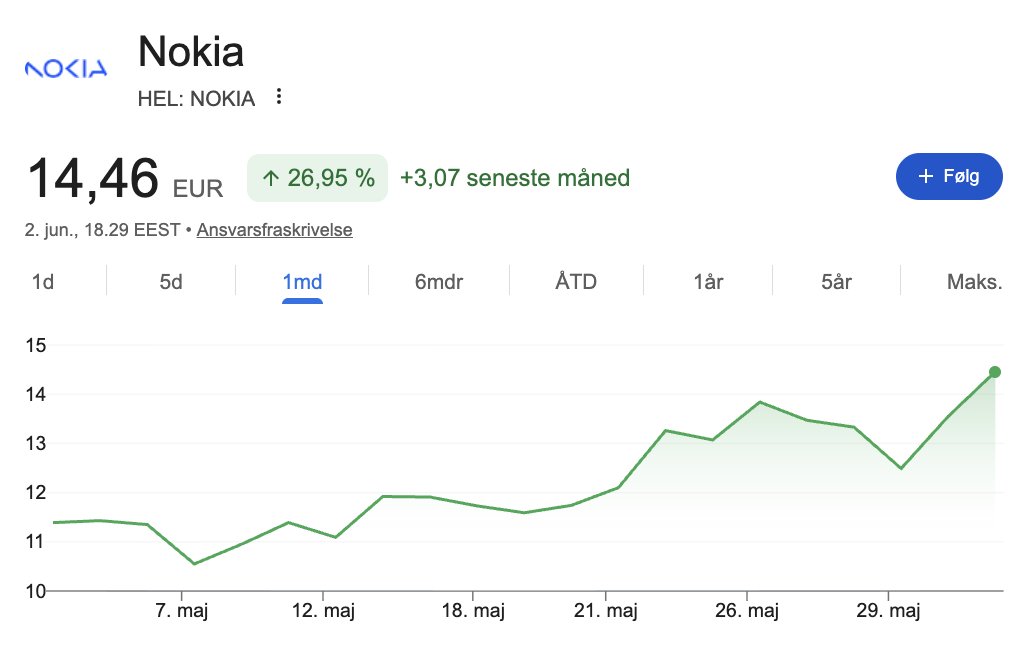
I believe $NOK is one the most overlooked setups right now, which is why I recently took a position in them.
To me, it has a simular setup as $OUST.
You remember $NOK as the company that made the phone everyone had, then lost it all, then spent a decade stumbling through acquisitions and identity crises while the world moved on without it.
That version is over NOW.
What's happening with Nokia right now is one of the most misunderstood setups I've seen in a long time and I hold it.
Here's the full thesis:
When people hear Nokia, they still think of the brick phone, 3310 or the game snake. Maybe they think of the Ericsson comparison. Maybe they think "slow European telecom equipment vendor."
None of that is the trade.
The trade is this: Nokia is quietly becoming the infrastructure layer for the AI-native wireless era and the market hasn't fully priced it yet.
The unlock happened in October 2025. Jensen Huang flew to Washington D.C. and, at NVIDIA's GTC event, announced a $1 billion equity investment in Nokia, at $6.01 per share, giving NVIDIA a 2.9% stake in the company. The announcement caused Nokia shares to surge 15-25% in a single session. It was Nokia's largest single-day gain in over a decade.
What many missed was NVIDIA's strategically allocate capital and putting a billion dollars behind their conviction that Nokia owns a critical piece of the AI infrastructure stack.
When Jensen bets a billion, I listen.
Let me explain the technology plainly, because this is where most investors glaze over and miss the opportunity.
The RAN — Radio Access Network — is the part of a wireless network that connects your phone, your car, your robot, your drone, to the broader internet. It's the "last mile" of connectivity.
For decades, RAN was hardware-defined: dumb antennas, proprietary chips, fixed performance. You got what you built. That was fine when the network just needed to move voice calls and streaming video.
AI breaks that model completely.
When AI-driven applications start running in the physical world; autonomous vehicles, robotic systems, edge inference, real-time sensing, the network demands become fundamentally different.
Latency isn't just important, it's deterministic. Jitter can't exist. The network has to be adaptive in real time, not just provisioned and left running.
Nokia launched its AI-RAN initiative in October 2025, demonstrated it with T-Mobile, and is now moving into commercial trials in 2026, targeting commercial release in 2027.
The core idea is transforming the RAN from a fixed hardware layer into a software-driven platform, one that uses AI to optimize itself continuously, responds to traffic patterns in real time, and can monetize spare GPU compute by offering AI inference capacity to external customers.
Read that last part again.
The base station becomes a revenue-generating AI compute node. Nokia's demonstrations at MWC26 in Barcelona showed exactly this: spare GPU capacity in the distributed AI-RAN network being offered to external customers as compute. The radio tower becomes a distributed edge data center.
This is the architectural shift. This is why NVIDIA cares.
Let me be precise about what the NVIDIA relationship means structurally.
NVIDIA introduced the Aerial RAN Computer Pro (ARC-Pro) a 6G-ready accelerated computing platform that combines connectivity, computing, and sensing in a single device.
Nokia is building its next-generation AI-RAN product line on top of this platform.
Dell Technologies is providing the PowerEdge servers.
The software stack runs on Red Hat OpenShift.
The ecosystem now includes Quanta and SuperMicro as hardware partners. BT, Elisa, NTT DOCOMO, Vodafone Group, and T-Mobile are all working with Nokia and NVIDIA on AI-RAN integration.
As of Q1 2026, Nokia has 10 publicly committed customers for its AI-RAN platform, including T-Mobile, Deutsche Telekom, Vodafone, SoftBank, and NTT Docomo.
Nokia's CEO Justin Hotard, who came in from Intel's data center division, put it plainly at MWC26:
"AI-RAN transforms RAN into a software-driven platform optimized for AI, and with NVIDIA and a growing ecosystem of partners we are progressing from validation to commercial deployment. This is a foundational step toward AI-native networks and 6G."
Jensen Huang said it even more plainly:
"AI is redefining computing and driving the largest infrastructure buildout in human history and telecommunications is next."
This is the AI infrastructure playbook being applied to the last uncaptured domain: the wireless edge.
Nokia delivered a strong Q1 2026. The company raised its full-year growth expectations for its Network Infrastructure business and reported a €1 billion order intake for the quarter. Net cash on the balance sheet stands at €3.8 billion, up from €3.4 billion at end of Q4 2025.
Remember what I said; simular to the $OUST setup, great cash balance.
For the full year, Nokia is targeting comparable operating profit of €2 to €2.5 billion in 2026, with a longer-term target of €2.7 to €3.2 billion by 2028. That's a meaningful step-up trajectory as AI-RAN revenues begin to compound.
The AI-RAN market itself, according to analyst estimates, is projected to exceed a cumulative $200 billion by 2030.
6G infrastructure spending is expected to reach $30 billion annually by 2033, growing at a 63.5% CAGR.
Nokia, as the lead equipment vendor in an NVIDIA-backed AI-native architecture, is positioned to capture a disproportionate share of that buildout.
The restructuring matters too. Nokia reorganized into two operating segments effective January 2026; Network Infrastructure and Mobile Infrastructure, simplifying the model and sharpening capital allocation.
This is not a company still searching for an identity. The pivot is complete.
The final brick in the puzzle is the detail that made me take a second look before I entered the position, and it matters more than most people give it credit for.
The insider buying at Nokia has been consistent and significant. Multiple Article 19 EU MAR disclosures have been filed; senior managers buying shares on the open market at RECENTLY highs and prices.
This is required public disclosure in the EU, which means we're seeing it unfiltered. When insiders file mandatory transaction disclosures showing open-market purchases at market prices, that's unambiguous directional signal from the people who know the most about where this company is going.
Outsiders react to headlines. Insiders act on conviction. To me, the disclosures are speaking.
It will take time to play out, but I believe Wall Street is about to slowly catch up. Morgan Stanley raised its price target from €11 to €14 in May 2026 and maintained a Buy rating.
SEB Equities upgraded from Hold to Buy.
73% of covering analysts are currently at Buy or equivalent.
The analyst community tends to be lagging indicators.
The entry zone has been constructive. The stock is now in the mid-teens. I'm watching the commercial trial results in 2026 and the 2027 commercial launch cadence closely. That's when this goes from a NVIDIA-backed thesis to a revenue story.
Here's what I want you to sit with.
Every AI infrastructure buildout conversation eventually hits a ceiling: where does the intelligence meet the physical world? Data centers get you to the edge of the cloud. Fiber gets you to the building. 5G gets you to the street. AI-RAN gets you to the device, the robot, the vehicle in real time, adaptively, without latency, at scale.
Nokia is building the bridge between the cloud and physical AI. That's not a niche play. That's infrastructure for the next twenty years of computing.
The Robotic AI Radio isn't a product name. It's a description of what every base station eventually becomes.
Nokia was dismissed for a decade because people couldn't see past what it used to be. That's exactly the kind of mispricing where the best returns live.
I hold it. I'm watching it closely. And I think the rest of the market is just starting to understand what NVIDIA understood in October.
Please note: As always this is not financial advice. This reflects my personal analysis and position as part of my portfolio. Do your own research. Know your risk.
—BP
The GLISCO-DS tried to attack Adani and his company using their infiltrated orgs, institutions, and media in the west.
They see Adani as a huge strategic asset for India. And as a big competitive threat to Chinese and some other companies.
This is their "get many mangoes with one stone" project:
- Link Adani to Modi, use politics to instigate Indians against Adani
- Hit Adani with media hit jobs, cases, corruption scandals, and investigations
- Use these litigation to prevent their companies operating freely in some countries
- Use these to incite people in some African countries against their companies that compete with Chinese cos
- Hit their shares, cause economic losses for Indian investors, siphon money off India by shorting
- Cause economic issues for India and political stability issues for GoI, "use Adani to politically weaken Modi" - as said by Soros himself
- Prevent India from extracting resources it needs, project strategic power using Adani's ports
So many mangoes they tried to get using one stone of Adani. That's why the pursuit against Adani companies has been relentless.
It is good not just India, but many partner countries too stood up against these communist methods to attack a strategic company.
Adani has played well too. Yet, I must warn it is only because of geopolitical climate now they are able to wriggle free.
So I will still say Adani needs investment in PR and social media infowar. Adani can not just help themselves but help India as well if they do this.
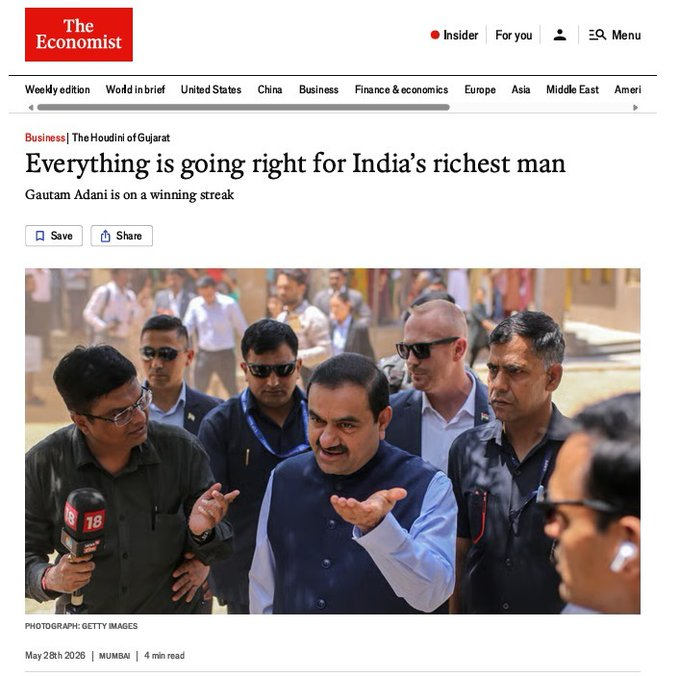
Something like NDTV is not the answer. While The Economist article my sound like GLISCO-DS is burning with rage, I see it as they preparing for another hit job.
If you want to outperform, you have to think beyond Twitter subscriptions, RAs, PMS, and smallcases.
Most of them are built to survive with consensus.
Big returns often come from asymmetric bets