End-to-end whole-body mobile manipulation on Digit — straight from research onto the show floor with zero-shot performance in a chaotic environment. #IROS2026@agilityrobotics
Talked to a Stanford prof last night who told me that AI has led to students all acing all the homeworks, never showing up to office hours, and then failing the final exams in-person.
So in response the department is changing the TA's purpose, by eliminating office hours and requiring students meet with TAs 1:1 and walking them through each coding assignment to demonstrate they actually understand what's going on in the code.
End-to-end whole-body mobile manipulation on Digit — straight from research onto the show floor with zero-shot performance in a chaotic environment. #IROS2026@agilityrobotics
I know teleoperation is old these days but it feels magical when you could teleoperate a humanoid just by wearing a pair of classes (bonus: the robot also sees from glasses too!)
Of course we don't stop here --- we are working on a system to train robots with everyday human experience, without any teleop data. More to come!
Kudos to the team Chuye Zhang @DanielZhenyang@ChuizhengKong
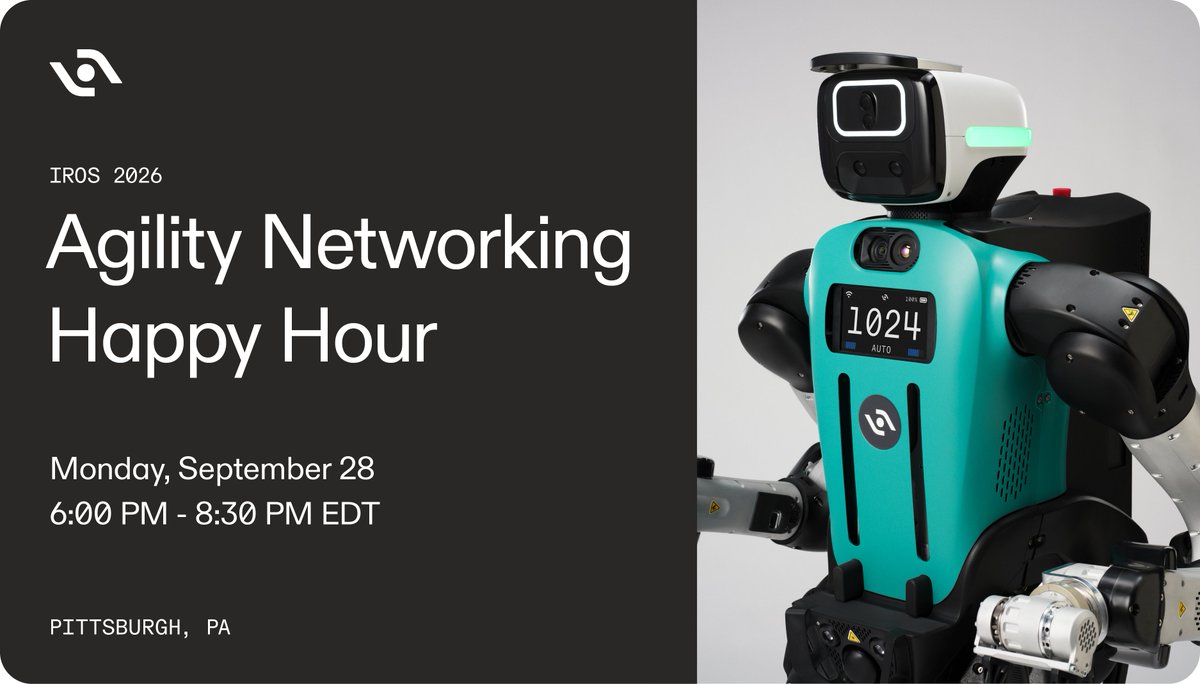
Heading to #IROS2026? See you in Pittsburgh next week!
Looking to join Agility? Connect with our talent team and leaders ⬇️
Registration required: https://t.co/jO1uxC4PC2
Excited to see TrackEverything out! 🚀
We tackle long-horizon dense 3D tracking across 1000+ frames. It was great working with @ayushjain1144 and the whole team!
1/ We introduce TrackEverything: a 3D point tracker that tracks all points across all frames of long videos (1000+ frames).
Our key idea is to tie computation to unique 3D scene content rather than redundant 2D pixels in a video.
https://t.co/NYHPTTg0Gr
Introducing OM-1, our first robot foundation model, zero-shot generalizing to any robot: table-top arms, industrial arms and humanoids.
- learned directly from human manipulation data
- no teleop/robot data
- close to human-level dexterity and efficiency
- multi-robot collab
We've improved how GEN-1 learns to adapt to new actuators and new robots at the lowest level, with up to 10-20x gains on internal benchmarks. This significantly boosts performance on high-precision tasks like disassembling parts from a NIST board.
Read more about GEN-1 in our blog posts in the comments below.
Learning from suboptimal data is important, because robots make suboptimal data on their own, and the more robots there are, the more data they make. If you want to contribute to building a public, open dataset of suboptimal data, check this out!
Today, we’re launching Tau’s humanoid cleaning service in San Francisco at $30 per hour.
Access is initially invite-only as we scale operations. If you don’t have an invite yet, join the waitlist at https://t.co/JrRpjIzRZv.
All footage is shown at 1× speed. Each humanoid is jointly controlled by a human operator and AI.
Why create robot intelligence for just one hand, when we could have it learn from many?
GEN-1, our latest embodied foundation model, now supports a broad range of end effectors from 5-finger hands, to specialized tools, and everything in between.
Yesterday we opened our new Fremont facility — a physical AI hub in the heart of Silicon Valley, where we advance Digit's skills and hardware and put new capabilities to work for customers faster.
We're hiring nearly 200 people to lead it.
Read the announcement: https://t.co/evR9Nvd5pE
#PhysicalAI #FutureOfWork
Introducing NEO’s 25 Degrees of Freedom, tendon-driven hands — nearing or surpassing human-level dexterity, strength, speed, and reliability.
For seventy years, robotics worked around the hand problem. The humanoid bet is the reverse: it lives or dies at the fingertips.