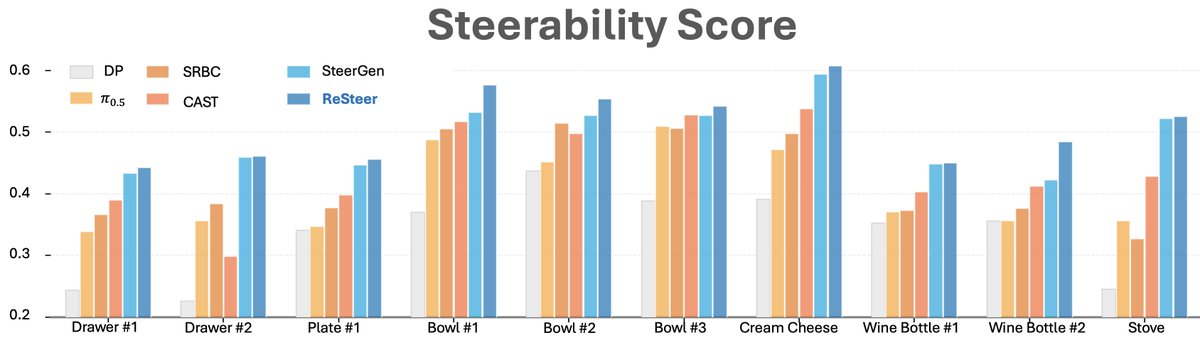
It turns out most SOTA VLAs are not very steerable: you cannot simply say, “Pick up A. No, sorry, I meant B.”
In @DanielZhenyang 's RSS'26 paper ReSteer, we systematically study this gap, propose a way to quantify steerability, and show how to improve it for any VLA.
Most VLA-steering work happens at inference time. We argue steerability is also a data problem — and the real win is a tool that tells you which data is missing, so you can collect it on purpose. Understand the data, get the behavior.
📄 Paper: https://t.co/s1r4E7SEaj
📷 Project: https://t.co/GR1M6vYnwY
This work cannot be done without wonderful collaborators and advisors. Alan, Liquan, Benjamin, @CelineLinatGT@Yuxiao_Chen_@siddkaramcheti@danfei_xu
Today's frontier VLAs can do many tasks—but they're far less steerable than advertised. Switch the instruction mid-execution and frontier models often plow ahead with the original task anyway.
🤖In our #RSS2026 paper, we measure steerability, explain why it breaks, and fix it. Introducing **ReSteer** (1/7)
State-action and visual gap are the key blockers for leveraging egocentric data. Checkout Egoengine led by @Randle_Liu@ShuoCheng94 on how we tackle this↓
The web is full of egocentric human videos. But robots can’t directly use them as demonstrations yet.
Meet EgoEngine: From Egocentric Human Videos to High-Fidelity Dexterous Robot Demonstrations, for zero-shot visuomotor learning without real-robot demos.
https://t.co/2DZx9xMPEH
A few big updates from https://t.co/87ZgYr4hRb:
1. EgoVerse is coming to RSS'26! @ryan_punamiya will present the work, and @simar_kareer will give a keynote at the Data-Centric Robotics workshop.
2. EgoVerse is expanding with more industry partners, including @microagi, @LightwheelAI, and Trace Labs, with a growing pool of training-validated, permissively licensed data (hitting 10k hours soon).
3. We are building the ecosystem around egocentric intelligence: Through a new partnership with the @nvidia Inception Program, we are connecting data vendors with researchers who can put this data to work.
Egocentric human data is abundant, but human motion is not always positive supervision for robot policy due to embodiment gaps. Naive BC co-training can HURT performance ☹️.
🌟Our key finding in **EgoWAM**: the state-prediction branch of a World Action Model effectively bridges this embodiment gap, enabling robot performance to scale with diverse **in-the-wild** human data.
💡The key question then becomes: what world representation transfers best across embodiments?
👇🏻Let’s take a deep dive into it:
🌐 https://t.co/VnhUs8CFKf
🧵[1/]
We are back. After one year of quiet building.
Introducing GENE-26.5, our first robotic brain that takes a major step toward human-level capability.
For years, robotics has struggled to learn from the world’s largest and valuable data source: Humans.
Solving it means rethinking the whole stack from the ground up:
- A robotics-native foundation model.
- A 1:1 human-like robotic hand.
- A noninvasive data collection glove for motion, force, and touch.
- A simulator that turns weeks of experiments into minutes.
GENE-26.5 is trained across language, vision, proprioception, tactile, and action. We designed a set of tasks to test how far we can go with this new paradigm.
Fully autonomous, 1x speed, one model, same weights. (Enjoy with sound on)
We are approaching the endgame for robotics.
And this is just a beginning.
GR00T-VisualSim2Real is now open source!
VIRAL and DoorMan are now available with training code, simulation assets, and the full recipe for bringing visual sim-to-real loco-manipulation skills to your own humanoids.
Repo: https://t.co/vgRsCeRG8w
when you ask Codex to optimize doc in codebase, this is what happened:
it first happily deleted the old CLAUDE.md and write this 😂😭
#claude#codex#ai#code#robotics
vision🍌 is here https://t.co/Ued6GGk4Et
if you got into computer vision the way I did, starting with pixel-level labeling tasks like segmentation, edges, depth, or surface normals, you’ll probably feel the same seeing these results -- something big has quietly shifted, and it’s going to change how we approach these problems for good 🧵
What's different between these two BC policies? It's the same architecture, training budget, and data collection setup — the only difference is the controller gains!
Controller gains are an understudied design parameter in robot learning. In our new work (w/ @BronarsToni*, @pulkitology), we show how they act as an inductive bias across BC, RL, and Sim2Real transfer, with real consequences on performance. Here's what we found 🧵
* Equal Contribution
📄arxiv: https://t.co/SMYgh7i8cA
🔗website: https://t.co/cLCd1FYCdJ
My conversation with Sergey Levine (@svlevine).
Sergey is the co-founder of @physical_int -- a company building foundation models that can control any robot to do any task in any environment.
The company's thesis is that generality is more scalable than specialization, meaning that a model trained across many different robots and tasks will ultimately outperform any system built to do one thing well (eg, just wash dishes).
Sergey is a researcher by background, but I think you will appreciate how practical and commercially grounded this conversation is.
We discuss:
- Why changing a diaper will be the last task a robot masters
- The simulation v. real-world data debate
- How multimodal LLMs give robots common sense
- Moravec's Paradox + Robot Olympics
- Why robots can do long-horizon tasks now
- A realistic timeline for robots in our homes
I should note that I am an investor in Physical Intelligence -- I made the investment because I believe it is one of the most important companies tackling the problem of robotics.
Enjoy!
Timestamps:
0:00 Intro
2:39 Defining Physical Intelligence
5:19 The Challenge of Building General Models
6:34 The Stakes and Future of General Purpose Robotics
8:15 Pros and Cons of Humanoid Robots
10:12 Historical Milestones in Robotics Research
15:31 Combining Generative AI and Deep RL
21:24 Moravec's Paradox 25:33 Kitchen Robots
29:30 Simulation vs. Real-World Data
30:48 The Robot Olympics
36:31 The Physiological Reality of Embodiment
38:56 Controversies in the Robotics Community
44:18 What Makes a Great Researcher
48:27 How Businesses Should Prepare for Robotics
54:09 Tracking Progress Through Research Papers
57:02 The Next Step: Mid-Level Reasoning
1:02:00 The Kindest Thing