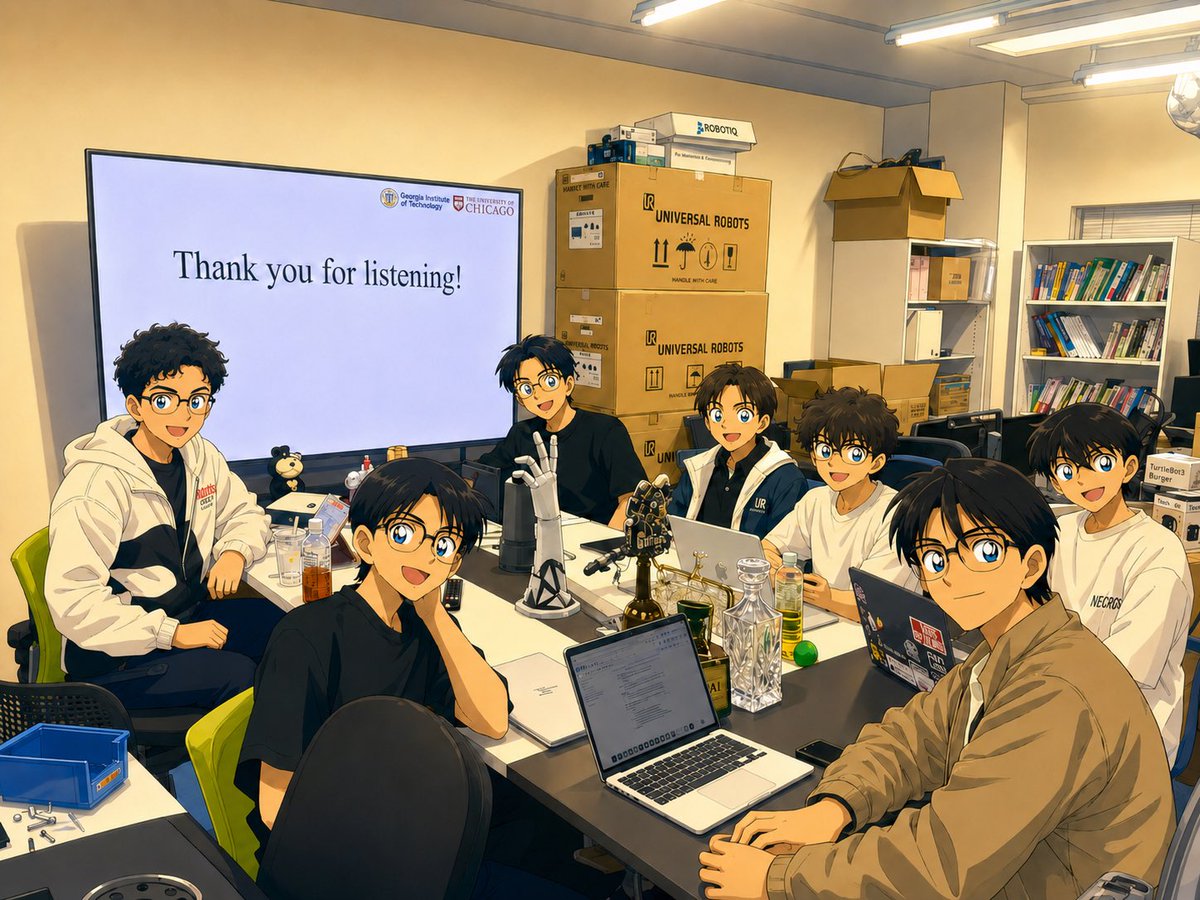
What if one unified method helps robots learn from human videos across many tasks, many robots?
Meet ImMimic: Cross-Domain Imitation from Human Videos via Mapping and Interpolation (CoRL 2025 Oral Presentation🏆) @ICatGT
Check it here https://t.co/mrBAjewrlg!
Humanoid robots don't need to look human.
Meet Eno, our first general-purpose robot.
Not a machine pretending to be human, but intelligence given a body.
At Genesis, we’re building a future where robots don’t feel cold or distant, but capable, calm, and ready to help.
Available Q4 this year.
Force sensing for low-cost robot arms — without adding force sensors.
🚀 Excited to share FACTR 2! 🚀
FACTR 2 enables external torque sensing on low cost arms and uses it to improve policy learning.
w/ @JasonJZLiu@_tonytao_
🧵(1/6)
I want to offer some unsolicited advice to computer vision researchers jumping into robotics. Don't focus too much on VLMs, VLAs etc. That's fine, but the real action is at the sensorimotor level. Most of the open problems in robotics are in manipulation, which is about hand-object interaction, and contacts and forces are central. Proprioception and tactile sensing are as important as vision. Don't get seduced by cherry-picked demos. You can't do robotics without doing robotics.
We show that robots can learn high-level task semantics, such as sorting rules, skill composition, and rule-based ordering, directly from human demos.
This is useful because if your target task is a composition of the robot's existing skills, you could just collect human demos for it without collecting further robot data.
Introducing Ego-Pi: VLA fine-tuning for egocentric human and robot data, a collaboration between @Stanford and @Meta.
Website: https://t.co/dIF6n4QGy3
Paper: https://t.co/3GFk6KQw9P
1/6
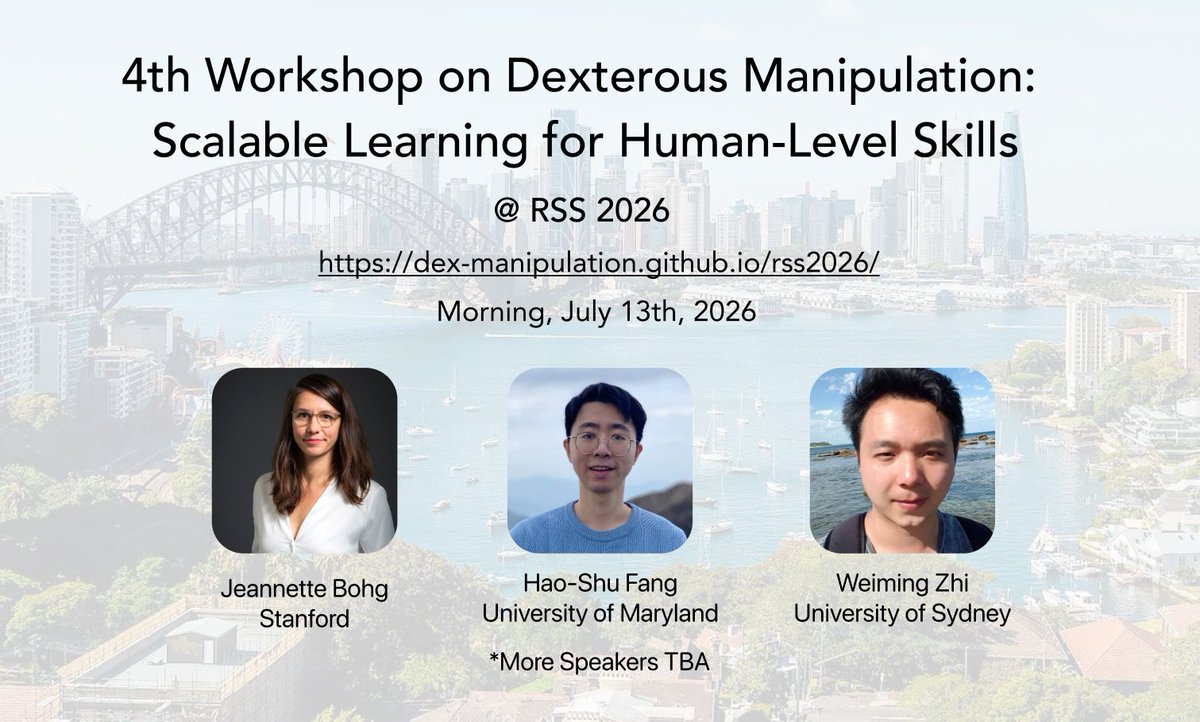
🤖 Excited to announce the 4th Workshop on Dex Manipulation. How time flies!
Join us and submit your work to our workshop!
Speakers, schedule, call for papers, and more details are available: https://t.co/mduNT39eFh
Deadline: June 22, 2026 (AoE)
See you in Sydney! #RSS2026
So honored to be invited to Sugano Lab at Waseda (早稻田) by my future labmate @StevenOh_@UChicagoCS@HaozhiQ . Sugano lab is one of the 3 best robotics lab in Japan, and the Hand Group is led by Prof. Funabashi. Looking forward to future collaboration!
We are back. After one year of quiet building.
Introducing GENE-26.5, our first robotic brain that takes a major step toward human-level capability.
For years, robotics has struggled to learn from the world’s largest and valuable data source: Humans.
Solving it means rethinking the whole stack from the ground up:
- A robotics-native foundation model.
- A 1:1 human-like robotic hand.
- A noninvasive data collection glove for motion, force, and touch.
- A simulator that turns weeks of experiments into minutes.
GENE-26.5 is trained across language, vision, proprioception, tactile, and action. We designed a set of tasks to test how far we can go with this new paradigm.
Fully autonomous, 1x speed, one model, same weights. (Enjoy with sound on)
We are approaching the endgame for robotics.
And this is just a beginning.
Just discovered this incredible Chinese podcast on robotics and AI hosted by @TairanHe99
Here's an episode with @danfei_xu
Definitely gives this a follow!
https://t.co/DWIcZvKWkU
🤖Low-data post-training can teach a VLA policy a new robot skill. But it also makes it too attached to the training demos.
We call this lock-in🔒: the policy can execute the post-training task, yet fails to respond to seemingly obvious prompt changes.
DeLock preserves steerability using only the policy’s own pretrained knowledge. No extra supervision needed!🚀🚀🚀
#Robotics #AI #EmbodiedAI #VLA
How humans move their hands is still the best blueprint for teaching robots to do the same. @mimicrobotics, a Switzerland-based physical AI company with roots in @ETH Zurich, builds dexterous robotic hands and the manipulation models that drive them. To train those models at scale, they use MANUS data gloves to capture human hand motion, turning real-world demonstrations into the datasets their manipulation policies learn from.
#robotics #datacollection #EmbodiedAI
⚡️EgoVerse is a first-of-its-kind, collaborative ecosystem for human-to-robot learning. The consortium leverages Project Aria to capture high-fidelity, egocentric human data — including 3D hand and head poses — to train next-gen robot manipulation policies.
With over 1,300 hours of data across 2,000+ tasks, EgoVerse is a prime example of how the Aria Research Kit is being used by our partners to accelerate the future of embodied AI.
Learn more:
🔗https://t.co/z5s7kl1hQc
📰 https://t.co/pqH73Jrx0F
Apply for the Aria Research Kit: https://t.co/4QCdyX3DTA
#MachineLearning #Robotics #ProjectAria #EgoVerse #ComputerVision
@simar_kareer , @ryan_punamiya , @RogerQiu_42, @XiongyiCai , @yexelal
Introducing EgoVerse: an ecosystem for robot learning from egocentric human data.
Built and tested by 4 research labs + 3 industry partners, EgoVerse enables both science and scaling
1300+ hrs, 240 scenes, 2000+ tasks, and growing
Dataset design, findings, and ecosystem 🧵
What an insightful essay! So amazing to work with Danfei for two years and explore at the frontier of learning from human behaviors. Zero-shot (bridge visual/action gap), co-design and VAM (H2R generation) three topics I am or will work on.
Excited to join an amazing lineup as an invited speaker at the Manipulation Robustness workshop @ #ICRA2026 🚀
If you’re working on robust manipulation, consider submitting https://t.co/IgFnQtKQng