Secret weapon for life: Be the type of person who's easy to be around. Speak when it adds value. Be quiet when you have something to learn. Stay calm when things go sideways. Laugh more than you complain. Most of all, be steady. Steady wins trust. Trust wins everything.
The deeper you go into the semiconductor supply chain, the less believable it becomes.
> TSMC, a company on a small island, produces over 90% of the world’s most advanced chips
> TSMC relies on dutch company ASML for EUV lithography machines
> ASML depends on German Company Carl Zeiss, the only firm in the world capable of making mirrors precise enough for ASML’s requirements.
> The light source for ASML’s EUV machines is produced by a single company in San Diego.
> The photoresists used to print transistor patterns are produced by Japanese firms like JSR and Tokyo Ohka Kogyo.
> The ultra-pure quartz needed to make silicon wafers comes entirely from a single mine in Spruce Pine, North Carolina.
> The copper and rare-earth materials inside chips are mined and refined across Chile, the Congo, and China.
> The specialized gases used in chipmaking, like neon and fluorine, largely come from Ukraine and Japan.
> The design blueprints for these chips often come from American companies like NVIDIA, AMD, and Apple, which rely on software tools from U.S. firms like Synopsys and Cadence.
Remove any single piece and the whole system collapses.
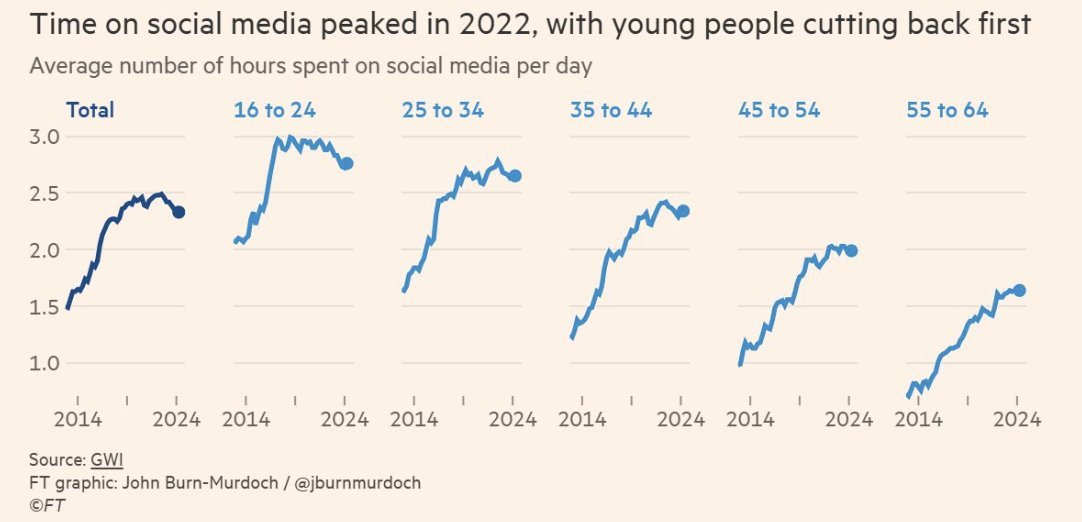
THIS chart is the CLEAREST signal of where the internet is heading.
social media time is SHRINKING for the first time in HISTORY, and young people are leading the pullback.
Brainrot is OUT.
they grew up online, saw the full cycle of social platforms, and learned early that endless scroll doesn’t make you happier or smarter.
they’re the LEADING indicator. their parents will follow in 3-5 years.
AI slop is the nail in the coffin.
every feed feels synthetic familiar faces, identical voices, recycled ideas. the “factory smell” of it all finally broke people’s curiosity.
but there’s an upside. every trend creates its anti-trend.
attention is shifting back to things that feel real, slow, and intentional.
people are paying for spaces that make them feel grounded, informed, and connected again.
the next $100M+ companies will engineer density, trust, and time well spent. they’ll build containers for meaning, then use AI to keep them organized, not optimized.
the internet’s oldest assumption that more engagement equals more value is breaking.
the white space i think is...
• "slow media" formats: weekly briefs, serialized content etc
• private groups that operate like clubs with applications and rituals
• provenance and identity layers that verify real creators and sources
• brands with offline gravity like real events, real belonging
• curated directories and vetted marketplaces
• paid memberships that deliver depth
• note: we share business ideas around this on @ideabrowser
• IRL anything - dinners, meetups, shared experiences
young people are abandoning social media faster than their parents are discovering it.
If you understand what that means, that's a big deal.
i can't stop thinking about this FT/GWI chart.
brainrot is OUT.
meaning is IN.
One way to stand out is to look for pockets of low competition.
Wake up early—less traffic, fewer people.
Go deeper or narrower in your field—less noise, more space.
People are drawn to where it is crowded. Look for the quiet spaces inside your areas of interest. Excellence often hides at the edges.
A lesson I wish I learned earlier: Fear comes from inexperience, not incapability. You're afraid because you haven't done it yet, not because you can't do it. Inexperience is the problem to be solved—and it's only solved through having the courage to act.
I'm going to call it right now. A lot of stuff is going to break on this mission.
By design.
As part of the plan.
Don't get upset. I'm not saying SpaceX plans to fail. I'm pointing out that SpaceX has taken an ultraimportant principle from software engineering, and realized it applies to all engineering.
Feedback beats planning.
And that, you see, is why SpaceX doesn't do things the NASA way. The NASA way was to gold-plate everything, plan and test and plan and test, and generate mountains of paper detailing every contingency, with every scenario prepared for.
SpaceX just shrugs, says "it's unmanned", and sends it.
Half the time it blows up. That's the whole point. They don't actually want it to blow up, of course, but they're anticipating that it might.
That possibility is part of the plan. Because one rocket blowing up, or crashing, in an actual end-to-end test, beats many, many man-years of planning and plotting.
The key realization here is that knowledge only comes from empirical observation. Everything else is just speculative.
The sooner you get into a feedback loop, and the faster you run it, the more iterations you can do in less time. This means, while others are planning and speculating, you actually learn something.
Relevant data is the most precious thing in the universe. And it's worth blowing up any number of rockets to get it.
Because rockets are just stuff. They're just made of stuff. And you can always get more stuff.
You can never get more time.
So expect to see a lot of things go wrong on this, and other SpaceX missions. Anticipate it. Accept it when it happens. Doesn't mean the dream of the stars is dead.
It just means we're doing it cowboy style.
This is a valuable lesson for our own lives. If there's something you want to do, something you want to try, some goal you have, it's easy to dip a toe in the water, test the temperature, and plan. A lot.
Planning makes us feel good if we're afraid. Because it provides us with the illusion of security. Never mind that we don't know which scenarios are actually going to happen, never mind that we're planning for the wrong thing, planning makes us feel safe. And if we're nervous, we can plan forever.
But the difference between the expert and the novice isn't theory or intelligence or plans. It's relevant domain knowledge. Gathered from empirical observation.
So the trick is to get into that feedback loop as soon as possible, and run it as fast as possible. Give yourself the most possible opportunities to learn, per unit time.
We only learn while we are moving.
"THE GRANDSTANDS THAT HE SAW BUILD AS A KID GROWING UP NOW RISE FOR HIM"
just listen to this narration. couldn't be more emotional.
https://t.co/MzRNnNke2n