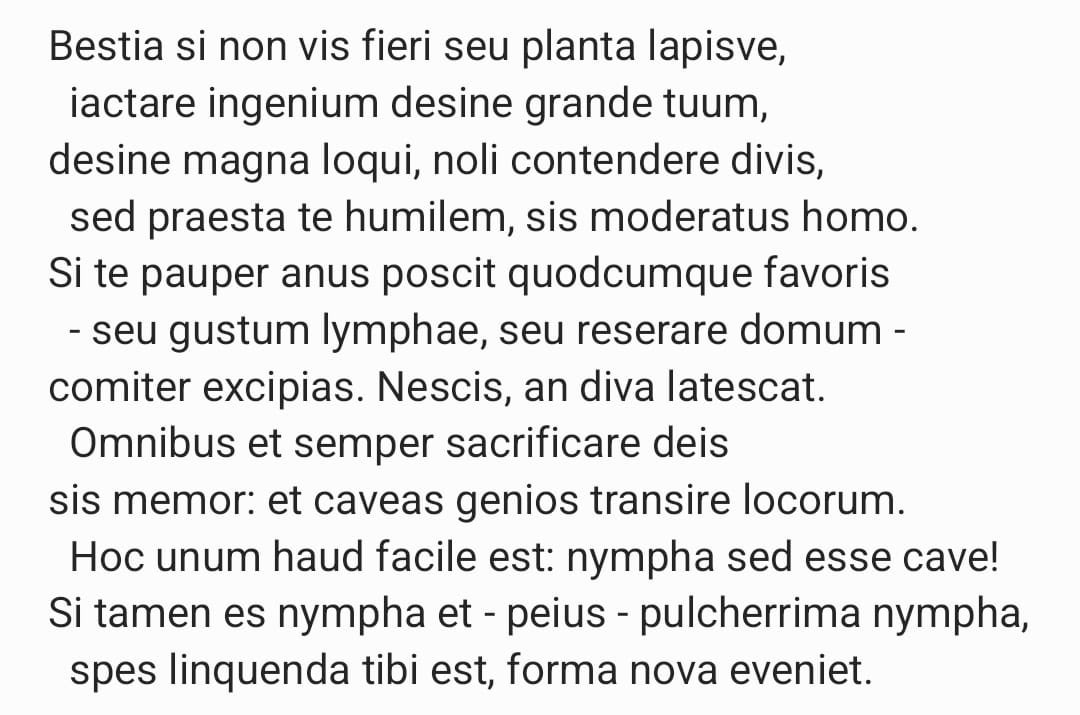
Did anyone ever render the Gospels in classical hexameters?
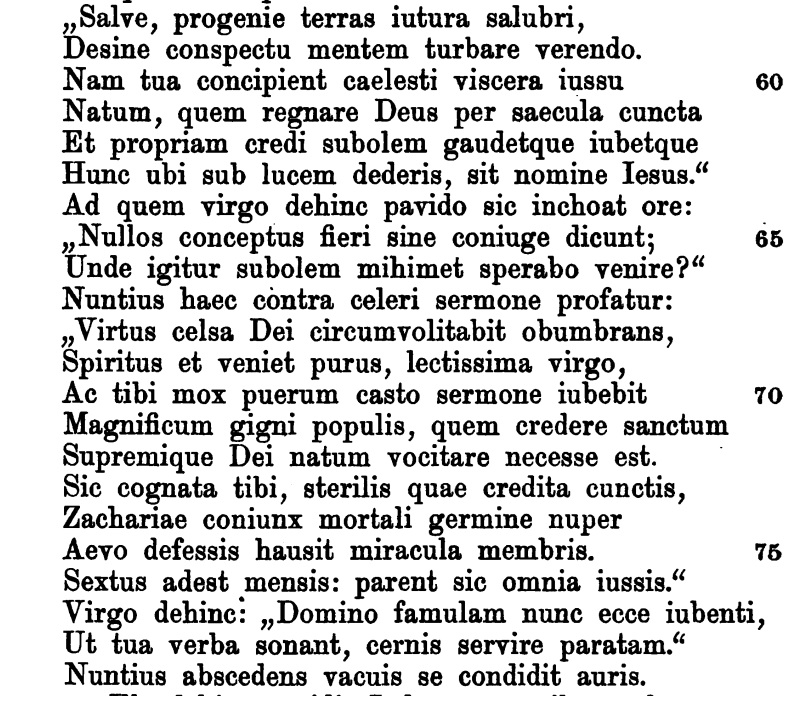
Few people know this, but there was an ancient poet, little known today, who transformed the Gospels into hexameter verse.
Who was he?
Gaius Vettius Aquilinus Juvencus was a Spanish priest who flourished during the reign of Constantine. He is thought to have written around AD 330.
His work is entitled Evangeliorum Libri IV. In it, he weaves the narrative contained in the Gospels into hexameter verses, imitating, as he himself admits, the great poets Virgil and Homer, but in order to sing the glory of the true faith.
Concerning him, Saint Jerome wrote in De viris illustribus:
“Juvencus, nobilissimi generis, Hispanus presbyter, quatuor Evangelia hexametris versibus pene ad verbum transferens, quatuor libros composuit, et nonnulla eodem metro ad Sacramentorum ordinem pertinentia. Floruit sub Constantino principe.”
It is interesting to note the poetic terms used to express Christian mysteries: for example, the Holy Spirit is called spiramen, Nuntius for the Angel and others.
Vergilii Georgicon Liber II, 328-342.
AVIA TUM RESONANT VIRGULTA CANORIS
ET VENEREM CERTIS REPETUNT ARMENTA DIEBUS
Latin recitation hexameters:
https://t.co/3ht4nFP9W3
Tothom dret: Virgili arriba a Anostrats.
Un passatge lluminós de les Geòrgiques: la primavera arriba i ens transporta als primers dies del món naixent.
En traducció de Pau Sabaté, que acaba de treure el Llibre Segon de les Geòrgiques a @EdicionsVibop
https://t.co/sZmHBlbRVQ
So there will not be a Latin version of Magnifica Humanitas?
Everyone has noticed by now that no Latin version of the new Encyclical has yet appeared. And so people have begun asking: where is the Latin text? Will there even be one? Has the Church abandoned Latin altogether?
I do not speak on behalf of the Church, of course, but the reason for the absence of a Latin version is not difficult to guess. For some years now, papal encyclicals have no longer been issued with a typical edition, that is, a definitive Latin text from which all translations are made. Instead, the Holy See now publishes the various vernacular versions simultaneously. Thus the old practice of first issuing an authoritative Latin edition, from which the others would derive, has gradually fallen out of use.
So then, will there be a Latin version or not?
I am quite certain that one will eventually appear. But when? If previous encyclicals are any guide, the Latin translation is usually published several months later. The chief difficulty is that these newer documents make use of many modern expressions and newly coined terms, so the translator must often devise fresh renderings and even create new vocabulary. And that, naturally, takes time.
Virgil’s Aeneid Book II, 437-557.
Latin Reading Hexameters.
ARMA DIU SENIOR DESUETA TREMENTIBUS AEVO //
CIRCUMDAT NEQUIQUAM UMERIS ET INUTILE FERRUM //
CINGITUR, AC DENSOS FERTUR MORITURUS IN HOSTIS
https://t.co/kXAzabrRBq
"'I sing of arms and the man,' said thund'ring Virgil; and all the world knows that he said it. Or do they? How do you know what Virgil said? How do I know? How does anybody know?" The tale of how Latin texts survive to the modern world is gripping stuff:
https://t.co/DyK9kFAKr8
MARS by James Diggle.
https://t.co/ZlhvJdhNRn
[Bimillenario Virgiliano. Premio Internazionale Valle d’Aosta 1981]
Many thanks to @AntigoneJournal for sharing this poem.
Could humans live on Mars? What would the god(s) make of it? Here is a poem where Virgil speculates on that very question. More Roman food for thought @elonmusk
Could humans live on Mars? What would the god(s) make of it? Here is a poem where Virgil speculates on that very question. More Roman food for thought @elonmusk
Je me levais à six heures; […] J’avais heuresement la rage du grec: je traduisais l’Odyssée et la Cyropédie jusqu’à deux heures, […] A deux heures je m’habillais, je me rendais chez mon frère; il me demandait ce que j’avais fait, ce que j’avais vu: je répondais: « Rien. »
Per aliquos menses huic incepto operam dedi, quod hodie omnibus aperio. Antiquam editionem operis nouaui, quod inscribitur Epistulae Laconicae. Quoad potui, exemplar descripsi; tantum pauca mutaui (u.g. quantitates notaui). Si plura scire uultis, ligamina trado, ex quibus opus


![isirgc's tweet photo. Je me levais à six heures; […] J’avais heuresement la rage du grec: je traduisais l’Odyssée et la Cyropédie jusqu’à deux heures, […] A deux heures je m’habillais, je me rendais chez mon frère; il me demandait ce que j’avais fait, ce que j’avais vu: je répondais: « Rien. » https://t.co/GFLkkSUvoI](https://pbs.twimg.com/media/Gy4F3lRWoAEtmEf.jpg)
![isirgc's tweet photo. Je me levais à six heures; […] J’avais heuresement la rage du grec: je traduisais l’Odyssée et la Cyropédie jusqu’à deux heures, […] A deux heures je m’habillais, je me rendais chez mon frère; il me demandait ce que j’avais fait, ce que j’avais vu: je répondais: « Rien. » https://t.co/GFLkkSUvoI](https://pbs.twimg.com/media/Gy4F3lPW4AAEcj-.jpg)
![isirgc's tweet photo. Je me levais à six heures; […] J’avais heuresement la rage du grec: je traduisais l’Odyssée et la Cyropédie jusqu’à deux heures, […] A deux heures je m’habillais, je me rendais chez mon frère; il me demandait ce que j’avais fait, ce que j’avais vu: je répondais: « Rien. » https://t.co/GFLkkSUvoI](https://pbs.twimg.com/media/Gy4F3lOW0AAfXHy.jpg)




![isirgc's tweet photo. Je me levais à six heures; […] J’avais heuresement la rage du grec: je traduisais l’Odyssée et la Cyropédie jusqu’à deux heures, […] A deux heures je m’habillais, je me rendais chez mon frère; il me demandait ce que j’avais fait, ce que j’avais vu: je répondais: « Rien. » https://t.co/GFLkkSUvoI](https://pbs.twimg.com/media/Gy4F3lSXoAAKtGJ.jpg)