我把一个网站的失败期限,限定为一个月。
如果一个月内,你只是在频繁修改产品、不断与 AI 讨论,却始终没有来自外部世界的客观反馈——没有真实用户互动,没有人愿意买单,甚至连一条差评都没有——那么你很容易陷入无休止的优化。
这并不意味着需求不存在,也不意味着你想解决的问题不真实,更不意味着你的解决方案一定错误。真正的问题是:你可能正在用勤奋的推广和反复优化产品设计,掩盖它尚未通过真实世界检验的事实。
AI 结对编程会不断提供即时满足和正反馈,让你感觉自己一直在推进。但也正因为如此,你可以一直忙下去,而不必面对真实世界给出的答案:
这个网站,至少在这一个月里,失败了。
I thought Codex was broken.
Same kind of task, completely different experience:
4 AM ET → ~5 min
1 PM ET → ~40 min
Even Fast mode felt painfully slow.
After testing it for a while, I changed two things:
• avoid peak hours when possible
• keep reasoning at medium and split heavy work across parallel agents
The biggest speed boost wasn’t a better prompt.
It was changing when and how I used Codex.
This is just my own experience, so I’m curious:
When is Codex fastest for you?
I used to work in investing. Now I build AI products.
The longer I do this, the more startups, investing and poker feel like the same game:
making bets under uncertainty.
Poker’s first lesson wasn’t how to win.
It was how to fold.
When the thesis changes, cut the loss. Money and time already spent are sunk costs. They shouldn’t vote on the next decision.
Then comes patience.
Position. Range. Odds.
No edge? Wait.
Real edge? Bet bigger.
I don’t believe much in “the weak beating the strong.”
Over time, the game is simpler:
lose small without an edge, win big when you have one.
But never lose your last chip.
Before any big bet, I ask:
If I’m completely wrong, can I still stay in the game?
Survival first. Returns second.
Loose can be a strategy. Tight can be a strategy. And sometimes how strong people think you are matters too.
Most of all:
Be patient. Then be a little more patient.
You don’t need every opportunity.
You need the right one — while you still have chips.
One day I realized something uncomfortable:
I thought I was using AI.
But a lot of the time, AI was using me.
I’d open ChatGPT to solve one problem.
It gave me 3 ideas.
So I asked another question.
That created 5 more questions.
Thirty minutes later, I had:
A better framework.
A cleaner workflow.
A smarter prompt.
A more “complete” plan.
The only thing I didn’t have?
A result.
Nothing shipped.
No user replied.
No revenue moved.
The original problem was still open.
Yet I felt productive.
That’s the trap.
AI’s biggest danger isn’t that it replaces your thinking.
It’s that it makes thinking almost frictionless.
So you can think forever.
Ask → answer → new idea → new question → optimize → repeat.
Every step feels like progress.
Sometimes it’s just:
high-quality procrastination.
Now I track one metric:
«Real-world output per hour of AI conversation.»
Did I ship code?
Publish the page?
Talk to a user?
Get data?
Make money?
If the answer is close to zero:
I close the chat and go do the work.
AI should be leverage.
Not a slot machine that keeps rewarding me with the feeling that I’m almost making progress. #Codex #vibecoding
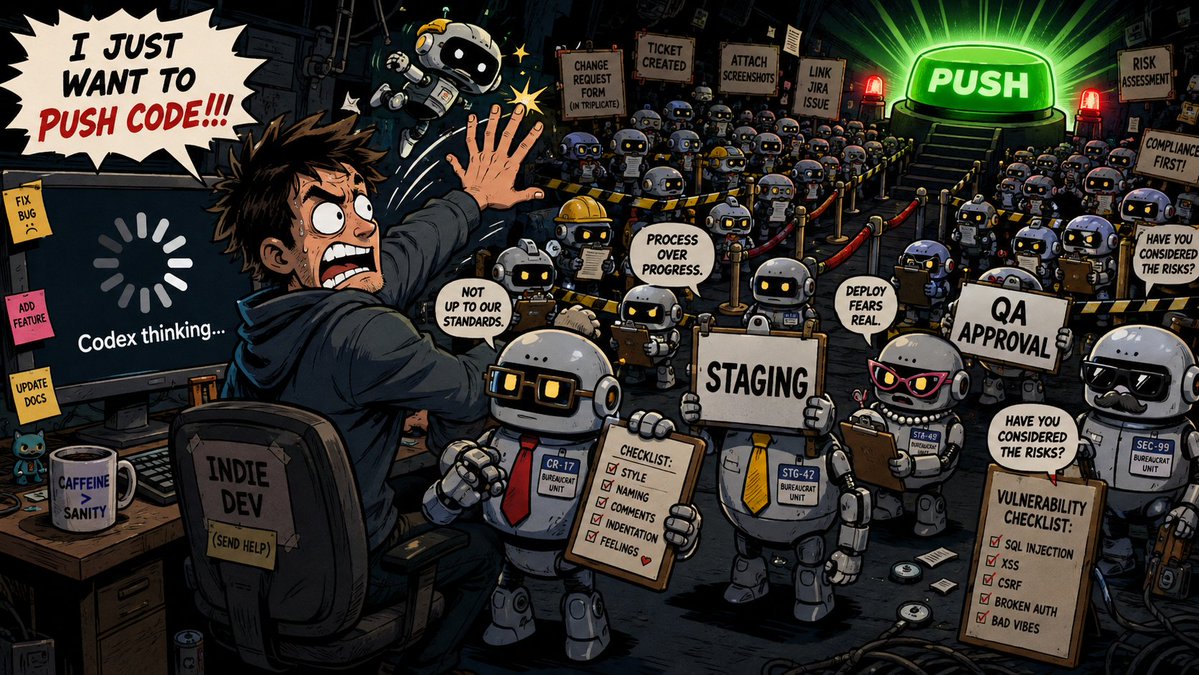
Why is your Codex so damn slow?!
Because it's applying enterprise-grade workflows to indie developers.
If you're a solo developer using AI to build products with enterprise-level
processes, you're signing up for pure torture.
What enterprises need:
Code Review → Staging → QA → Pre-prod → Canary → Production
Every step has a gate. Every step makes you wait.
What indie developers actually need:
Code → Core features bug-free → Push 🚀
That's it.
Agile development. Rapid iteration.
Fix it, push it, verify it.
Not perfect? Next commit fixes it.
If you treat every deploy like a NASA rocket launch, your product will live on
localhost forever.
The only exception worth adding a layer for:
Critical features (payments, auth, data migrations) — set up a staging branch for
preview validation. Everything else? Just push.
The biggest advantage of being an indie developer is speed.
Tying yourself down with enterprise workflows means voluntarily surrendering your
only competitive edge.
Ship fast. Break things. Fix forward.
#GPT #Codex #VibeCoding #IndieHacker #BuildInPublic