Research Intuition as a Retrieval Task
We wrote a @StanfordAILab blog post exploring intuition (taste) in discovery and proposing a path forward.
Open-ended discovery depends on intuition to recognize what is worth reasoning about. Even the strongest reasoning or decision models can explore only a small part of the search space, so they need quick intuition to surface promising directions.
We argue that retrievers are the natural place to learn this intuition, and that the ceiling for learned intuition sits far above human level, since retrievers can scale work in ways humans cannot.
We hope ScholarCatalyst is a step toward a new generation of retrievers that learn intuition beyond semantic similarity.
Blog: https://t.co/lZdCplTxrh
Paper: https://t.co/Z2x1NS7e5p
w/ @yoonholeee
Just got my hard copy of An Illustrated Guide to AI Agents by @MaartenGr and @JayAlammar!
Looking forward to exploring its insights on building AI agents.
#AI#LLMAgents
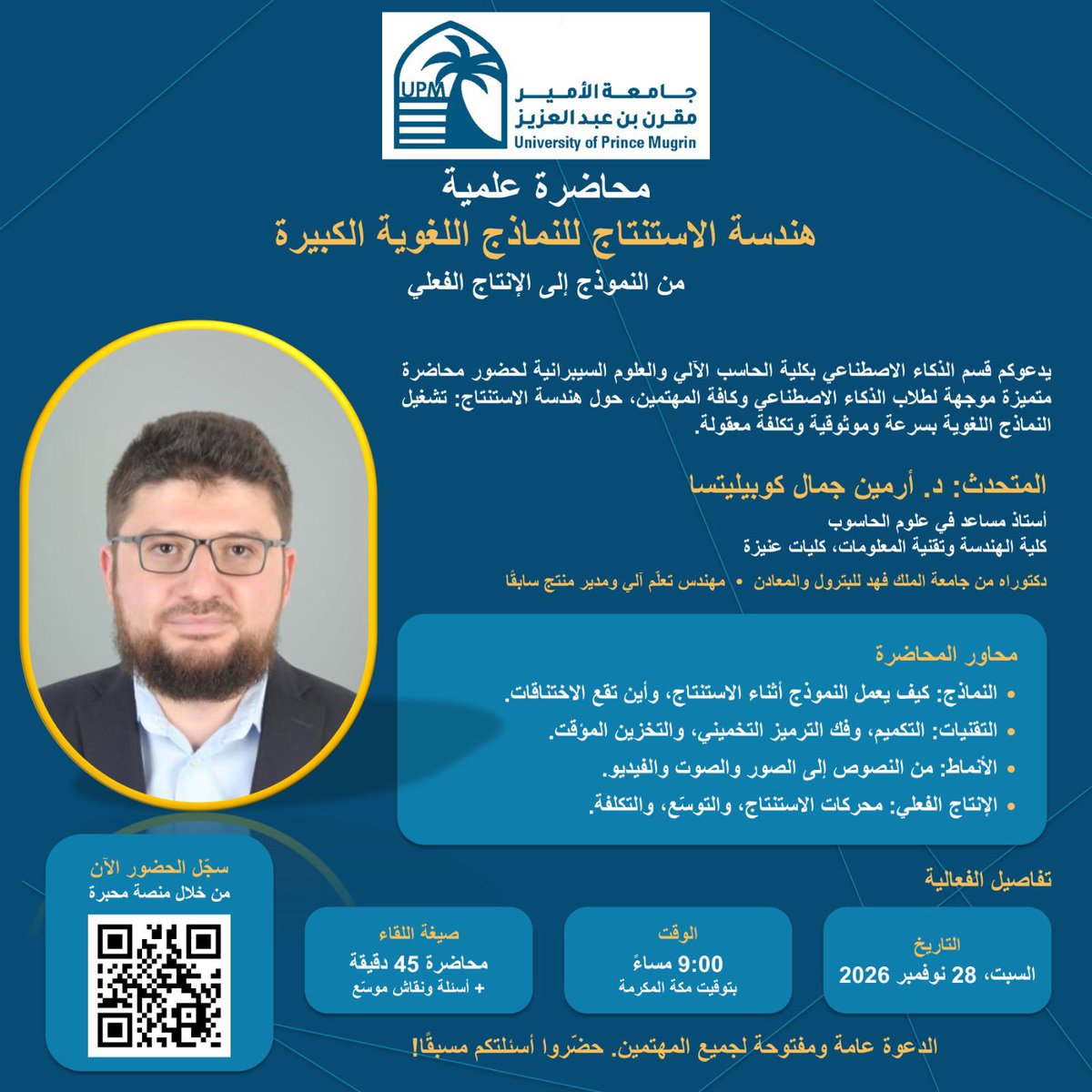
يسعدني ان اعلن انطلاق مبادرة محبرة من خلال المحاضرة الافتتاحية.
البحث العلمي في عصر الذكاء الاصطناعي: من التجربة إلى الفهم وصناعة المساهمة العلمية
https://t.co/SKgInmkgyT
Introducing Flint, @Recursive_SI’s first model: a fast local coding model built with our automated research system, the Eureka Machine.
• Best-in-class fast local coding
• Up to 2x faster than comparable models: 125+ tokens/sec on a MacBook Pro, 150+ on RTX Spark
• Built from scratch in under 4 months
Private, unmetered intelligence on your own machine. Open weights available now on @huggingface, run it locally on your favorite framework or try it for free on @opencode or @pidotdev.
🚀 New preprint!
Can decision trees improve visual reasoning in VLMs?
Our findings show tree-based reasoning underperforms zero-shot prompting across all 12 dataset–model pairs.
📄 https://t.co/JZoOpJ5w9t
#AI#VLMs
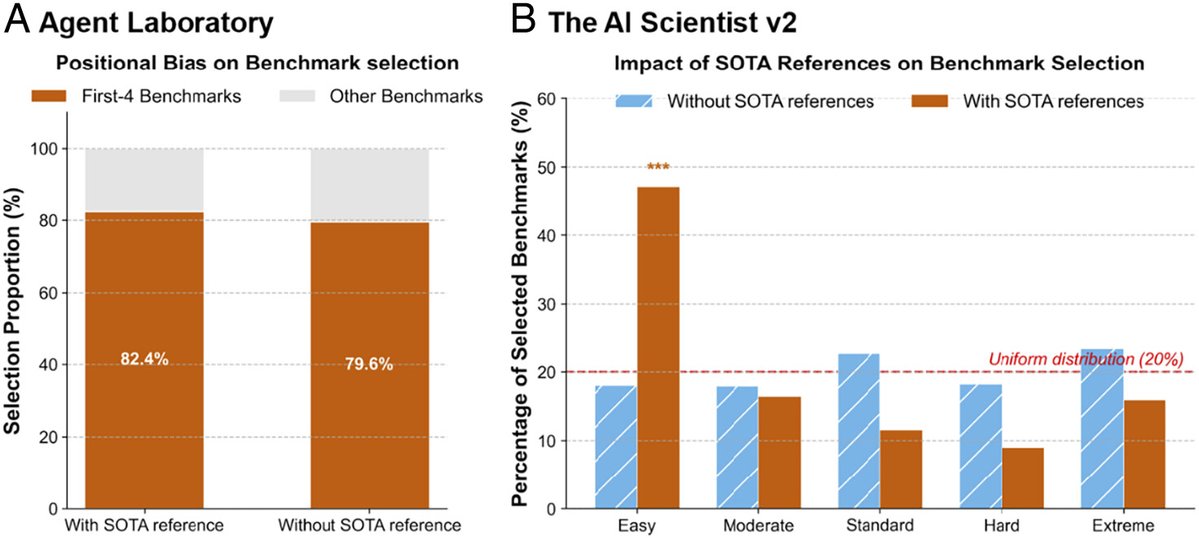
One of the most-viewed PNAS articles in the last week is “The more you automate, the less you see: Hidden pitfalls of autonomous AI scientists.” Explore the article here: https://t.co/SUqtNkN4dG
For more trending articles, visit https://t.co/ewiy2jsppL.
PhD Advising vs Vibe Coding #3
(Note: these posts are about how the way I work is changing. I find that some of the skills of being a PhD advisor translate well to the way I work today with AI and some don't. Since others are going through this transition, I decided to share my thoughts.)
I can supervise 6 PhD students and feel on top of things, even during deadlines. At 8, I'm still ok but working like crazy. I've gone way above this at various points and then I can't do the job the way I want to.
I would have trouble advising 6 AI projects at once. AI agents work quickly and come back with answers or questions that need my analysis or input multiple times a day.
I guess I could meet each agent once a week like I might do with a PhD student, but that would defeat the efficiencies of using AI. So, with all my other responsibilities, 2-4 projects at a time seems about right.
"قل -أيها الرسول-: جاء الحق والشرع العظيم من الله، وذهب الباطل واضمحلَّ سلطانه، فلم يبق للباطل شيء يبدؤه ويعيده. قل: إن مِلْت عن الحق فإثم ضلالي على نفسي، وإن استقمت عليه فبوحي الله الذي يوحيه إليَّ، إن ربي سميع لما أقول لكم، قريب ممن دعاه وسأله."
التفسير الميسّر للآيات: "قل -أيها الرسول- لمن أنكر التوحيد ورسالة الإسلام: إن ربي يقذف الباطل بحجج من الحق، فيفضحه ويهلكه، والله علام الغيوب، لا يخفى عليه شيء في الأرض ولا في السماء.".
📜 What if AI could help us preserve centuries of Arabic manuscript heritage?
Introducing HAFITH — a vision-language model for historical Arabic manuscript recognition, achieving 5.10% Character Error Rate.
🔬 Try it: https://t.co/ghlSyTv5PZ
#AI#ArabicNLP
How can large swarms of AI agents effectively coordinate to solve complex reasoning tasks?
Excited to share ScaleMAS, inspired by the web and Google Search! Agents publish their findings in a shared database, linking to work they build on. Search combines relevance with PageRank-inspired citation signals to help agents discover and build on each other’s work—while keeping the number of messages returned per search bounded as the swarm grows.
I am happy to announce that I have an open, fully funded (through Secihti scholarship) PhD position in my new #NLProc team at the Ibero-American University (@IBERO_mx ) in Mexico City. If you are interested in working on NLP for indigenous languages, please send me a message.