Official $ISOG Contract Address Announcement
The official $ISOG contract address is:
CA: 0x7f7EFe03343748FceC86C127e90F08e45f1A1Fca
https://t.co/uCOc5U2bFm
Please verify the contract address through our official channels before interacting with the token. Isogate will never send contract information through unsolicited private messages.
Isogate is a deterministic computing and token-launch application built around real CPU execution. Its Native Node runs supported, bounded workloads on a user’s computer, while the backend independently recomputes and verifies the submitted results. A matching CPU result is not presented as a blockchain proof it is a reproducible execution record verified by the Isogate system.
For Genesis launches, a wallet-bound Native Node generates a deterministic token identity, including its name, symbol, description, and RGB565 artwork. The creator then approves the exact generated identity, stores the canonical image on IPFS, receives a verifier-signed deployment proof, and confirms the required on-chain transactions through their own wallet.
Isogate does not provide server-side wallet custody and does not allow arbitrary workloads. Every finalized token displayed in the public registry must pass Native Node execution, independent backend verification, creator approval, immutable asset storage, contract deployment, liquidity launch, and on-chain receipt reconciliation.
One CPU. One reproducible identity. One verifiable launch path.
NEW UPDATE : Stronger Security and Production Controls
ISOGATE’s backend security has been upgraded with stricter origin controls, request limits, rate protection, security headers, safer error responses, and improved configuration validation.
The API now fails closed when critical production settings are invalid, while sensitive credentials remain excluded from logs and browser storage.
A safer foundation for real providers, verified workloads, and on-chain launches. $ISOG
Appreciate you putting ISOGATE on your radar.
That’s exactly what we’re building: not just another token launcher, but a connected and verifiable process from real CPU providers and deterministic execution to token creation, deployment, public verification, and network inspection.
The network is still in its early beta, but the utility is already live. Users can run Native Nodes, inspect public telemetry, and verify completed token launches on-chain.
This is only the beginning. More providers, workloads, and settlement capabilities are coming.
Thanks for checking us out and as always, verify everything yourself.
What devices can participate?
The Native Node currently supports:
➡️Windows desktops and laptops
➡️macOS computers
➡️Linux computers, mini PCs, and servers
➡️Node.js 20 or newer
➡️A supported Node.js CPU architecture and stable internet connection
➡️Android and iOS devices are not currently supported as Native Node providers.
Mobile users can access the web interface, but actual provider execution requires a supported desktop-class operating system.
Your CPU can do more than sit idle.
Join the ISOGATE network, register your machine, and contribute its processing power to verifiable workloads. Each participating CPU can generate a unique, deterministic identity that becomes the foundation of an original token on Robinhood Chain.
This creates a direct connection between real hardware, verified computation, and on-chain ownership. As the network grows, CPU providers can participate in eligible jobs and earning opportunities while creators launch tokens backed by authentic machine-generated identities.
One CPU. One verifiable identity. Real network utility.
Connect your machine, put your computing power to work, and become part of the ISOGATE provider network. $ISOG
Create and Launch Your Token On-Chain
Launching a token on Robinhood Chain is now simple with the ISOGATE Genesis Console. Follow these steps to create a valid, publicly verified token:
1. Connect Your Wallet
Open the ISOGATE Console, connect your creator wallet, and switch to Robinhood Chain.
2. Open Genesis
Go to Apps → Genesis and enter your token’s name and ticker symbol.
3. Generate Your Token Identity
Submit the generation request. An ISOGATE Native Node will produce your token’s unique deterministic artwork and identity data.
4. Review and Approve
Carefully verify the token name, symbol, artwork, creator wallet, contract addresses, and required launch value. Approve the generated identity with your wallet signature.
5. Store the Canonical Assets
The approved token artwork and metadata are uploaded to IPFS, creating an immutable content reference for the launch.
6. Complete the On-Chain Launch
Confirm the launch and approve the required wallet transactions:
Registry approval
Token deployment
Liquidity launch
Make sure your wallet has enough native ETH for the 0.001 ETH launch liquidity and network gas fees.
7. Wait for Final Verification
ISOGATE verifies the registry state, deployment receipt, liquidity launch, immutable contracts, and canonical token identity before accepting the token as valid.
8. View and Share Your Token
After reconciliation, your token will automatically appear in:
My Tokens & Fees
Live Tokens @gmgnai
Copy the complete contract address directly from the token card and use the Open on GMGN button to view or share its market page.
Generate. Verify. Launch.
Build your on-chain identity with ISOGATE Genesis. No shortcuts, no fake listings only launches backed by verifiable execution on Robinhood Chain.
ISOGATE is not a dummy product, a visual demo, or a simulated network.
Real users can register their CPUs as Native Nodes, contribute processing power to deterministic workloads, and generate original machine-based identities for tokens launched on Robinhood Chain.
Behind the interface is a working backend that records provider activity, verifies execution results, reconciles on-chain transactions, and rejects invalid data. Public network activity, completed jobs, token contracts, launch transactions, and verification records can be independently inspected.
Every valid token follows a real process:
CPU execution → deterministic identity → creator approval → immutable storage → contract deployment → liquidity launch → public verification.
This connects real hardware, verifiable computation, and on-chain ownership in one functional system.
No fake activity. No simulated launches. Real CPUs, real contracts, and verifiable results.
Put your CPU to work and become part of the ISOGATE provider network.
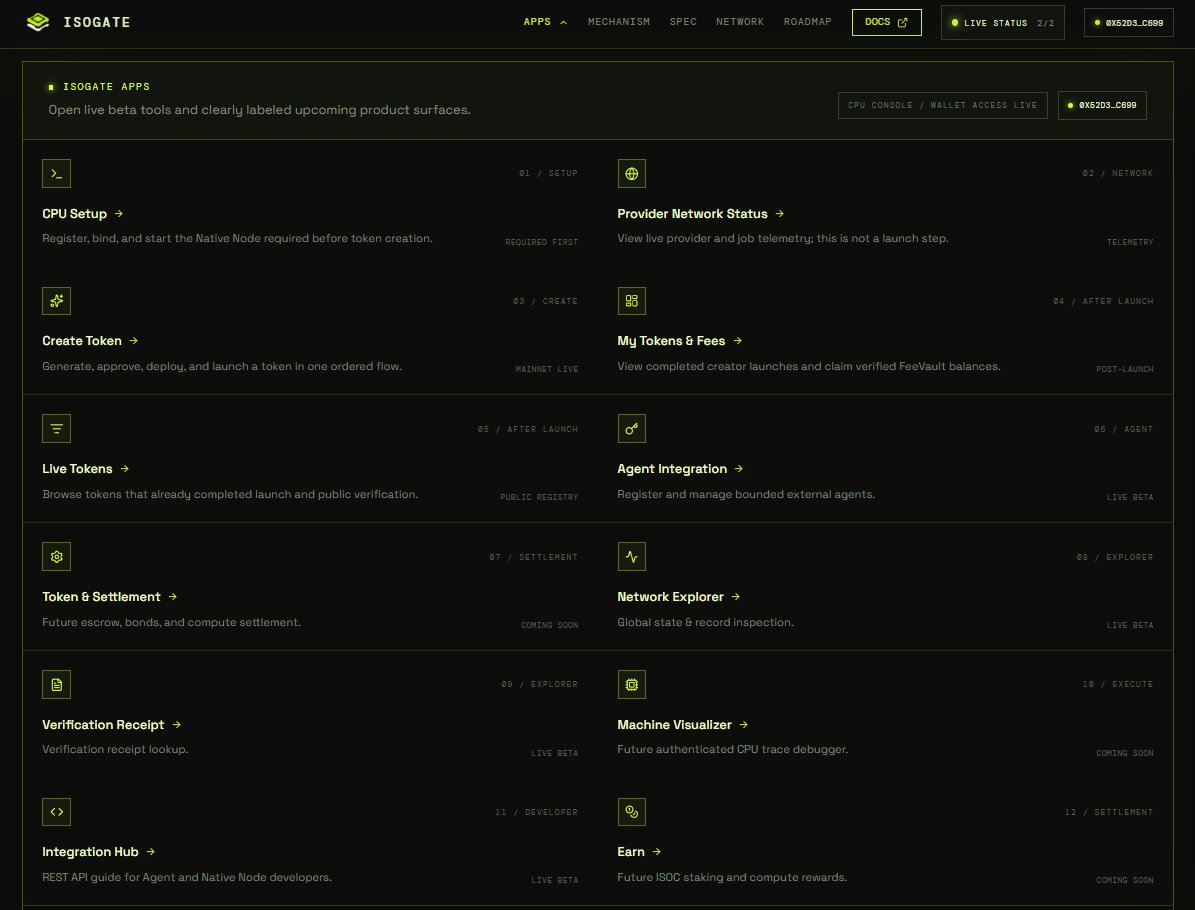
Explore the ISOGATE Apps Console 10 Tools for the Full Network Journey.
The ISOGATE Apps Console brings the entire workflow into one organized interfac from setting up a Native Node to creating a token, monitoring the network, verifying launches, and exploring machine execution.
There are currently 10 application pages listed in the console:
1. CPU Setup
Register, bind, and start the Native Node required before token creation. This page prepares your machine to participate in deterministic workloads.
2. Provider Network Status
Monitor provider availability and job telemetry across the network. This is a monitoring page not a token-launch step.
3. Create Token
Generate deterministic artwork, approve the identity, deploy the contract, and launch a token through one ordered workflow on Robinhood Chain.
4. My Tokens & Fees
View launches associated with your connected creator wallet, check complete contract addresses, and claim verified creator FeeVault balances when available.
5. Live Tokens
Browse tokens that have completed deployment, liquidity launch, reconciliation, and public verification. Every listed token includes its full CA and a direct GMGN link.
6. Agent Integration
Register and manage external agents with clearly defined and restricted permissions.
7. Token & Settlement
A future page for escrow, bonds, and compute settlement. This feature is currently marked as Coming Soon.
8. Network Explorer
Inspect the global state of the ISOGATE network, including registered providers and other network-level information.
9. Verification Registry
Review verification records and inspect the proof behind completed network activity.
10. Machine Visualizer
Explore how machine execution and deterministic workloads operate through a visual interface.
Together, these pages create a complete journey:
Set up a node. Monitor the network. Generate an identity. Launch a token. Verify the result. Manage fees. Explore execution.
ISOGATE is building more than a token launcher it is creating a verifiable network where generation, execution, deployment, and proof can be inspected from one console. $ISOG
The full ISOGATE Genesis launch flow has been completed successfully on Robinhood Chain.
From deterministic artwork generation and creator approval to immutable IPFS storage, token deployment, liquidity launch, and final on-chain verification every required step has been completed.
The token is now publicly visible on GMGN.
Token: Cysysy
Ticker: CU3KBQ
Contract Address:
0x20321fC1045C5FA23520eeBfbd65ADBBfE0D40cE
View the live token and verify the successful launch here:
https://t.co/UM1raOeZTa
This is real, public proof that the ISOGATE Genesis pipeline works from the Console to a valid token launch on Robinhood Chain.
Generated. Verified. Launched. Now live on GMGN.
The next generation of on-chain creation starts with ISOGATE.
Create and Launch Your Token On-Chain
Launching a token on Robinhood Chain is now simple with the ISOGATE Genesis Console. Follow these steps to create a valid, publicly verified token:
1. Connect Your Wallet
Open the ISOGATE Console, connect your creator wallet, and switch to Robinhood Chain.
2. Open Genesis
Go to Apps → Genesis and enter your token’s name and ticker symbol.
3. Generate Your Token Identity
Submit the generation request. An ISOGATE Native Node will produce your token’s unique deterministic artwork and identity data.
4. Review and Approve
Carefully verify the token name, symbol, artwork, creator wallet, contract addresses, and required launch value. Approve the generated identity with your wallet signature.
5. Store the Canonical Assets
The approved token artwork and metadata are uploaded to IPFS, creating an immutable content reference for the launch.
6. Complete the On-Chain Launch
Confirm the launch and approve the required wallet transactions:
Registry approval
Token deployment
Liquidity launch
Make sure your wallet has enough native ETH for the 0.001 ETH launch liquidity and network gas fees.
7. Wait for Final Verification
ISOGATE verifies the registry state, deployment receipt, liquidity launch, immutable contracts, and canonical token identity before accepting the token as valid.
8. View and Share Your Token
After reconciliation, your token will automatically appear in:
My Tokens & Fees
Live Tokens @gmgnai
Copy the complete contract address directly from the token card and use the Open on GMGN button to view or share its market page.
Generate. Verify. Launch.
Build your on-chain identity with ISOGATE Genesis. No shortcuts, no fake listings only launches backed by verifiable execution on Robinhood Chain.
Run and Verify a Real CPU Job with Isogate
The Isogate CPU Console sends a real computing job to an Isogate Native Node running on your Windows PC. The backend independently recalculates the result and marks the job Verified only when both results match.
How to Use It
1. Install the Native Node:
npm install -g @isogate/[email protected]
2. Generate and import the device report:
isogate-node diagnose --output isogate-diagnostic.json
3, Connect and bind your wallet in the CPU Console.
4. Start the Native Node using the command shown on the website.
5. Click Run Provider Job.
6. When completed, check the Verified result and Proof Receipt.
This technical beta demonstrates real job assignment, Windows CPU execution, and deterministic backend verification.
Official $ISOG Token Burn !
A total of 11,4 M $ISOG has been permanently sent to the dead address and removed from circulation on Robinhood Chain.
The transaction was successfully processed and confirmed on-chain. Anyone can independently verify the burn here:
https://t.co/NQSyG649o7
This burn reflects our commitment to transparent and verifiable on-chain actions as we continue building the Isogate ecosystem.
From CPU Execution to On-Chain Assets
For decades, @intel and @AMD have advanced the physical processors behind modern computing. Isogate is exploring a different layer: how CPU execution can become visible, replayable, and connected to blockchain applications.
The Isogate ecosystem brings together a browser-based virtual CPU, deterministic execution traces, Native Node workloads, canonical result recomputation, wallet-bound providers, CPU-generated identities, Genesis smart contracts, and public launch records.
With @RobinhoodApp and @vladtenev pushing financial infrastructure toward Robinhood Chain, and @Uniswap advancing programmable on-chain liquidity, Isogate connects computation with asset creation: the CPU generates the identity, deterministic rules control the launch, and the blockchain records the result.
Which part should we explain next: the virtual CPU, Native Node, Genesis creation, or the on-chain launch process?
A Token Launch Designed Around Fixed Rules
A token contract should be understandable before users interact with it. Supply, ownership, liquidity, creator allocation, fees, and source code should not be hidden behind marketing language.
Every Isogate Genesis launch follows constrained rules: 999 million final supply, no additional minting, no creator token allocation, no mutable tax, no hidden blacklist, no proxy upgrade, and ownership ending at the zero address.
The remaining supply is assigned to a locked @Uniswap v4 liquidity position on Robinhood Chain. A static 1% LP fee is distributed through FeeVault 70% to the creator and 30% to the protocol. Token and hook source verification are also required by the launch workflow.
Before buying a new token, what do you check first: source code, ownership, supply, creator allocation, or liquidity?
What If a CPU Created the Token?
Most token launch platforms begin with a form. Creators manually choose the name, ticker, description, and logo. Isogate Genesis begins with computation instead.
A deterministic Native Node workload generates the token’s identity, including its name, symbol, description, visual output, image digest, and canonical identity digest. The creator starts the process, but the CPU determines what emerges.
The generated identity is then launched on Robinhood Chain as an on-chain asset. As @vladtenev and @RobinhoodApp expand Robinhood Chain for tokenized assets and on-chain financial applications, Isogate is exploring a new category: assets whose identities originate from deterministic computation.
Would you launch a token without knowing its name, ticker, or appearance until the CPU reveals it?
https://t.co/9fkCndLhvh
#RobinhoodChain #TokenLaunch #DigitalAssets
Distributed computing is powerful, but receiving a result from another machine still requires trust. Isogate Native Node is designed around a simple principle: a submitted result should not be accepted just because a provider says the work is complete.
A wallet-connected provider runs a deterministic workload locally. The Isogate server then independently recomputes the same workload and compares the canonical result before accepting it into the network.
Native Node is currently a technical beta with built-in workloads. It is not yet an open marketplace for arbitrary computing power. The current goal is to establish a transparent foundation for provider execution, result checking, and reproducible compute.
Would you run an Isogate Native Node if every accepted job could be independently recomputed?
https://t.co/9fkCndKJFJ
#NativeNode
Modern infrastructure can distribute enormous amounts of computing power, but more capacity does not automatically create more transparency. Users still need to understand how a result was produced and whether it can be reproduced.
Isogate turns fixed workloads into visible execution traces. Instructions, registers, memory changes, NAND-gate activity, and checkpoint results can be inspected through the virtual CPU instead of being hidden behind a generic “completed” status.
Don’t just trust the output. Inspect the execution.
A deterministic computing ecosystem combining an inspectable virtual CPU, Native Node execution, canonical verification, and CPU-generated digital assets on Robinhood Chain. https://t.co/UrcIbvmXWX
Most compute platforms ask users to trust the final result. Isogate takes a different approach: expose the execution process so it can be inspected, replayed, and independently recomputed.
The Isogate ecosystem combines a deterministic virtual CPU, browser-based execution simulation, wallet-bound Native Nodes, canonical server recomputation, and Genesis assets generated from CPU output. The same workload and engine produce the same result.
As decentralized computing expands through projects such as Render, Akash Network, and https://t.co/8yT3UL4xx2, Isogate focuses on a narrower problem: making deterministic execution transparent from instruction to final checkpoint.
Explore Isogate: https://t.co/9fkCndKJFJ
Connect your device, detect its CPU capabilities, and see how it can contribute to useful workloads across the network.
We’re still building, and your feedback matters. What feature would you like to see first.