I gave the Bott lectures at Harvard last week, about some topics (around the arithmetic of differential equations) that I've been thinking about recently. You can watch the first one, which starts out relatively elementary, here: https://t.co/K7XhcKWSuO
Our release process continues to evolve in response to feedback from the associated academic communities. In our view, these manuscripts are best understood as a form of raw research data. To convert this raw research data into scientific understanding, in this release we are experimenting with a new approach.
We reached out to external experts and asked them to act as shepherds, organizing groups to understand the new results. They advised three different release strategies:
For the math result, release the AI output, leaving researchers free to organize their own efforts to explain the result.
For the computer science result, form an external group of collaborators to explain the result, while making the AI output publicly available for anyone to examine and build on.
For the physics result, form an external group of collaborators and defer to them on the release of materials.
The @kevinroose book The AGI Chronicles is really good. The Google chapter should be required reading for everyone working in a corporate environment on what not to do. Many of the details were known, but seeing them all together is so painful.
By the mid-2010s, AI is the official focus of the company. They have virtually all the best researchers, the most compute, all the data, the cloud and consumer business to plug it into, and founders who are obsessed with it.
They have not one, but two, internal, at-scale teams (Brain and Deepmind) pursuing AI, one in Europe, one in the US. The two teams hate each other and don’t collaborate.
Google introduces the phrase “Large Language Model”, and invents the transformer architecture, and techniques like mixture of experts and distillation for neural networks.
By 2020 Google has an internal LLM called Meena that was trained on an internet sized text corpus and rolled out as a prototype to the company. It’s immensely popular.
The researchers behind it write a memo “Meena Eats Google” laying out the competitive threat from LLMs and calling it a trillion dollar opportunity if they launch it publicly.
The project is immediately enmeshed in interteam politics with search feeling that a chatbot shouldn’t be allowed as it will confuse people who also enter questions into search.
The phrase “Meena Eats Google” is considered very hostile by Google’s many teams working on AI and it is renamed to “Meena Eats The World”.
The researchers are all caught up in a pre-existing world view of classical ML, and each researcher is pursuing a pet paradigm. They all criticize LLMs for not using their techniques.
Teams working on making AI more politically correct call LLMs “stochastic parrots” and don’t want models trained on real world data as that contains disparities and could perpetuate racism and sexism.
The Meena effort is criticized as sexist for giving the AI a female name, and a memo is written demanding that no one refer to Meena as she.
Ultimately the talented people get frustrated and leave for Google, and, as it comes into existence, Anthropic.
Google isn’t out of the race, but somehow managed to fumble the biggest lead imaginable and now has to play catch up to formerly broke no-name startups with research teams who are all ex-Google.
Oofda.
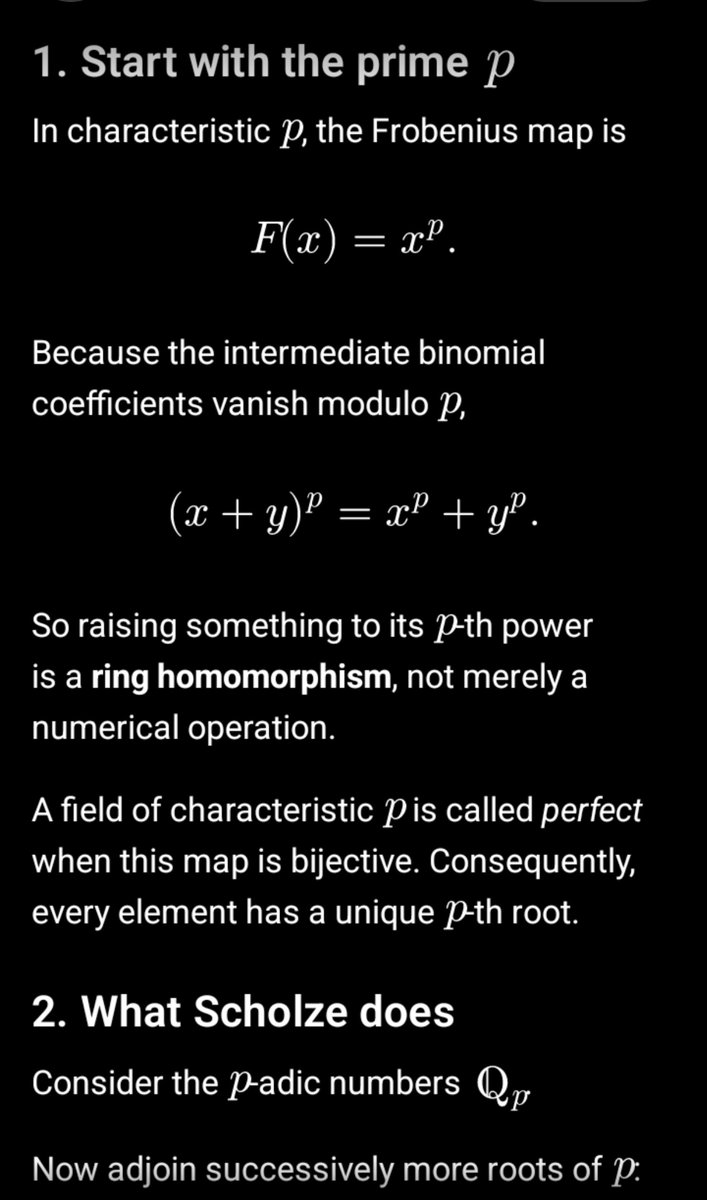
I asked about perfectoid spaces and laughed out loud that (xᵖ + yᵖ) = xᵖ + yᵖ was observation one of Scholze’s argument
(I know, somebody made the joke last week …)
And … economists, too. After 3 months of LLM play, it finally occurred to me today to ask about the curvature of
MV=PY
Y = G(T) + I(r) + NX(e) + C(Y-T)
etc.
Go back in time and hand a frontier model to D'Alembert.
Not just tell him the most recent answer to a hard question, but give him the tool to explore, formulate, and resolve questions which used to take centuries to answer.
Amidst the supposed downfall of mathematics, I'm so surprised I haven't heard anything about theoretical physics?
These guys (usually guys, it seems) faced an enormous selective pressure to not just care about the deep structure of the universe, but to be very good at math.
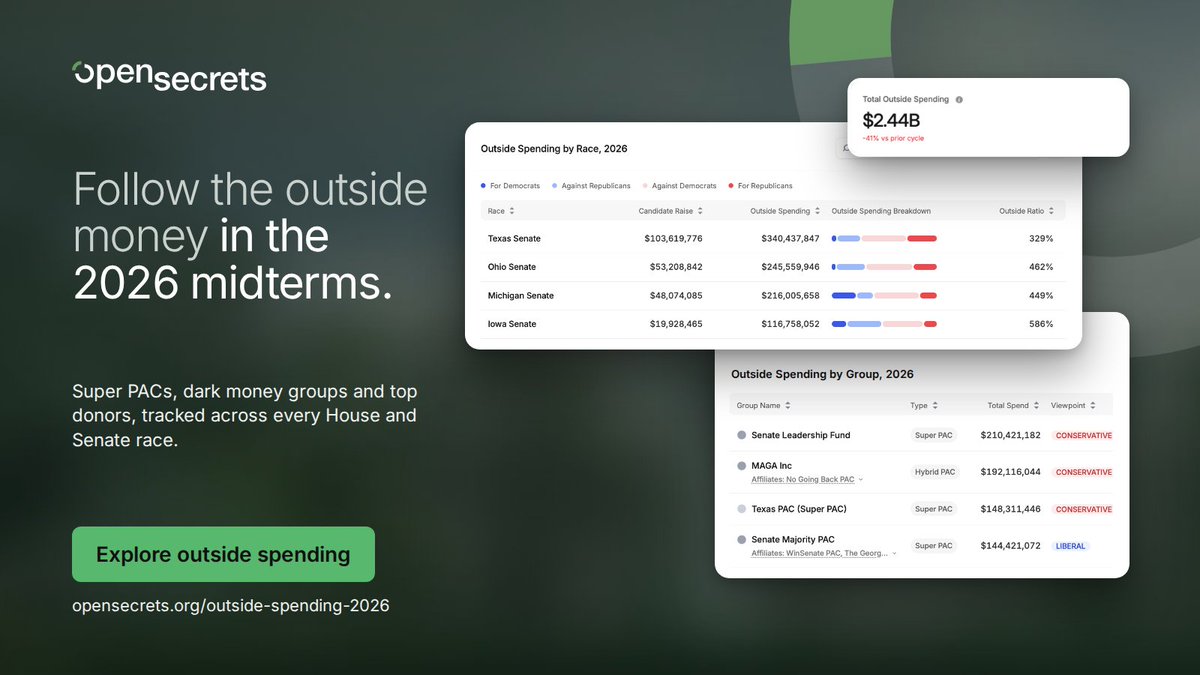
Outside spending in the 2026 midterms is nearing $3B. Our new, expanded tracker lets you follow super PACs, top donors & targeted spending in every House + Senate race, with filters by group type, party, ideology & industry.
Dive in: https://t.co/ollh3QqaXK