Privileged to have had the opportunity to think with @JElyachar's brilliance in this review essay on her book "On the Semicivilized" for Anthropological Quarterly:
https://t.co/FRpjHT2eOB
Excited to organize this and think about our ethnographic craft in these times alongside brilliant folk in a few days! The full agenda and booklet can be found here: https://t.co/Lcbk61iITu
The #MESA2025 Malcolm H. Kerr Dissertation Award in the Social Sciences Honorable Mention is Ferda Nur Demirci, for “Rescaling Family and Intimacy via Indebtedness in the Soma Coal Basin.”
@ferdandemirci
صدر عن عن دائرة سليمان الحلبي للدراسات الاستعمار��ة والتحرر المعرفي العدد الأول من 'الجنوب: المجلة الفلسطينية للدراسات التحررية'، وهي مجلة لا تُشرى ولا تُباع، تنشر بطبعة محدودة في فلسطين وبصيغة إلكترونية على موقع "باب الواد".
https://t.co/xkTSDoswDc
🧵Friends, thrilled to organize this symposium and workshop later this year @dohainstitute! Consider submitting and circulating with those who've been contemplating on the thresholds and emancipatory potential of ethnographic praxis in the Arab world. Deadline: August 10, 2025!
“Didn’t you read the leaflets that they dropped
from their hotshot fighter jets?
They told you to go.
One hundred and thirty-five thousand
Palestinians in Beirut and why
didn’t you take the hint?
Go!
There was the Mediterranean: You
could walk into the water and stay
there.
What was the problem?”
— JUNE JORDAN, APOLOGIES TO ALL THE PEOPLE IN LEBANON (2005)
OPEN LETTER: More than 2000 University of Toronto community members are demanding that @UofT remedy its statement about Israel-Palestine and urgently provide support, care and recognition for Palestinians at UofT.
Please read and share: https://t.co/nUu5IK0IvI
We are shocked and disturbed to learn that a landlord in Chicago expressing anti-Muslim and anti-Palestinian views broke into a Muslim family's apartment and attacked them with a knife, injuring the mother and killing her 6-year-old son, Wadea Al-Fayoume. @cairchicago will hold a press conference this afternoon to share more details, God willing. The Islamophobic rhetoric and anti-Palestinian racism being spread by politicians, media outlets, and social media platforms must stop. Now. #Palestine #Israel #Islamophobia #Wadea
Long before Israeli authorities imposed the blockade on Gaza in 2007, they instituted some of the harshest apartheid policies and escalating closures over a period of three decades. These measures were calculated to permanently isolate Gaza, turning it into a sacrifice zone.
The idea of resettling Palestinians in Gaza in the Sinai Peninsula isn't new. In the mid-1950s, the United Nations explored a refugee resettlement project, planning to rehabilitate 50 thousand feddans in the northwestern part of Sinai for the transfer of thousands of Palestinian refugees.
Back then, the situation in Gaza was dire. The wounds of the Nakba were still raw. Over 250,000 Palestinian refugees lived in harsh conditions, many in tents, reeling from the expulsion and massacres of 1948 and the anguish of losing their homes, lands, and memories.
Nevertheless, Palestinians refused to accept this reality. They tried repeatedly to return, making thousands of attempts. Palestinians crossed the armistice lines to get back to their homes, retrieve their cattle, harvest their fields, reclaim their properties, or reunite with their families. Notably, most Palestinians in Gaza originated from villages and towns just beyond the armistice lines, within walking distance of their refugee camps.
Israel countered these efforts with violence, including documented instances of murder and rape. Israel enacted the Prevention of Infiltration Law, branding Palestinians returning home as infiltrators, while simultaneously confiscating their land and property under the Absentees' Property Law.
To prevent their return and to liquidate the Palestinian refugee problem, the idea of resettlement surfaced in the early and mid-1950s. Many in the West saw this as a solution that would resolve the Palestinian refugee issue and normalize Israel's existence in light of the de facto realities created by the 1948 conquest.
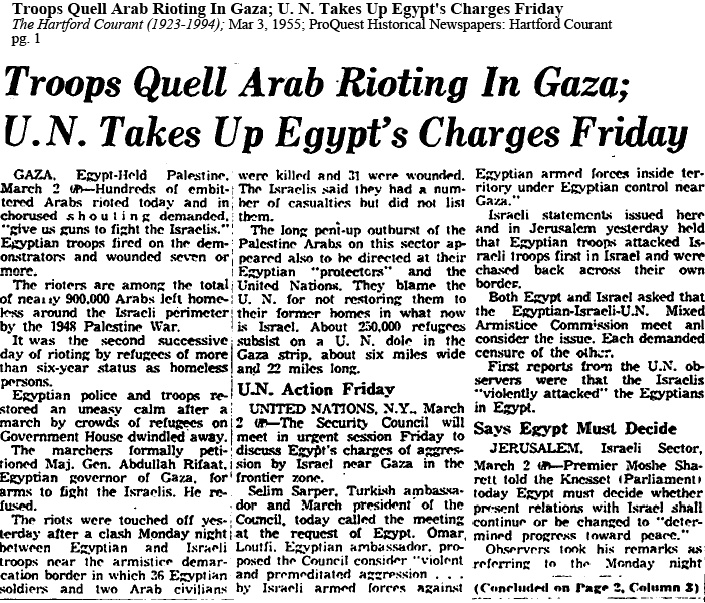
In 1955, an UNRWA worker leaked a copy of the plan to resettle Palestinian refugees in Sinai's northwestern region. He translated the document and spread it throughout the Gaza Strip. In response, Palestinians quickly organized themselves against this plan and others, such as the Alpha plan, known as the “U.S. Efforts to Obtain a Settlement Between Egypt and Israel; the Beginnings of Operation Alpha, January 1–August 26, 1955.”
By March 1955, Palestinian frustration in Gaza had peaked, especially after the Israeli Black Arrow operation, which resulted in the deaths of 40 Egyptian soldiers in the region. The next day, thousands of Palestinians in Gaza took to the streets. They demanded the Egyptian administration end any international or western attempts to impose resettlement projects, demanded the creation of a Palestinian Liberation Army, and called for democratic freedoms in the Gaza Strip.
Protesters nearly took over the entire Gaza Strip, and thanks to their mass uprising, any notion of resettling refugees away from their homeland became a taboo topic and a red line that no one dared to cross.
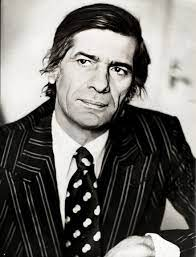
A central figure in spearheading this uprising was Palestinian poet Muin Bseiso (1926-1984). This event significantly fueled Bseiso's writing and activism for subsequent years, instilling in the Palestinian consciousness, for generations, an unwavering refusal to accept the notion of resettlement. This stance was grounded in the recognition that such a move would spell the end of Palestinians' national aspirations and their right to live with dignity in their ancestral homeland.
The American University in #Baghdad (a private university, or a front for money laundering?) tells students they can't wear kaffiyyah as "it may be perceived to be connected with a certain agenda. . . in light of sensitive world events" #Gaza
الجامعة الأمريكية في بغداد (جامعة خاصة، أو مشروع تبييض أموال؟) لن تسمح للطلاب بارتداء الكفيّة لأنها "قد ترى بأنها مرتبطة بأجندة سياسية" يا عيني على حرية التعبير! #غزة
Grateful for the opportunity to curate this emergent conversation series for @Polar_Journal. The series features critical ethnographic reflections on imperiality by Fadi Bardawil, Rebecca Bryant, Omar Dewachi, and Maira Hayat https://t.co/L3naHy73cO
The series closes with Omar Dewachi’s timely contribution coinciding with the 20th “anniversary” of the invasion of Iraq, in which the proliferation of antimicrobial resistance in Mosul uncovers the legacy and futurity of a biological (after)life of empire https://t.co/BqdwuhXp1y