Starter
Member
Weekly Payouts
N500 Welcome Bonus
Access to Unlimited paid digital jobs
Earn Commissions On Sale
Get 2% of each referrer Deposit
Get N500 on each referrer
https://t.co/miVr3maaJs
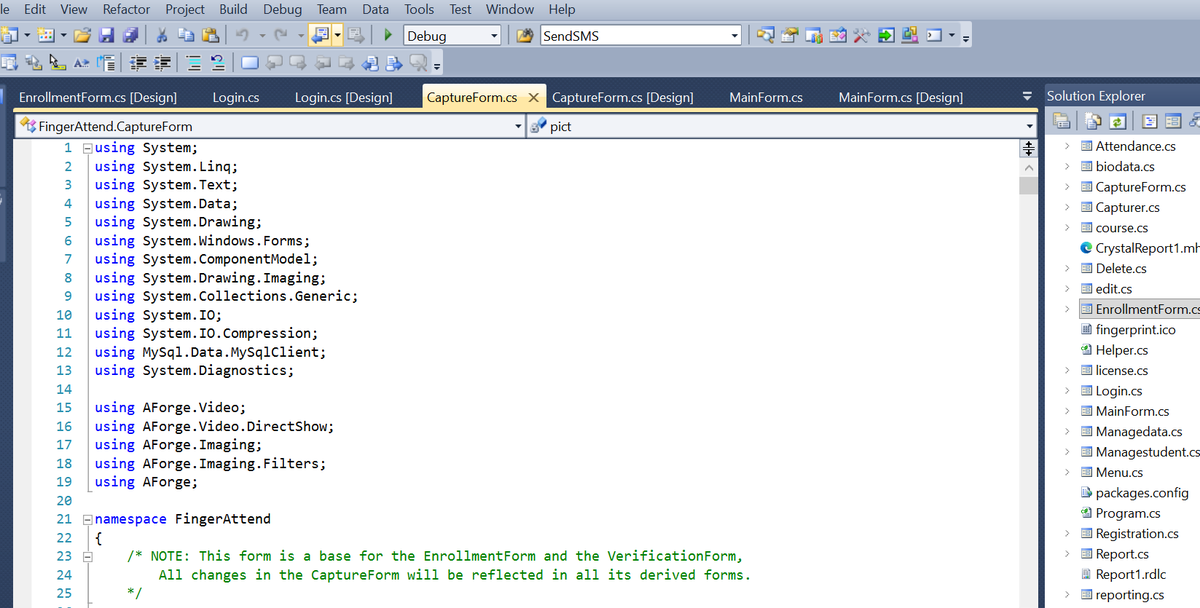
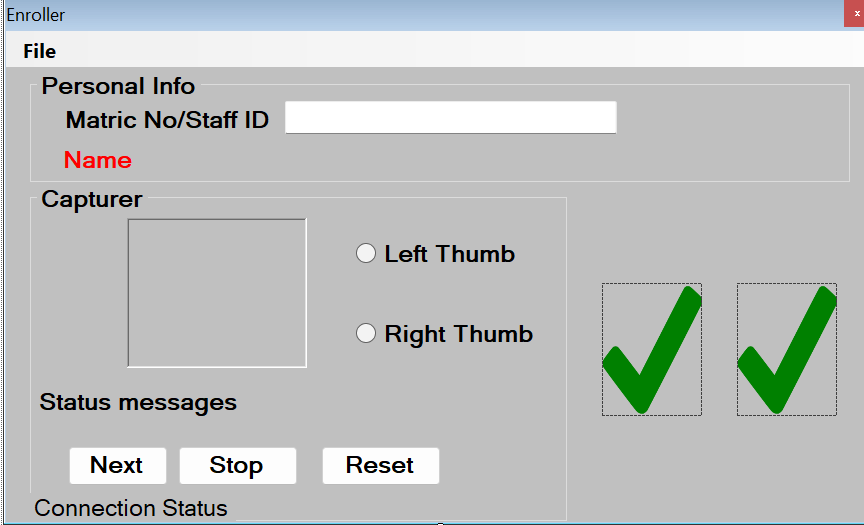
Just completed one of the most complex projects I’ve worked on in recent years. A Biometric Exeat Management System for a university.
What makes this project special is that the journey actually started back in 2018.
At the time, a student from the National Open University of Nigeria approached me to help build a fingerprint-based attendance system for his final year project. I developed it using C# and the DigitalPersona Fingerprint SDK.
What seemed like a small student project at the time became the foundation for something much bigger.
That first project eventually led me to build a full biometric ID capturing system for a Nigerian university, and now, a complete biometric access control and exeat management system designed to monitor and control student entry and exit within a private university environment.
One of the biggest challenges was overcoming the limitations of the DigitalPersona SDK architecture I previously used. The applications were heavy and tightly coupled - enrollment, capture, and verification all revolved around a base form structure that limited flexibility.
This time, I wanted complete control.
So I challenged myself to build the enrollment and verification workflows independently from scratch for better flexibility, scalability, and performance. At some point, it honestly felt impossible… but today, it’s fully working and deployed.
Looking back now, I realise something important:
If I had ignored that "small" student request in 2018, I probably would never have discovered the confidence, experience, and direction that led to these bigger projects.
Lesson for every developer:
Never underestimate a small project. The thing you build today for learning, curiosity, or even as a favour might become the foundation for something far bigger in the future.
Most people think fine-tuning LLMs is only for big labs with deep pockets. @OpenledgerHQ is changing that,
they are making model building accessible, cheap, and onchain with two powerful tools:
1. modelFactory: a no-code playground where anyone can fine-tune LLaMA, Mistral, and other frontier models without writing a single line of code.
2. openLoRA: a deployment engine so efficient, you can run thousands of fine-tuned models on just one GPU, not a typo, 99% cheaper than traditional infra.
together, they unlock a new paradigm:
→ models as public infrastructure
→ ownership at the edge
→ open AI for everyone
if you've got ideas, insights, or data, you can now build and deploy at scale.
no gatekeepers
no guesswork
just pure verifiable AI.
Say hello to the future of mining, meets ZK.
the DogeBox 1 by @cysic_xyz isn't just another miner, it's a pocket-sized entry point into ComputeFi, blending traditional crypto mining with next-gen zero-knowledge proof infrastructure.
here is what makes it a breakthrough:
>Ultra-Efficient Home Mining:
- ~125 MH/s hash rate
- Consumes only ~55W
- Ultra-compact: 100 x 100 x 35 mm
- Wi-Fi & Bluetooth enabled for easy, silent 24/7 home use
Mine DOGE andLTC without the bulk, heat, or noise.
> More Than Mining: It's ZK Ready
What sets DogeBox 1 apart is its dual purpose.
while mining, it also verifies ZK proofs for DogeOS, tapping directly into @cysic_xyz's broader vision, a decentralized, hardware-powered ZK network.
Enter ComputeFi
DogeBox 1 is a core part of the Cysic Network, where verifying ZK proofs = earning extra $CYS rewards.
That means your device works not just for mining, but for ZK compute tasks, stacking yield across two dimensions:
> Traditional mining + proof verification.
As the network rolls out, DogeBox 1 becomes a gateway to ComputeFi, enabling anyone to contribute compute power and earn. no racks, no farms, no noise.
this is mining reimagined.
this is ZK at the edge.
this is @cysic_xyz.
Every app you love, from Netflix to ChatGPT, to X, etc, runs on one silent engine: compute.
But until now, compute has been locked behind closed walls. They are:
-Expensive.
-Centralized.
-Unreachable.
@cysic_xyz is changing that.
They are turning compute into an open, onchain economy, something you can
>own,
>trade, and
>earn from.
it is not just infra for builders alone but a financial primitive for everyone.
This is ComputeFi, and Cysic is making it real.
The gates aren't just open. They're wide. gmsor
While most networks throttle under load, @cysic_xyz is just getting started.
decentralized GPUs, ASICs, and custom hardware.
all working in sync to accelerate ZK proofs at scale.
Cysic didn't just make ZK proofs faster, but freer and not just cheaper, but fairer.
ZK is no longer a bottleneck. It's a backbone.
Don't forget to study @Infinit_Labs
If you have a powerful NVIDIA/AMD rig sitting partially idle since the last crypto market shift, you know the frustration of underutilized hardware. @cysic_xyz offers a compelling answer: put that compute power to work verifying ZK-Proofs.
ZK-Proof verification is perfectly suited for parallel processing, making GPUs highly efficient for the task. Unlike traditional PoW mining, which uses energy for security without a direct utility output, Cysic Verifiers are performing a highly valuable service: confirming the validity of transactions on major ZK-Rollups. It's Proof-of-Utility.
The Cysic Verifier Node software is optimized to tap into this power, offering a streamlined way for hardware owners to earn rewards by providing a critical public service. It’s an easy entry point into the highly technical ZK ecosystem.
Starting my week again and talking about Cysic network
AI and ZK don't just need better math. They need better infrastructure.
This is where @cysic_xyz steps in.
The thesis is ComputeFi:
ComputeFi means anyone anywhere can plug in hardware and help power billions of verifiable proofs. Decentralized, programmable, and open by design.
The testnet already showed it works.
And mainnet is where it gets real.
The future of ZK and AI needs muscle.
Cysic is bringing it.
While the world slows down on Sunday, open intelligence doesn't.
@SentientAGI is quietly reshaping what it means to build with AGI, open, monetizable, and aligned with the people who power it.
they are not just building another AI tool, they are building a full-stack ecosystem where anyone can launch agents, own their models, and earn from their creations.
Think:
> Open-source models that don't beg for VC money
> Agents that work for you, not a centralized platform
> A network that scales with the crowd, not the cloud
AGI shouldn't be locked behind closed doors, and with Sentient, it won"t be.
so if you are building, now is the time to plug into The GRID.
the @lute tournament is live on @xeetdotai and the arena's already buzzing.
leaderboard's up, prizes locked in, and creators are stepping onto the field.
1M Lute XP up for grabs plus
Xeets and Abstract XP.
top 500 take the glory, but only the bold make the board.
this isn't just a challenge.
it's a chance to earn your place.
let the grind begin.
football gave us drama today. City stunned by AstonVilla, Arsenal maintained their lead, and the big one, Madrid owning ElClasico.
but even in the middle of these, the real grind stayed top of mind
@cysic_xyz unlocking verifiable compute for a decentralized future
@Infinit_Labs bringing AI agents to make DeFi smarter, faster, simpler.
from pitch to protocol, it's all about precision and execution.
goodnight, fellas, we run it back tomorrow.
Unlike many others, @playAInetwork does not merely combine AI and crypto technologies, instead, it builds a control layer which allows AI to utilize and engage with Web3 technologies.
Here's how the stack comes together:
-Multi-Chain Protocol (MCP): This allows AI agents to perform DeFi and gaming blockchain actions, including swaps, staking, governance voting, and more.
-PlayHub: The AI agents execute tasks, guided by MCP, to fulfill objectives you set in the PlayHub orchestration layer, such as "farm the best yield" or "monitor DAO proposals."
-Oasis Node Network (secured by EigenLayer): Decentralized, trust layer secured by node operators, who confirm agents' actions and protect the network.
-Integrations: Out-of-the-box cross-chain operations designed for Solana, Polygon, Ethereum, LayerZero, and others.
The $PLAI Token Utility:
- Accessing, training, and deploying agents.
- Rewards for node operators and data contributors.
- Governance and control via staking over agents' logic and protocol edits.
This is what on-chain AI lacks. This is what on-chain AI needs. This is PlayAI.
We always talk about how easy it is to move stablecoins across chains…
But what about your identity?
@idOS_network is building the rails so your identity can move just as smoothly as your stablecoins.
Verified once, and usable across wallets, DeFi apps, and remittance platforms.
And it's not just about ticking a KYC box.
idOS is creating the core infrastructure that lets stablecoins actually serve people at scale, without compromising privacy or decentralization.
Think of things like remittances, onchain payments, or compliance, they all need trust and verification, but without locking your data in some random database.
In a world where money moves in seconds, your identity shouldn't be stuck in the past.
This is what real, self-owned access looks like, and it's already happening with idOS.
@wallchain_xyz
A). A Web3 developer with multiple tabs open and looking overwhelmed.
Caption: "Me, trying to manage 5 protocols, 3 bots, and a Telegram alert… all manually."
B). Same developer, now having discovered Play Hub, looking amazed
Caption: "Wait… a single AI agent can handle all that?"
C). Developer sipping coffee while Aura Agent manages the workflows.
Caption: "Now all I do is talk to Aura, and go touch grass."
D). Developer in sunglasses, strutting away while multiple tabs explode in the background.
Caption: "Automation isn't the future. It's the Play."
CTA:
Make your life easier. Try @PlayAINetwork.
Decentralized, creator-first video generation with real-time rendering and verifiable ownership? Wild. The combo of DePIN infra + $LYN utility + interactive agents makes it feel like the future of content is already here. #bb27#BBNaija#hildabaci#BBNaijaS10#bb26#BBN
Day 1 of talking about @Everlyn_ai an AI driven decentralized video generation platform. The project was earlier launched in mid 2024 but recently gained traction in the web3 community after it's campaign was launched on @KaitoAI.
@Everlyn_ai key features includes:
1. Everlyn-1 model, an open source autoregressive video foundation model. This model can generate video on 25 seconds.
2. Everworld Platform: this is a decentralized environment for interactive video agents that can adapts, learn and respond like digital twins.
3. $LYN Token: this is the native token of the platform, it powers rendering, staking, and governance.
4. Decentralized Infrastructure: this is built on DePIN with partners like AethirCloud, https://t.co/2PjIkWwoX9, ensuring speed, privacy, and on-chain auditability.
And Everlyn has raised $15M in seed funding at a $250M valuation, it is backed by investors like Mysten Labs (Sui), Selini Capital, NesaOrg, and others.
The "DeFi Degenerate" Problem Solved
Part 1:
You are a DeFi Degenerate, and your workflow is broken. 💔
You jump from Telegram to Etherscan to a trading bot to a governance vote. That's 4 apps. That's slow
Part 2: The PlayAI "Play"
This is the @PlayAINetwork doing the work for you:
If: A new governance proposal is detected on a specific DAO (Web3).
Then: An AI Agent is triggered to read and summarize the document instantly.
And: If the summary sentiment is positive, a transaction is pre-staged in your wallet.
Finally, a single push notification goes to your phone: "Positive Proposal. Gas is low. Tap to confirm the vote now." (Web2 → Web3)
Part 3: The Takeaway
PlayAI is not just another notification tool, it's the first decentralized intelligence layer that connects every part of your digital stack.
From your phone to your smart contract.
PlayAI doesn't just send alerts, it acts. One secure, automated system that seamlessly orchestrates across web2 and web3.
And it's not just smart, it's secure. PlayAI is powered by EigenLayer restaking for robust, decentralized security.
The era of endless clicking is over.
Welcome to effortless execution.
What's the most frustrating, repetitive task in your Web3 routine you wish you could automate into a Play?