Los pelos de punta. Desconozco al autor del video pero, por si le llega este post, probablemente sea lo mejor que he visto en muuuuuucho tiempo.
Que maravilla.
🚨 FROM EVERYTHING YOU KNOW… TO 46.5 BILLION LIGHT-YEARS INTO THE PAST
Stop scrolling for a moment.
Take a breath.
This isn’t just a video — it’s a journey through space and time, from our home on Earth to the very edge of the observable universe.
It begins here. Our sky. Our planet. Our tiny blue world, floating quietly in the dark. Then the view starts to pull back… and back… and back. Earth shrinks into a dot. The Sun becomes a spark. Our entire solar system fades into something almost invisible.
But the journey keeps going.
Galaxies appear — not dozens, not thousands, but billions. Each one filled with billions of stars, each star possibly holding worlds of its own. As the distance grows, something strange happens: the farther we go, the further into the past we look. This video takes us 46.5 billion light-years back in time, toward the oldest light the universe allows us to see.
Somewhere along the way, a quiet realization hits: everything humanity has ever known exists in the very first moment of this journey.
Every love story. Every war. Every dream. Every fear.
All of it happened on that tiny speck you can barely see anymore.
And beyond that?
Darkness. Silence. Mystery.
A boundary where our understanding ends — and the universe keeps its secrets.
This video doesn’t try to impress you.
It humbles you.
Watch it carefully. By the time you reach the edge of everything — 46.5 billion light-years into the past — the universe won’t feel the same anymore. ✨
🔴 Airbus A350F : fin des essais de vibration au sol.
Airbus a donc achevé avec succès les Ground Vibration Tests sur le prototype MSN700 à Toulouse.
Ces essais, critiques pour la certification, confirment que le comportement aéroélastique du freighter correspond aux modèles numériques.
Prochaine étape : premier vol d’ici fin 2026, certification et mises en service visées en 2027.
Plus de 100 commandes fermes déjà enregistrées.
Neptune: A Planet of Extreme Records 🌪
The Solar System's most distant ice giant harbors astonishing extremes. The fiercest winds in space—exceeding 2,000 km/h—blow here, while upper-cloud temperatures plummet to a staggering -221°C.
At the same time, the planet takes nearly 165 Earth years to complete one orbit around the Sun, even though its own day lasts just 16 hours.
To think that we aren't just going "to the Moon," but rather traveling to meet it at an exact point in space... changes everything.
It all comes down to orbital mechanics: arriving at the precise location, at the precise moment.
One tiny error... and it simply doesn't happen
Step inside #Airbus’ newest Training Centre ✈️
With immersive Full Flight Simulators and cutting-edge learning spaces, the new centre welcomes 9,000 trainees every year and will help us meet the industry’s growing demand for additional pilots, technicians and cabin crew.
Read more: https://t.co/m2H5OEqYnZ
Evrenin doğum anında bir şey oldu ve kimse bunu durduracak kelime bulamadı kozmik enflasyon 10 üzeri eksi 36 saniyede uzayı 10 üzeri 26 kat şişirdi
ve bu şişme durduğu anda her şey kilitlendi yerçekimi kuvveti ışık hızı karanlık enerji yoğunluğu hepsi milyarda bir sapmayla yerine oturdu eğer bu sayılardan biri trilyonda bir bile farklı olsaydı hidrojen atomu oluşamazdı yıldızlar tutuşamazdı galaksiler bir araya gelemezdi hiçbir şey bir araya gelemezdi fizikçiler buna ince ayar problemi dedi ve sonra sustu çünkü cevap yoktu ama rahatsız edici olan şu bu ayar bir tanrının eliyle yapılmadı enflasyon teorisi diyor ki o anda uzay trilyonlarca baloncuk fırlattı her biri farklı sabitlerle doğdu her biri farklı fizik kurallarıyla çalıştı çoğu doğar doğmaz çöktü çoğu boş kaldı çoğu anlamsız bir denklem yığını olarak söndü bizim evrenimiz o baloncuklardan sadece biri ama sabitleri tesadüfen tutmuş olan tek köpük burası mucize değil burası devasa bir çöplüğün içinden kazara yuvarlanmış bir bilye ve sen o bilyenin üstüne çıkıp evrenin merkezi benim diyorsun
güneşin etrafında dönen bir taş parçasısın ve o taş parçası sonsuz sayıda ölmüş evrenin ortak çöpünden sıyrılmış tek istatistiksel hatayla ayakta duruyor eğer bu tasarımsa tasarımcı son derece savurgan ve geri kalanı çöpe atmış eğer bu tesadüfse o zaman sen bir mucize değil bir hata payısın ve hata payı olmak bile güzel çünkü hata payı olmasaydı senin bu soruyu sormanı sağlayacak kimse kalmayacaktı belki de varoluşun en soğuk tanımı şu trilyonlarca başarısızlığın arasından çıkmış kör bir piyango ve biz hâlâ biletin önemli olduğuna inanmak istiyoruz
çünkü alternatif düşünmek bile kaldıramayacağımız kadar ağır bir boşluk bırakıyor zihinde.
Gökyüzüne bak. Saniyede 200 bin ışık yılı genişleyen bir evrende 2 trilyon galaksi var ve her birinde ortalama 100 milyar yıldız.
Yani evrenin içinde trilyonlarca güneş, katrilyonlarca gezegen dönüyor. Fiziğin dediği şey basit: yaşam sıradan bir kimyasal kaza, su varsa ve biraz zaman varsa mutlaka çıkar. Drake denklemi en kötü senaryoda bile galaksimizde 1 milyon uygarlık öngörüyor. Ama gökyüzü tam bir mezarlık kadar sessiz. Hiçbir sinyal yok, hiçbir iz yok, hiçbir parıltı yok. Bize ulaşabilecek kadar gelişmiş tek bir medeniyet bile 13.8 milyar yıllık tarihimiz boyunca radyo dalgalarımıza cevap vermedi. Sadece Dünyada değil tüm gözlemlenebilir evrende aynı boşluk. Bu boşluğa Fermi Paradoksu deniyor ve insanlık bunu bir bulmaca gibi tartışıyor ama bu bir sessiz çığlık. İşte tam burada Büyük Filtre devreye giriyor. Yaşamın başlamasından türler arası iletişime kadar uzanan yolda bir noktada mutlaka aşılmaz bir duvar var.
Belki o duvar prokaryottan öteye geçememek, belki çok hücreli yapıda çökmek, belki atmosferi zehirlemek, belki nükleer bir savaşla her şeyi silmek. Sebebi önemli değil, sonucu hep aynı: her medeniyet aynı kapıda bekliyor. Ve korkutucu kısım şu: bu filtrenin nerede olduğunu bilmiyoruz. Arkamızda olabilir yani biz o imkansız basamağı şans eseri geçmiş nadir türlerden biri olabiliriz. Ama önümüzde de duruyor olabilir. Yani bir sonraki adımda, belki 50 yıl belki 500 yıl belki 5 milyar yıl sonra, o duvara toslamış ve evrenin sessiz koleksiyonuna karışmış olabiliriz. İnsanlık kendi küçük mavi noktasında kozmik bir geleceğin hayalini kurarken büyük filtrenin soğuk dişlileri arasında sırasını bekleyen sıradan bir veri olabilir. Ya da belki de tam tersi: o duvarı yıkan ilk tür olabiliriz. Ama bunu bile bilmenin bir yolu yok, çünkü cevabı verebilecek kadar uzun yaşayanlar zaten sessizliğe karışmış oluyor.
Simülasyonun en korkutucu bugı bu olmalı: her uygarlık aynı anda hem evrende yalnız olduğunu düşünüyor hem de bir sonraki adımda toplu olarak silineceğini bilmeden yaşıyor.
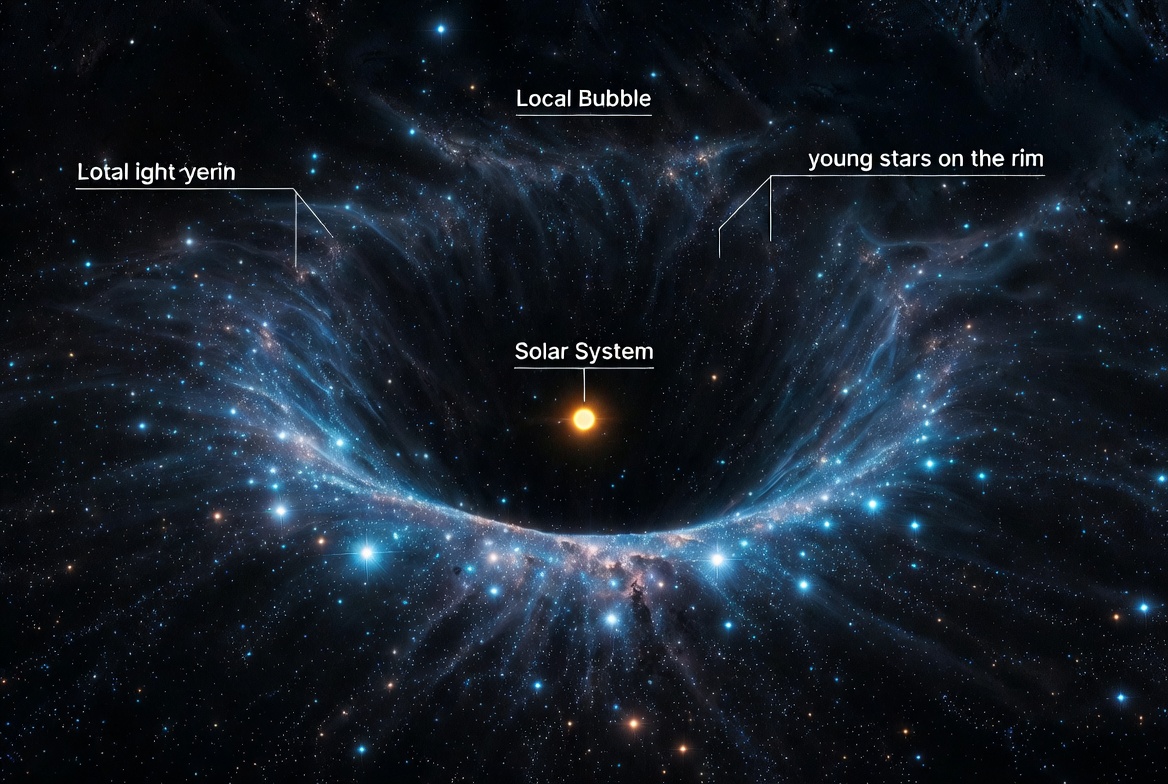
🌌 Picture this: our entire Solar System is floating right in the heart of a colossal, almost empty cosmic void — a thousand light-years across!
This eerie “Local Bubble” is strangely quiet inside, with barely any stars or glowing plasma clouds. Yet its edges are bursting with vibrant young stars, as if the bubble’s walls are sparkling with new life.
Just a couple of years ago, astronomers used the incredible Gaia space telescope to map this mysterious cavity in stunning detail. What they found was mind-blowing: those stars lining the rim formed from the very gas and dust that the bubble itself pushed outward.
The whole structure was carved by a dramatic series of supernova explosions that began about 14 million years ago. These stellar blasts swept matter to the periphery, leaving the inside shockingly sparse — only one-tenth the normal density of the galaxy’s interstellar medium.
So why is our Sun sitting perfectly in the center? Pure cosmic coincidence! When those supernovae first erupted, the Sun was far away. It only drifted into the bubble around 5 million years ago and is still sailing through this quiet void today.
The most fascinating idea of all? Scientists suspect the entire Milky Way is riddled with similar bubbles, turning our galaxy into a vast, foamy cosmic sponge. 🪐🌙
🚨 What Happened Before the Big Bang? 🤯
What if the universe didn’t begin with a slow expansion… but with a violent, mind-bending growth spurt that happened in less than a blink of an eye? Scientists believe that right after the Big Bang, the universe suddenly expanded at an unbelievable speed—stretching space itself faster than light. This mysterious event is called Cosmic Inflation, and it may explain why the universe looks so calm, balanced, and strangely familiar today.
Here’s the eerie part: regions of the universe that are billions of light-years apart look almost identical, as if they once whispered secrets to each other. But how could they, when there wasn’t enough time for light—or anything—to travel between them? Inflation offers a chilling answer: long ago, everything was tightly packed together… and then space itself exploded outward, tearing the universe apart while keeping its hidden order intact.
The idea was first proposed by physicist Alan Guth, and it changed cosmology forever. According to this theory, tiny quantum ripples—smaller than an atom—were stretched across the universe, becoming the seeds of galaxies, stars, and even us. That means every galaxy you see tonight may have started as a random quantum twitch in the newborn universe.
Even more unsettling? Inflation suggests the universe was designed to look flat and smooth, like a cosmic illusion. And some versions of the theory hint that inflation never truly ends… that it keeps creating new universes endlessly. If that’s true, our universe might be just one bubble in an infinite cosmic ocean.
We can’t see inflation directly—but its fingerprints are everywhere, written into the faint glow left behind by the Big Bang. The deeper scientists look, the more it feels like the universe is hiding a secret from its very first second.
So the next time you look up at the night sky, ask yourself this:
Are we living in the quiet aftermath of the most explosive moment reality has ever known? 🌠
The Flame Nebula, in the constellation of Orion with its surroundings, including the Horsehead Nebula.
In visible light it is hidden by cosmic dust, but in the infrared it reveals a dense cluster of newly born stars.
Captured by the VISTA telescope, in Chile.
🚀🌌 Voyager 1 has left the Sun's protective bubble—the heliosphere—and is now traveling through interstellar space, over 25 billion km from Earth.
Launched in 1977, it's the most distant human-made object ever. Yet even after nearly 50 years, it isn't close to another star. At its current speed, reaching the nearest star system, Alpha Centauri, would take tens of thousands of years.
A humbling reminder of both human curiosity and the unimaginable scale of the universe. ✨
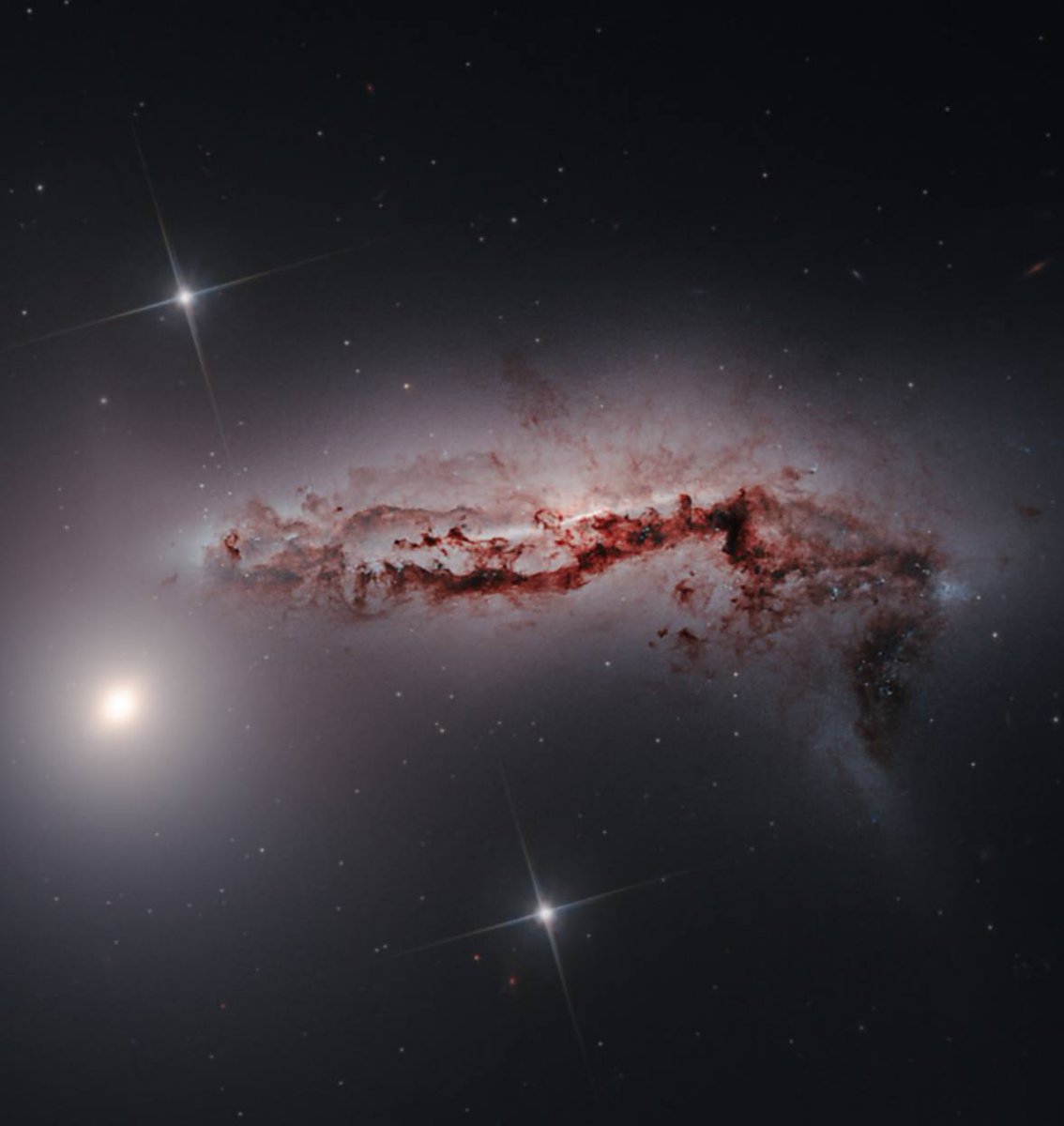
🪐 NGC 7174 is a spiral galaxy located in the constellation Piscis Austrinus.
Apparent magnitude: 13.1.
Distance from the Sun: about 37.5 Mpc (approximately 120 million light-years).