Hoy en @nadaesgratis cuento los resultados del último trabajo con @luismmiller y Tom Lane, en el que examinamos la aceptabilidad social del partidismo político.
Spoiler: no nos parece del todo mal eso de favorecer a alguien que vota lo mismo que tú. 👀
https://t.co/6CNNCfgPrk
Fascinating paper just published in Science.
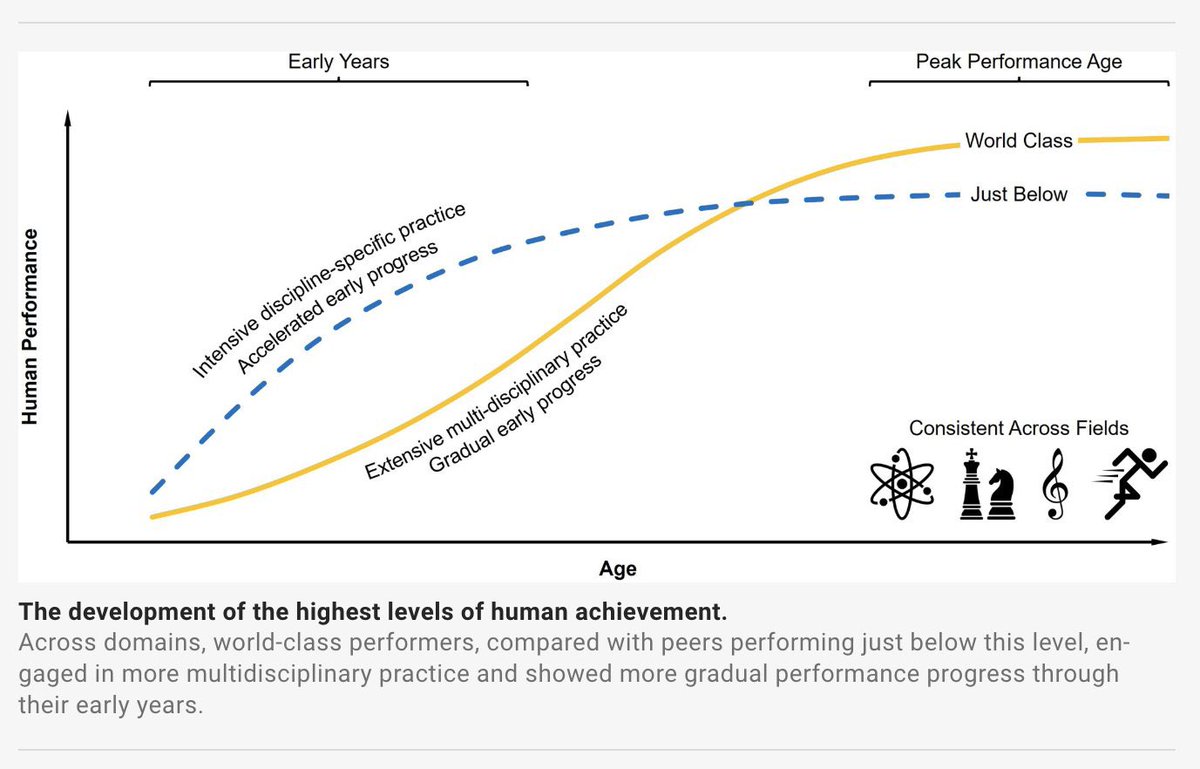
The authors analyze the career trajectories of top performers across multiple domains, including Nobel laureates, elite chess players, Olympic gold medalists, and more.
Their central finding challenges a common belief.
Intensive, single-discipline training at a young age does confer an early advantage, but this advantage fades over time.
By contrast, individuals exposed to multidisciplinary practice early in life tend to start more slowly. Yet, over the long run, they are more likely to reach world-class performance, eventually overtaking early specialists, who often plateau just below the very top.
An important reminder that breadth early on can be a powerful investment in long-term excellence.
Link to the paper in the first reply.
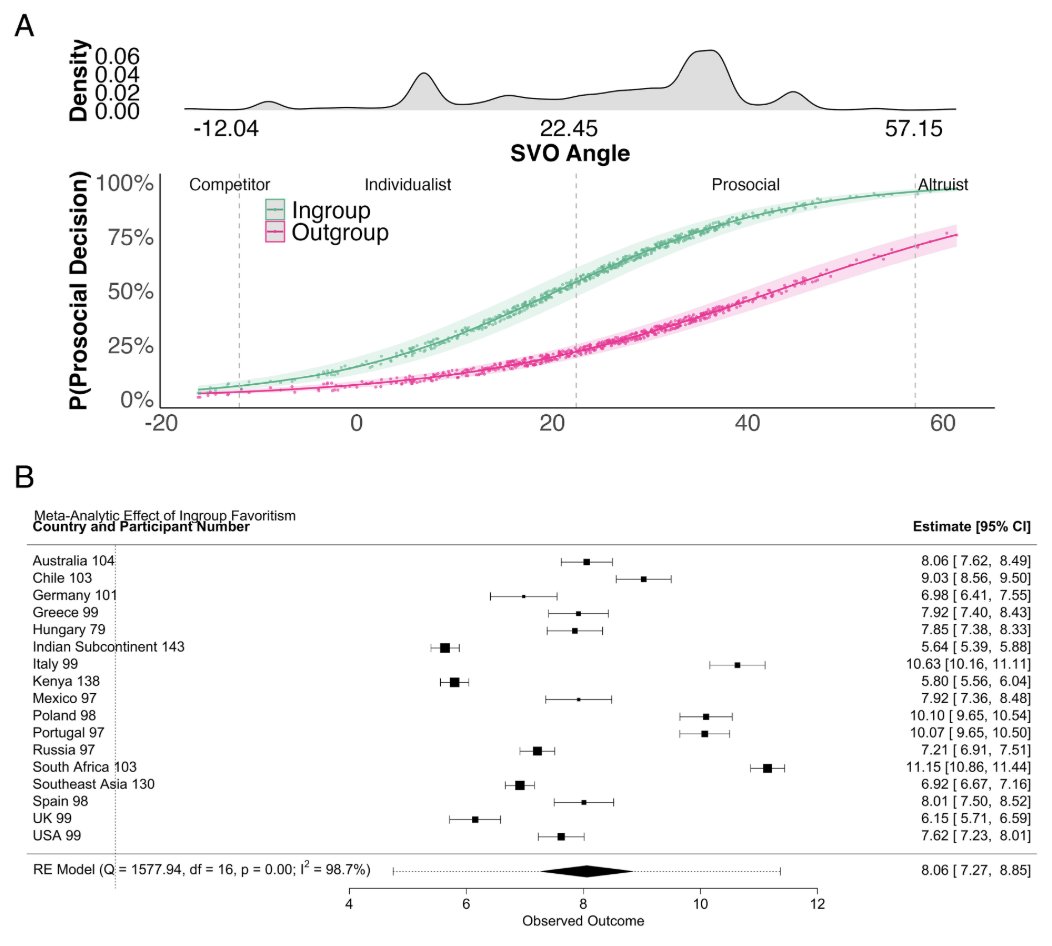
A global study of minimal groups finds discrimination in favor of the in-group in all 20 countries, yielding a large overall effect (OR = 4.58).
The degree of intergroup discrimination was related to higher societal uncertainty https://t.co/kQpvEB3gWQ
Most divides aren't due to differing values. They're driven by focusing on different things.
After a 10-minute talk, people with opposing views are less polarized a week later. They find more common ground than expected.
Prejudice festers in silence. Civil dialogue opens minds.
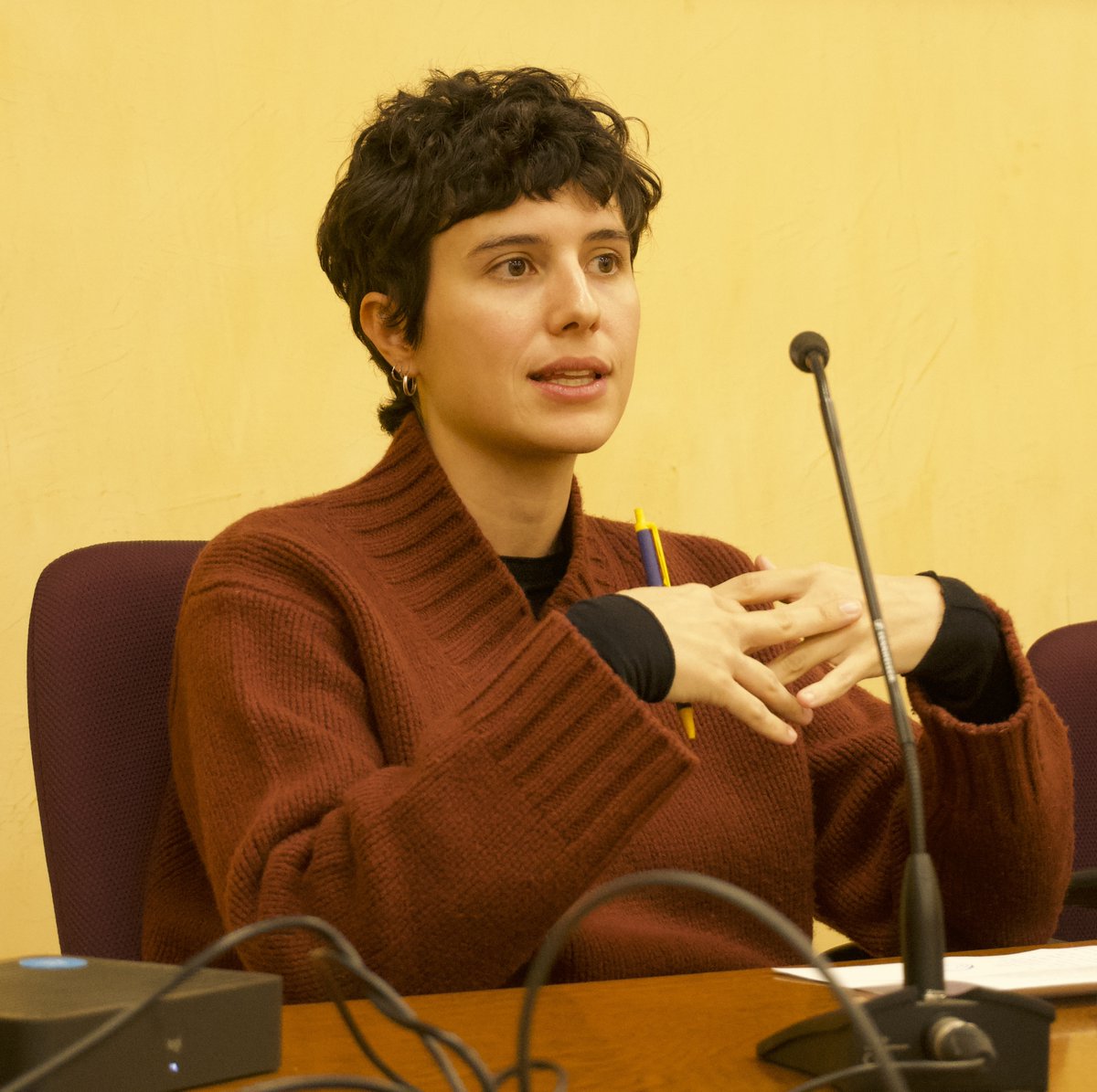
Gracias a todas las personas que nos acompañasteis en la primera sesión de #DiálogosMax
Y un agradecimiento muy especial a quienes hicieron posible una conversación rica y abierta:
@gascondaniel · @hectorgbarnes · @saraselvaortiz · @isrodrz
Aquí van algunas 📸 del encuentro
Here's yet another study showing that kids who get smartphones earlier have worse mental health as teens.
So what's the right age for a first smartphone? I'd say its whatever age you want them to cut back on sleeping, reading, exercise, and socializing. I advise not doing that before 14, at the earliest.
Let's make that a new norm, to break out of the collective action trap together. Some parents may then wait even longer. But lets try to get all kids through middle school in the real world, before exposing them to the many harms of adolescence lived on a phone.
Note that this research use the ABCD study, which is the highest quality longitudinal study going.
It confirms an earlier finding by @sapien_labs that found the same thing
https://t.co/eTWs0LM3BE
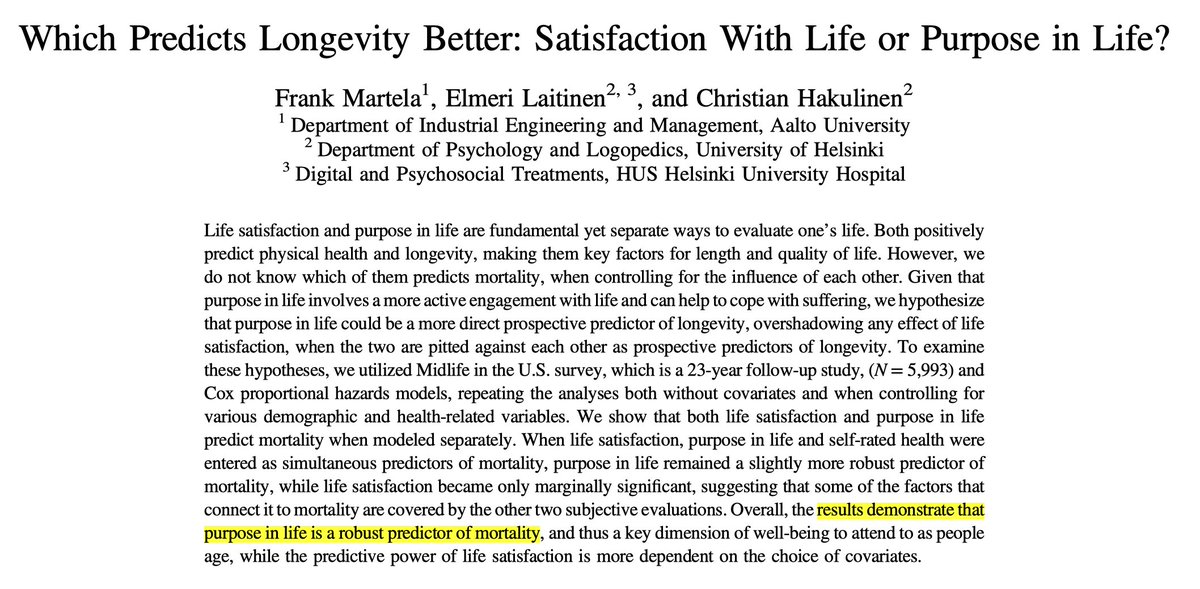
Purpose in life predicts longevity better than life satisfaction
Why? Purpose leads to:
- Active engagement vs. passive contentment
- Resilience during stress
- Meaningful activity and self-worth
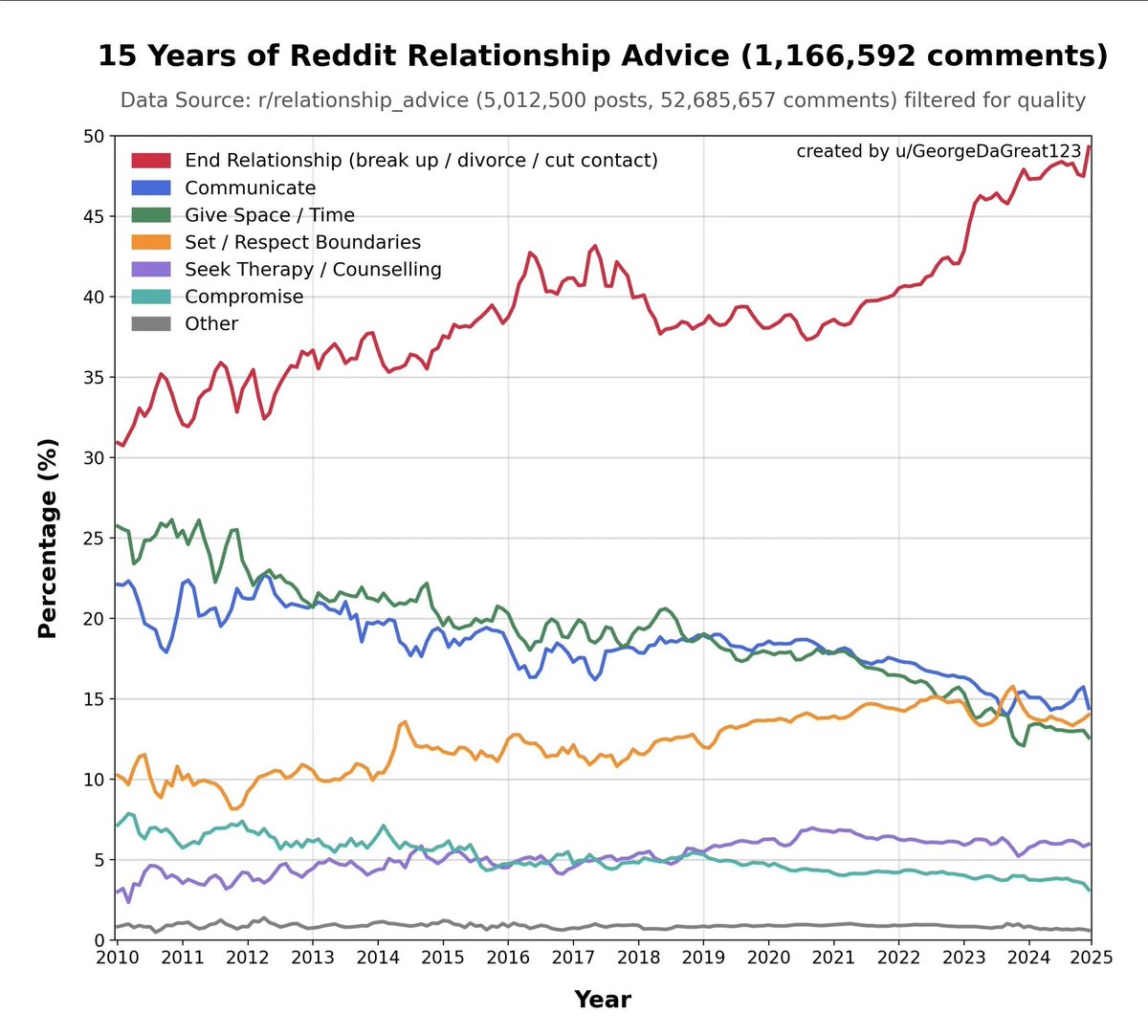
Over the last fifteen years, Reddit's relationship advice has shifted towards recommending:
- Breakups
- Boundaries
- Therapy
And against compromise, communication, and letting people have their space.
Engaging in creative, skill-based activities like dance, music, visual arts, or gaming can reduce your brain's biological age by ~6 years.
Researchers measured the 'brain age gap' (the difference between predicted and actual brain age) and found that creative experts had significantly younger brains.
This expertise translates to greater neural connectivity in brain regions responsible for motor control, precise timing, mental imagery, and salience detection. They also had more efficient local and global neural networks, which is a signature of robust cognitive function.
Healthy brain aging isn't just about nutrition and exercise protocols. Deliberately challenging your brain with creative and skill-intensive pursuits profoundly enhances neural resilience and longevity.
Teniendo una de las mejores becas postdoctorales de España, gasto el 70% en pagar el alquiler (piso de 40m2 lejos del centro). En otras palabras, mi casera está recibiendo una de las mejores becas postdoctorales de España 👍🙃 #vivienda#especulacion#derechoalavivienda
🎞️ De las fotos de tus tíos a la economía de la atención
No hace tanto, cuando alguien volvía de viaje te sentaba en el salón a ver las 100 fotos random que habían hecho de París, Londres y con mucha suerte Nueva York.
Imaginad lo poco que había que hacer. Lo escaso que era el “contenido”, las fotos y hasta los viajes.
Algunos tenían diapositivas y lo proyectaban a oscuras:
- “Mirad, la Torre Eiffel”
- “Aquí en los Campos Elíseos”
- “Esto era nuestro hotel”
La escena es hoy incomprensible.
Como explicarle a un millenial que dedicabas una hora a ver fotos desenfocadas del viaje de otras personas. Eso era entretenimiento. ¿No tenías nada mejor que hacer? Estabas ahí sentado. Mirando.
Y apenas han pasado 30 años.
Es el mejor ejemplo de un giro radical: en 1990 era escaso el contenido; ahora lo escaso es la atención.
Pasamos de un mundo donde guardabas las diapositivas, a uno donde nunca miras tus fotos. Leías textos aleatorios: las revistas de tu madre, las revistas viejas de un dentista y hasta las cajas de cereales por detrás. Hoy no lees ni los libros que quieres leer.
Es una transformación que rompe con milenios de escasez en solo 30 años. Y seguimos sin saber gestionarla.
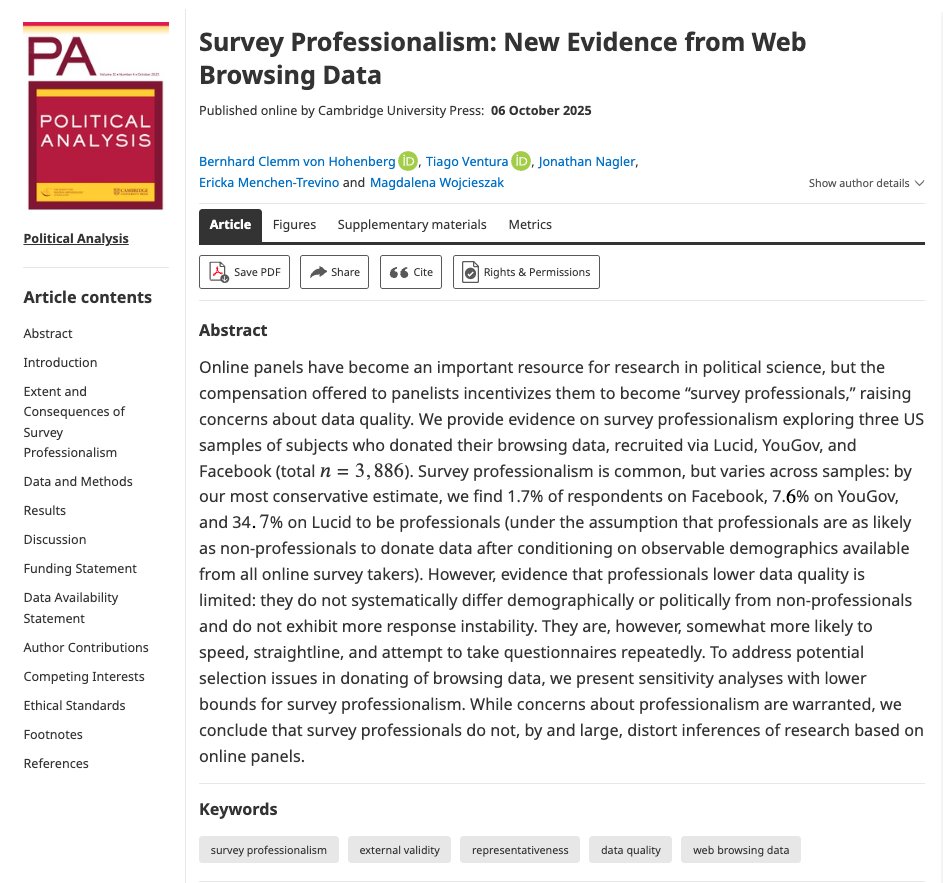
How common are “survey professionals” - people who take dozens of online surveys for pay - across online panels, and do they harm data quality?
Our paper, first view at @polanalysis, tackles this question using browsing data from three U.S. samples (Facebook, YouGov, Lucid):
Creative Minds, Younger Brains: Engaging in music, dance, painting, or even (some) gaming is linked to delayed brain aging.
Article: https://t.co/04vS4dgVQs.
🧵1/5
Biophysical modeling, graph theory, and Neurosynth analyses reveal plasticity-driven efficiency in regions most vulnerable to aging. Out Today in @NatureComms, congrats @carlosmig_12 and colls! @CreativeAgeIntl@j_artshealthlab@CreativeBrainWk
Research output after tenure drops off a cliff for business, economics, sociology, and other non-lab fields.
But it remains high post-tenure in lab-based fields such as chemistry, physics, computer science, and engineering.
People who have more complex social identities view political identity as a less reliable source of information about others. Therefore they rely less on group-based stereotypes when judging outgroup members.
They are less likely to judge outgroup members more harshly than ingroup member. Instead, they treat all transgressors equally because they see people as individuals: https://t.co/3FbJb5m3h1
🗣️ @kanciller: "Sí, los jóvenes de hoy salen menos de fiesta. Los datos lo señalan. Cuando tengamos a la tertulianada diciendo que se quiten Netflix y dejen de viajar para pagar la hipoteca, de mi parte les dais un abrazo fuerte"
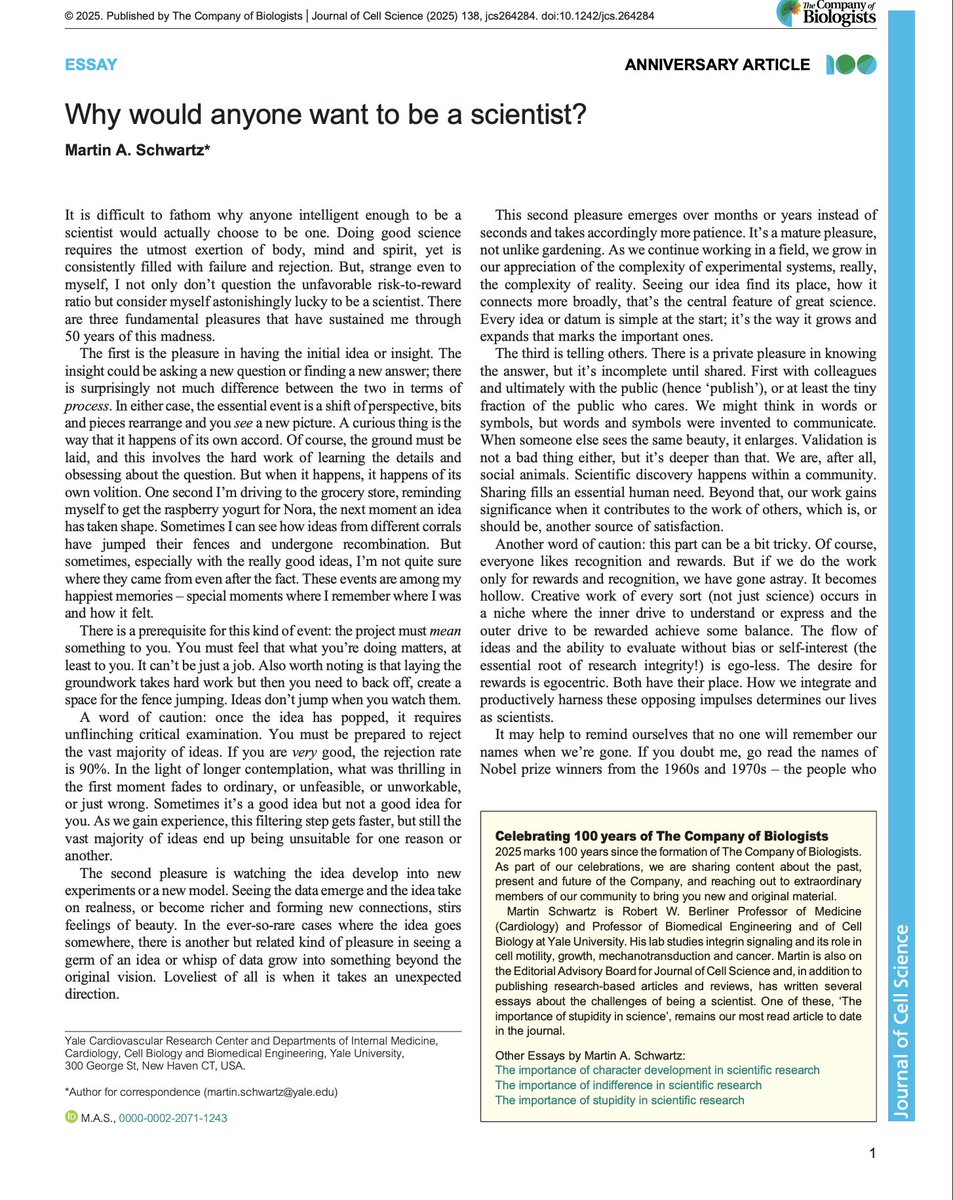
"Doing good science requires the utmost exertion of body, mind & spirit, yet is consistently filled with failure and rejection." He talks about 3 reasons he kept going. I can relate to the 2nd one - "Watching the idea develop into new experiments/a new model". What's it for you?
This new AER paper finds that business owners are much more likely to hire workers who share their political views. Political opinions of business owners have a real impact on who gets hired, how much they get paid, and who gets promoted. Political bias plays a big role in hiring