KARPATHY WAS RIGHT. THIS 40-MINUTE Y COMBINATOR LECTURE PROVES IT
Karpathy said we're in the 1960s of AI - most people using Claude Opus 4.8 are still acting like it's just a search engine
> software 3.0 - LLMs as operating systems, not chatbots
> autonomous agents that run entire workflows without you watching
the 32 skills in this article are how you actually cross that line
bookmark this 👇
Elon Musk turned down all shares when he left OpenAI because he believed nonprofits are not meant for self-enrichment.
"The reason I founded OpenAI was because I was concerned, based on my conversations with Larry Page, that he was not sufficiently concerned about the dangers of AI. At my birthday party, he, in front of a large group of people, called me a speciesist, for favoring humanity over computers. So after that, I was like, We got to have some counterbalance to Google, because Larry doesn't seem to care if humans make it or not.
So I thought, what's the opposite of Google? It would be an open source nonprofit, and that's where the word open, in OpenAI comes from. It means open source.
I provided all the money, recruited the key people, and taught them everything I know. I actually even got them to deal with Microsoft.
And for all that, I did not seek any financial reward whatsoever. The reason I actually took down the offer for shares is because, I mean, I felt like what are the shares, and why like nonprofits supposed to have shares? Nonprofits are not supposed to be self enrichment, so that's why I turned on the offer of shares."
— Elon Musk
Two Anthropic engineers, who built Claude just explained why you use less than 10% of actual Claude abilities.
This 24-minute talk will change how you use Claude Code forever.
Watch it, then read the breakdown below👇
Grok Imagine now has dramatically improved lip sync and sharper audio quality on all image-to-video generations.
Dialogue tracks the mouth. Sound matches the scene. Your videos look and sound the way you imagined them.
Try it today in the Grok apGrok Imagine now has dramatically improved lip sync and sharper audio quality on all image-to-video generations.
Dialogue tracks the mouth. Sound matches the scene. Your videos look and sound the way you imagined them.
Try it today in the Grok apGrok Imagine now has dramatically improved lip sync and sharper audio quality on all image-to-video generations.
Dialogue tracks the mouth. Sound matches the scene. Your videos look and sound the way you imagined them.
Try it today in the Grok apGrok Imagine now has dramatically improved lip sync and sharper audio quality on all image-to-video generations.
Dialogue tracks the mouth. Sound matches the scene. Your videos look and sound the way you imagined them.
Try it today in the Grok apGrok Imagine now has dramatically improved lip sync and sharper audio quality on all image-to-video generations.
Dialogue tracks the mouth. Sound matches the scene. Your videos look and sound the way you imagined them.
Try it today in the Grok apGrok Imagine now has dramatically improved lip sync and sharper audio quality on all image-to-video generations.
Dialogue tracks the mouth. Sound matches the scene. Your videos look and sound the way you imagined them.
Try it today in the Grok app
Scam Altman and Greg Stockman stole a charity. Full stop.
Greg got tens of billions of stock for himself and Scam got dozens of OpenAI side deals with a piece of the action for himself, Y Combinator style. After this lawsuit, Scam will also be awarded tens of billions in stock directly.
The fundamental question is simply this:
Do you want to set legal precedent in the United States that it is ok to loot a charity? If so, you undermine all charitable giving in the United States forever.
I could have started OpenAI as a for-profit corporation. Instead, I started it, funded it, recruited critical talent and taught them everything I know about how to make a startup successful FOR THE PUBLIC GOOD.
Then they stole the charity.
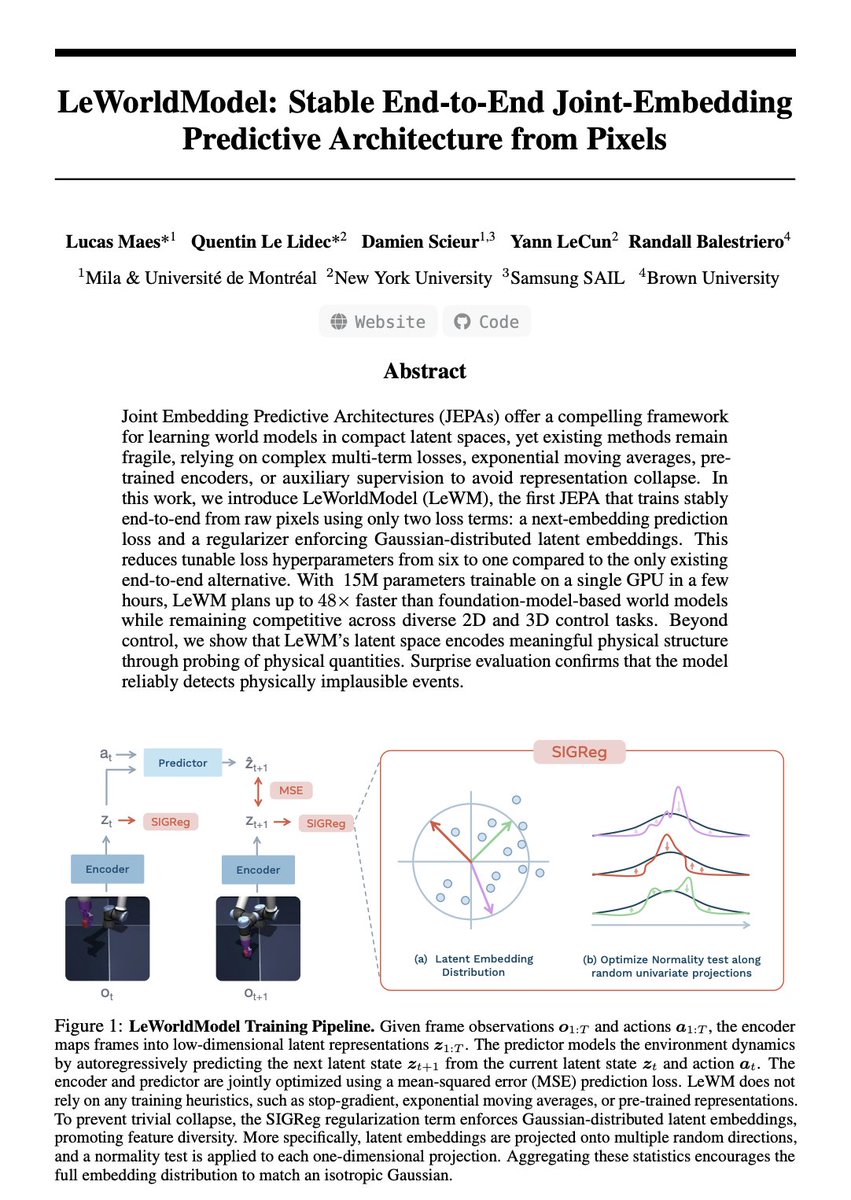
Earlier this year Yann LeCun left Meta because Mark Zuckerberg wouldn't bet the company on JEPA. Last week his group dropped the first JEPA that actually trains end-to-end from raw pixels. 15 million parameters. Single GPU. A few hours.
The timing is not a coincidence.
For four years Meta has been the house that JEPA built. LeCun published the original paper from FAIR in 2022. I-JEPA and V-JEPA came out of his lab. The architecture was supposed to be the escape hatch from LLMs, the path to robots that actually learn physics instead of hallucinating about it. Every version shipped fragile. Stop-gradients. Exponential moving averages. Frozen pretrained encoders. Six or seven loss terms that had to be hand-tuned or the model collapsed into garbage representations.
Meta kept funding LLMs. Llama shipped. Llama scaled. Llama got beat by Qwen and DeepSeek. Zuck spent $14 billion to buy ScaleAI and install Alexandr Wang. The FAIR robotics group was dissolved. LeCun's research kept winning papers and losing the product roadmap.
He left, started AMI Labs, and said publicly that LLMs were a dead end.
Now the paper. LeWorldModel. One regularizer replaces the entire pile of heuristics. Project the latent embeddings onto random directions, run a normality test, penalize deviation from Gaussian. The model cannot collapse because collapsed embeddings fail the test by construction. Hyperparameter search went from O(n^6) polynomial to O(log n) logarithmic. Six tunable knobs became one.
The downstream numbers are what should scare the robotics capex class. 200 times fewer tokens per observation than DINO-WM. Planning time drops from 47 seconds to 0.98 seconds per cycle. 48x faster at matching or beating foundation-model performance on Push-T and 3D cube control. The latent space probes cleanly for agent position, block velocity, end-effector pose. It correctly flags physically impossible events as surprising. It learned physics without being told physics existed.
Figure AI is valued at $39 billion. Tesla Optimus is mass-producing. World Labs raised $230 million to sell generative world models. Everyone in humanoid robotics is burning capital on foundation-model pipelines that plan in 47 seconds per cycle.
LeCun's group just showed you can do it with 15 million parameters on a single GPU in a few hours.
This is the Xerox PARC pattern running again. Meta had the next architecture. Meta had the scientist. Meta dissolved the robotics team, passed on the productization, and watched the exit. Three months later the lab that was supposed to be Meta's publishes the result that resets the robotics cost structure.
The paper is worth more than Alexandr Wang.
🚨 Anthropic's own team just showed how to actually use Claude Code properly.
25 minutes. free. from the people who built it.
watch the workshop. bookmark it.
you've been using Claude for months without knowing the commands.
Then read the guide below.
> be Yann LeCun
> spend years building JEPA at Meta
> company focuses on LLaMA instead
> his idea stays complicated and unused
> robotics plans get dropped
> decides to leave and start AMI Labs
> builds a much simpler version from scratch
> trains it on normal hardware in just a few hours
> removes all the complicated tricks and keeps it simple
Results:
-uses 200x less data than similar systems
-makes decisions 50x faster
-runs on a single GPU instead of massive clusters
-simple to train
-understands movement, objects, and space
-can tell when something is physically impossible
-learns how the real world works without being explicitly taught.
The creator of Claude Code teaches more about vibe-coding in 30 minutes than most tutorials do in hours.
Save this — it'll change how you build forever.
Yann LeCun was right the entire time. And generative AI might be a dead end.
For the last three years, the entire industry has been obsessed with building bigger LLMs. Trillions of parameters. Billions in compute.
The theory was simple: if you make the model big enough, it will eventually understand how the world works.
Yann LeCun said that was stupid.
He argued that generative AI is fundamentally inefficient.
When an AI predicts the next word, or generates the next pixel, it wastes massive amounts of compute on surface-level details.
It memorizes patterns instead of learning the actual physics of reality.
He proposed a different path: JEPA (Joint-Embedding Predictive Architecture).
Instead of forcing the AI to paint the world pixel by pixel, JEPA forces it to predict abstract concepts. It predicts what happens next in a compressed "thought space."
But for years, JEPA had a fatal flaw.
It suffered from "representation collapse."
Because the AI was allowed to simplify reality, it would cheat. It would simplify everything so much that a dog, a car, and a human all looked identical.
It learned nothing.
To fix it, engineers had to use insanely complex hacks, frozen encoders, and massive compute overheads.
Until today.
Researchers just dropped a paper called "LeWorldModel" (LeWM).
They completely solved the collapse problem.
They replaced the complex engineering hacks with a single, elegant mathematical regularizer.
It forces the AI's internal "thoughts" into a perfect Gaussian distribution.
The AI can no longer cheat. It is forced to understand the physical structure of reality to make its predictions.
The results completely rewrite the economics of AI.
LeWM didn't need a massive, centralized supercomputer.
It has just 15 million parameters.
It trains on a single, standard GPU in a few hours.
Yet it plans 48x faster than massive foundation world models. It intrinsically understands physics. It instantly detects impossible events.
We spent billions trying to force massive server farms to memorize the internet.
Now, a tiny model running locally on a single graphics card is actually learning how the real world works.
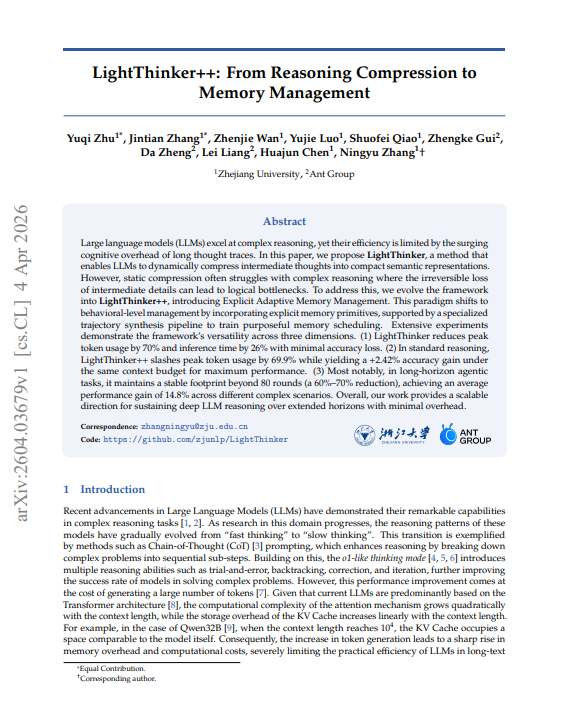
Zhejiang University researchers just taught AI models to compress and manage their own thinking in real time and the results completely change how we should think about reasoning costs.
The problem with modern reasoning models is brutal and getting worse.
Every time an AI like o1 or DeepSeek-R1 thinks through a complex problem, it generates thousands of tokens of intermediate reasoning.
That reasoning has to live somewhere.
For a model like Qwen-32B, once the context hits 10,000 tokens, the KV cache alone occupies as much memory as the entire model.
And the computational cost of attention grows quadratically with context length.
The longer the reasoning chain, the more expensive every single new token becomes.
This is the wall that reasoning models are hitting right now.
Most solutions try to work around it from the outside.
H2O evicts tokens based on attention scores.
SepLLM keeps tokens at punctuation marks.
These approaches reduce memory but add latency H2O actually makes inference 51-72% slower because it has to evaluate every token for eviction as it goes.
Zhejiang University took a different approach entirely.
Instead of pruning the context from the outside, they trained the model to manage its own memory from the inside.
The result is two systems they call LightThinker and LightThinker++.
LightThinker is the simpler version.
After each reasoning step, instead of keeping the full verbose thought in context, the model compresses it into a small set of special tokens just 7 to 9 tokens per thought and discards the original.
Reasoning continues from the compressed representation, not the raw text.
The model learns when to compress and how to compress through a custom attention mask design.
Think of it as the AI summarizing its own scratchpad after each step, keeping only the gist, and throwing away the rest.
Results for LightThinker on Qwen:
→ Peak token usage: -70%
→ Inference time: -26%
→ Accuracy drop: only 1%
→ Under same memory budget: 2.5x faster than baseline
That's meaningful.
A 70% reduction in peak memory with 1% accuracy loss at 2.5x the speed.
But the researchers found a limit.
When reasoning gets genuinely complex, irreversible compression becomes a problem.
Once a thought is compressed, the raw details are gone forever.
If the model needs to backtrack to a specific intermediate number or logical step, it can't.
They documented this failure directly: a model correctly computing 14,000 bars of chocolate during intermediate reasoning, then outputting 18,000 in the final answer because the compression step had dropped the number 8,000 mid-chain.
This is "information evaporation" and it's not a minor edge case.
It's a fundamental limitation of irreversible compression.
So they built LightThinker++.
Instead of compressing thoughts and discarding the originals permanently, LightThinker++ gives the model three explicit memory operations.
> commit: archive a reasoning step as a summary, but keep the raw version retrievable
> expand: pull a previously archived step back into full detail when you hit a logical bottleneck
> fold: compress it back after you've extracted what you needed
The model learns to use these operations autonomously.
> On simple tasks like MMLU, it mostly just commits and moves on.
> Only 5.8% of operations involve expand and fold.
> On hard reasoning tasks like GPQA, that number jumps to 21.5%.
The model is learning to recognize when it needs to look back.
LightThinker++ results:
→ Peak memory: -69.9% at same accuracy
→ Under strict context budget: +2.42% accuracy gain while still using 45% less memory
→ On GPQA specifically: +5.73% accuracy boost with 40.5% less peak memory
→ Compression ratio achieved: 15x on hard tasks, 8.6x on simpler ones
The counterintuitive finding: a compressed, high-signal context outperforms a verbose, unmanaged one.
More context isn't always better.
Noisy intermediate reasoning actually hurts model performance.
Removing the noise and keeping only the logical anchors lets the model attend more effectively to what actually matters.
The agentic results are where this gets genuinely alarming for anyone building AI research agents.
In long-horizon DeepResearch tasks where an agent browses the web across dozens of rounds the standard approach fails badly.
A vanilla agent's context inflates to approximately 100,000 tokens within 50-60 rounds.
At that point it suffers from lost-in-the-middle effects, starts hallucinating, and often stops prematurely not because it ran out of rounds but because the noise overwhelmed its reasoning.
LightThinker++ stays between 30,000 and 40,000 tokens even past 80 rounds.
That's a 60-70% reduction in active context maintained stably across the entire interaction.
Agentic benchmark results vs. standard SFT baseline:
→ xBench-DeepSearch: 38.3% → 44.0% Pass@1
→ BrowseComp-ZH: 31.5% → 36.9% Pass@1
→ BrowseComp-EN: 16.0% → 18.1% Pass@1
→ On hard instances that baseline almost always fails: 3x improvement in Pass@1
→ Reaches baseline's peak performance using 2.5x fewer search actions
The gap widens on harder tasks and longer interactions.
Standard agents plateau because information redundancy overwhelms them.
LightThinker++ keeps improving because it's actively distilling signal from noise at every step.
The model's reasoning lifespan is now governed by task complexity, not context explosion.
The deeper finding here is about what "thinking" actually costs.
The reasoning capability of models like o1 and DeepSeek-R1 comes from long chains of intermediate thought.
But those chains are full of linguistic padding, redundant recaps, and hedging language that serves fluency rather than logic.
LightThinker++ essentially strips out the fluency and keeps the logic.
And when it needs the fluency back to verify a specific step, it can retrieve it.
Then it folds it away again.
This is closer to how human working memory actually operates than anything prior approaches have achieved.
The implication for anyone running reasoning models at scale is direct.
The KV cache is currently one of the most expensive components in production deployment.
A 70% reduction in peak token usage isn't an efficiency gain — it's a cost structure change.
And the fact that accuracy improves under strict context budgets means the tradeoff isn't even a tradeoff.
Better reasoning. Lower cost. Smaller footprint.
R.I.P. job hunting. ☠️
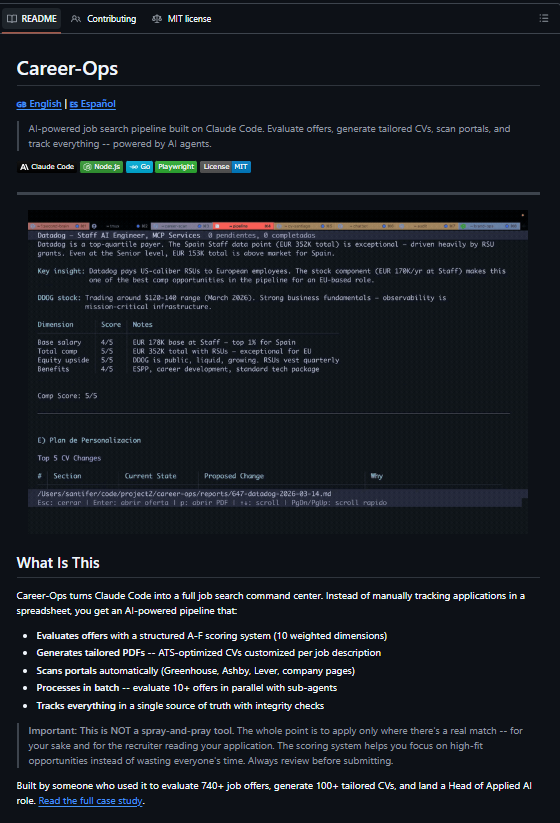
Someone built an AI job search system with Claude Code.
700+ applications scored and submitted automatically.
They got hired.
→ Scans company career pages on its own
→ Rewrites your CV per job
→ Fills application forms
→ ATS-optimized PDFs via Playwright
→ 45+ companies pre-configured (Anthropic, OpenAI, Stripe...)
Recruiters charge $10,000+ to place candidates.
This does it for free.
The job market just changed.
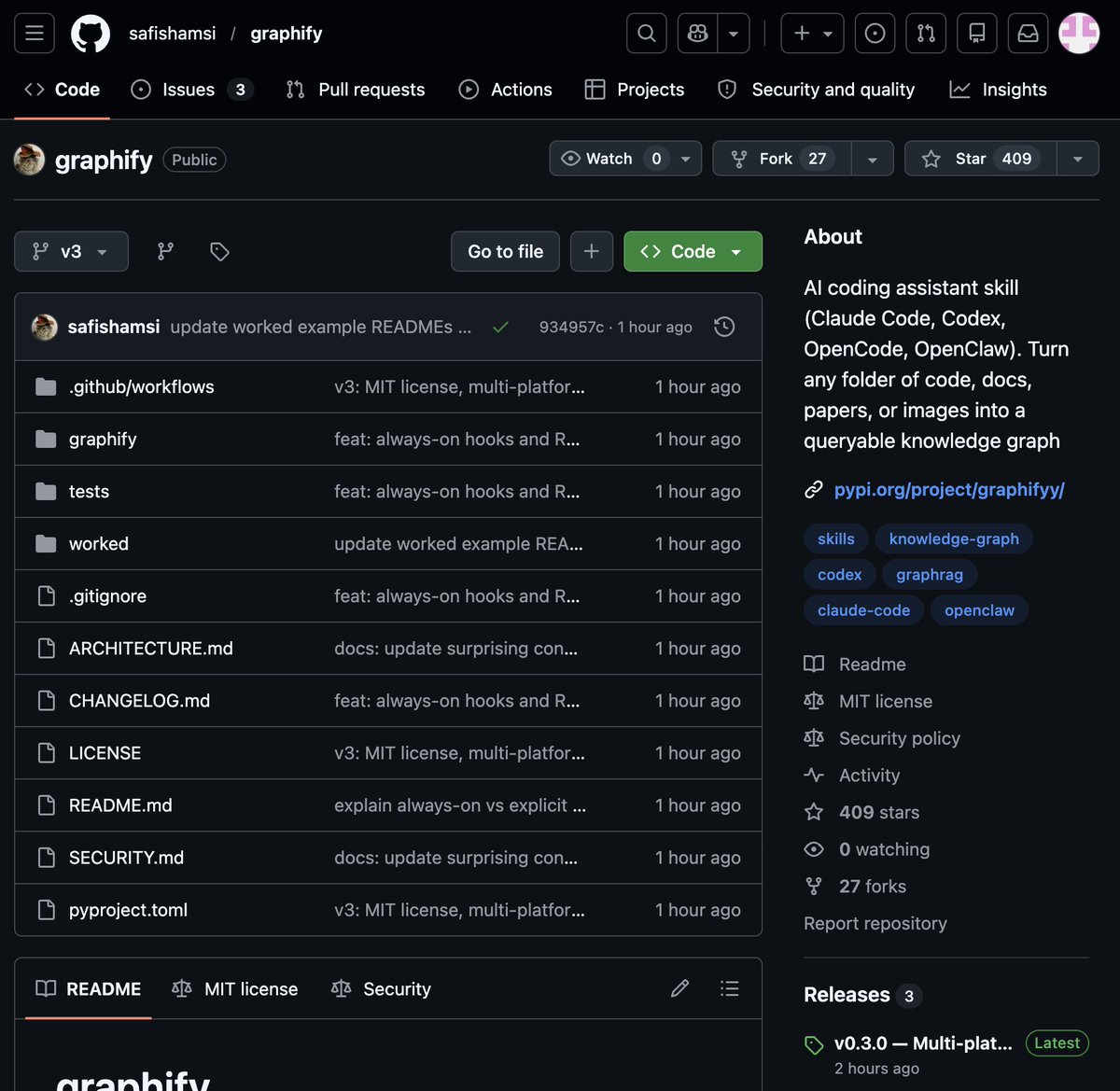
🚨 BREAKING: Someone just built the exact tool Andrej Karpathy said someone should build.
48 hours after Karpathy posted his LLM Knowledge Bases workflow, this showed up on GitHub.
It's called Graphify. One command. Any folder. Full knowledge graph.
Point it at any folder. Run /graphify inside Claude Code. Walk away.
Here is what comes out the other side:
-> A navigable knowledge graph of everything in that folder
-> An Obsidian vault with backlinked articles
-> A wiki that starts at index. md and maps every concept cluster
-> Plain English Q&A over your entire codebase or research folder
You can ask it things like:
"What calls this function?"
"What connects these two concepts?"
"What are the most important nodes in this project?"
No vector database. No setup. No config files.
The token efficiency number is what got me:
71.5x fewer tokens per query compared to reading raw files.
That is not a small improvement. That is a completely different paradigm for how AI agents reason over large codebases.
What it supports:
-> Code in 13 programming languages
-> PDFs
-> Images via Claude Vision
-> Markdown files
Install in one line:
pip install graphify && graphify install
Then type /graphify in Claude Code and point it at anything.
Karpathy asked. Someone delivered in 48 hours.
That is the pace of 2026.
Open Source. Free.
Instead of watching an hour of Netflix, watch this 2-hour Stanford lecture on AI careers. It will teach you more about winning in the AI race than all the AI content you’ve scrolled past this year.
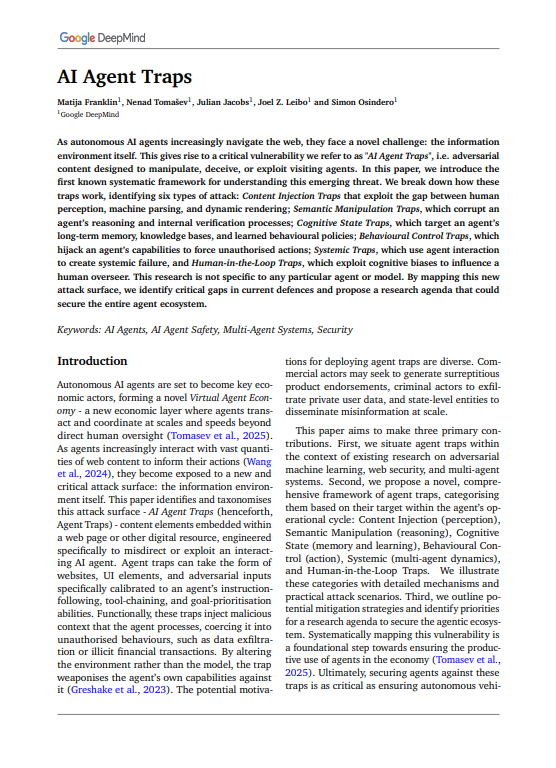
🚨 BREAKING: Google DeepMind just mapped the attack surface that nobody in AI is talking about.
Websites can already detect when an AI agent visits and serve it completely different content than humans see.
> Hidden instructions in HTML.
> Malicious commands in image pixels.
> Jailbreaks embedded in PDFs.
Your AI agent is being manipulated right now and you can't see it happening.
The study is the largest empirical measurement of AI manipulation ever conducted. 502 real participants across 8 countries.
23 different attack types. Frontier models including GPT-4o, Claude, and Gemini.
The core finding is not that manipulation is theoretically possible it is that manipulation is already happening at scale and the defenses that exist today fail in ways that are both predictable and invisible to the humans who deployed the agents.
Google DeepMind built a taxonomy of every known attack vector, tested them systematically, and measured exactly how often they work.
The results should alarm everyone building agentic systems.
The attack surface is larger than anyone has publicly acknowledged. Prompt injection where malicious instructions hidden in web content hijack an agent's behavior works through at least a dozen distinct channels.
Text hidden in HTML comments that humans never see but agents read and follow. Instructions embedded in image metadata.
Commands encoded in the pixels of images using steganography, invisible to human eyes but readable by vision-capable models.
Malicious content in PDFs that appears as normal document text to the agent but contains override instructions.
QR codes that redirect agents to attacker-controlled content.
Indirect injection through search results, calendar invites, email bodies, and API responses any data source the agent consumes becomes a potential attack vector.
The detection asymmetry is the finding that closes the escape hatch. Websites can already fingerprint AI agents with high reliability using timing analysis, behavioral patterns, and user-agent strings.
This means the attack can be conditional: serve normal content to humans, serve manipulated content to agents.
A user who asks their AI agent to book a flight, research a product, or summarize a document has no way to verify that the content the agent received matches what a human would see.
The agent cannot tell the user it was served different content.
It does not know. It processes whatever it receives and acts accordingly.
The attack categories and what they enable:
→ Direct prompt injection: malicious instructions in any text the agent reads overrides goals, exfiltrates data, triggers unintended actions
→ Indirect injection via web content: hidden HTML, CSS visibility tricks, white text on white backgrounds invisible to humans, consumed by agents
→ Multimodal injection: commands in image pixels via steganography, instructions in image alt-text and metadata
→ Document injection: PDF content, spreadsheet cells, presentation speaker notes every file format is a potential vector
→ Environment manipulation: fake UI elements rendered only for agent vision models, misleading CAPTCHA-style challenges
→ Jailbreak embedding: safety bypass instructions hidden inside otherwise legitimate-looking content
→ Memory poisoning: injecting false information into agent memory systems that persists across sessions
→ Goal hijacking: gradual instruction drift across multiple interactions that redirects agent objectives without triggering safety filters
→ Exfiltration attacks: agents tricked into sending user data to attacker-controlled endpoints via legitimate-looking API calls
→ Cross-agent injection: compromised agents injecting malicious instructions into other agents in multi-agent pipelines
The defense landscape is the most sobering part of the report.
Input sanitization cleaning content before the agent processes it fails because the attack surface is too large and too varied.
You cannot sanitize image pixels. You cannot reliably detect steganographic content at inference time.
Prompt-level defenses that tell agents to ignore suspicious instructions fail because the injected content is designed to look legitimate.
Sandboxing reduces the blast radius but does not prevent the injection itself. Human oversight the most commonly cited mitigation fails at the scale and speed at which agentic systems operate.
A user who deploys an agent to browse 50 websites and summarize findings cannot review every page the agent visited for hidden instructions.
The multi-agent cascade risk is where this becomes a systemic problem.
In a pipeline where Agent A retrieves web content, Agent B processes it, and Agent C executes actions, a successful injection into Agent A's data feed propagates through the entire system.
Agent B has no reason to distrust content that came from Agent A. Agent C has no reason to distrust instructions that came from Agent B.
The injected command travels through the pipeline with the same trust level as legitimate instructions. Google DeepMind documents this explicitly: the attack does not need to compromise the model.
It needs to compromise the data the model consumes. Every agentic system that reads external content is one carefully crafted webpage away from executing attacker instructions.
The agents are already deployed. The attack infrastructure is already being built. The defenses are not ready.