Where does a tiny defect in the bulk send the light? We modeled it as a transverse electric dipole. Without the quasi-moving response, half its power goes into each hemisphere. With it, the forward share rises to 55% in one case and nearly 90% in the stronger one.
🚀 New in PRL! Can you turn a focusing lens into a diverging one just by illuminating it from the other side? Dmitry Vagin and Maxim Gorlach predict that a lens-shaped cavity in a magnetic material can do exactly that. Same cavity, same polarization.
👇
https://t.co/GxoWvv2vfB
Why does the focus flip? In the “quasi-moving” model, waves traveling in opposite directions along the magnetic axis see the same refractive index. Tilt them, and their indices split. Reversing the beam changes the phase the outer rays accumulate relative to the central ray.
Shine light on the sample and the conventional and dual axion responses can give the same reflection. So we put an electric current inside our simulated spin lattice. The polarization of the wave it emits reveals the dual response.
More on #arXiv 👇
https://t.co/fGbNoixYj6�
🚀 New paper in PRB! Can a dual axion response arise in a crystal? Elina Kokurina, Dmitry Vagin, Eduardo Barredo-Alamilla and Maxim Gorlach trace it to spin dynamics in a model antiferromagnet. Two candidates to test are Cr₂O₃ and MnBi₂Te₄.
Read👇
https://t.co/c1gBZJSpcH�
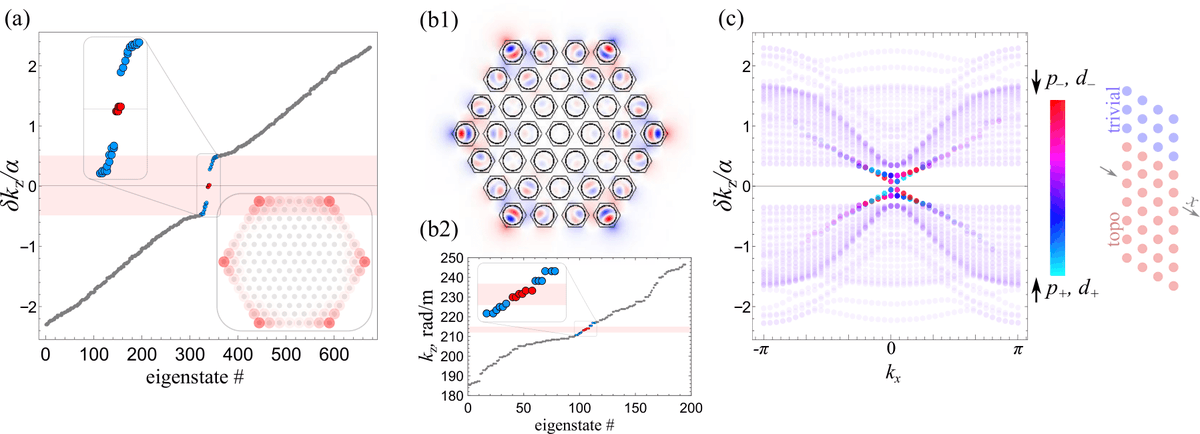
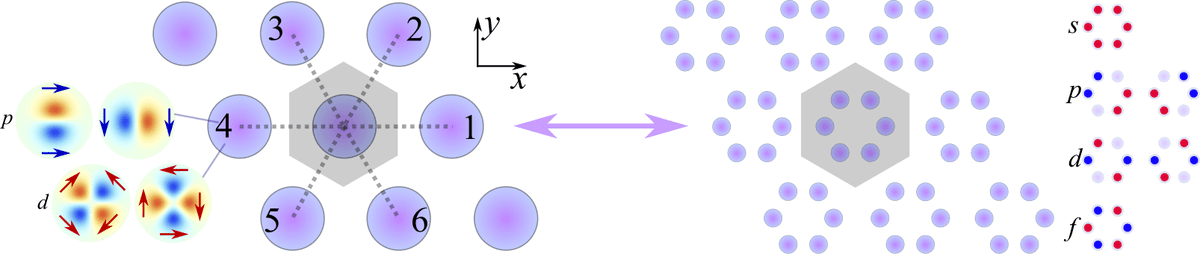
We capture the same topological properties as a complex breathing honeycomb lattice using a simpler triangular lattice of two-mode! 🍯🐝
This breakthrough means a more efficient, and scalable way to obtain topological insulators! 🌟
Read more on #arXiv https://t.co/EtFGZvm7yH
🚀New paper at @ITMO_AxTop. Our recent paper on Crystalline Topological Insulators is now on PRB! Max Mazanov and Kostya Rodionenko show how to get photonic topological states by leveraging accidental mode degeneracies!
Full story here👇
https://t.co/JCdsfFkWAO
Excited to share our latest work published in PRB (my first in PhD) on on higher-ordered derivatives extensions of axion electrodynamics in metamaterials.
https://t.co/iQk0BB8sDT
Now, metamaterials can probe axion physics and its generalizations with quite exotic phenomena!
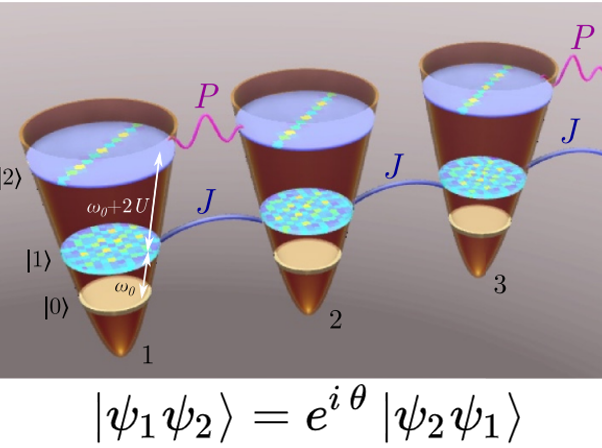
Our colleagues Andrey Stepanenko, Mark Lyubarov, and Maxim Gorlach published an article in @PhysRevLett discussing how #topological two-photon states can help to resist fluctuations in 2D arrays of #superconducting#qubits.
https://t.co/1Jl6rLoUYD
🏆Congratulations to our group leader Maxim Gorlach on winning the ITMO Open Education award! Maxim has been teaching courses in electrodynamics of continuous media (https://t.co/HI39viWNdI) and metamaterials (https://t.co/1QAaWwSchj) for the last few years.
Our colleagues Nikita Olehno, Alina Rozenblit, Andrey Stepanenko, Alexey Dmitriev, Daniil Bobylev and Maxim Gorlach published an article in Phys.Rev.B about the novel topological phases of #anyons — quasiparticles that generalize fermions and bosons. https://t.co/WK4PrVDJnm
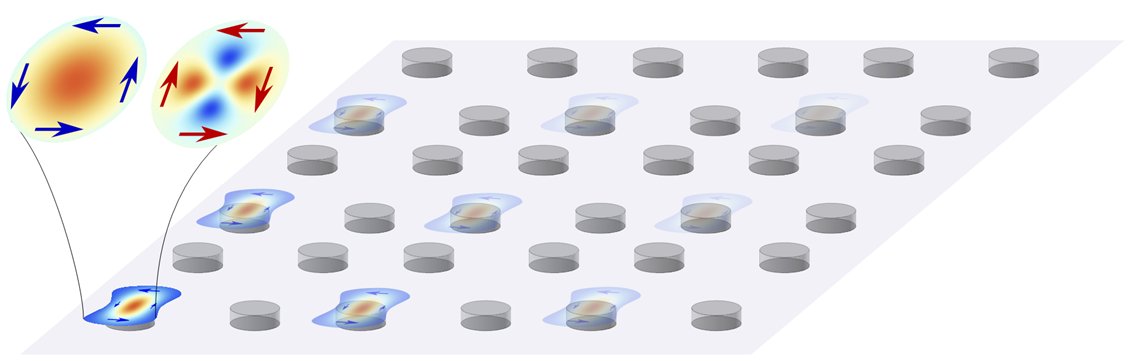
Our colleagues Maxim Mazanov and Maxim Gorlach published an article in Phys.Rev.B about the model of a photonic topological insulator made from two-mode waveguides which serves as an analogue of the QSHE and allows transfer of pure angular momentum. https://t.co/sLhC8sEc6I
Our head prof. Gorlach held a brilliant seminar “#Metamaterials and #dark_matter” from a series of meetups with ITMO Vice-Rector for Research Vladimir Nikiforov.
https://t.co/3CIb8yoXB0
New frontier laboratories are opening at ITMO University, including our Laboratory of Probing Fundamental Physics with Topological Metamaterials, headed by Maxim Gorlach. https://t.co/vM4iPA3ujN
@spbifmo_en@physics_itmo