Our Agent Orchestration team has cooked hard!
98% faster time to first token 🚄🚄
Significantly faster analysis
Best AI for financial research and portfolio management, now also the fastest.
Compute Crunch just changed the AI mix. Its +56.3% strategy now holds Google 20%, Cisco 16%, Micron 12%, Datadog 12% and AMD 8% after an Aug 20 rebalance. If it lags $QQQ over five sessions, breadth did not widen.
Small-cap India got harder to read.
Itoflow's Small Cap Discovery is up 33.3% since Mar 31. The Aug 15 rebalance left 47.2% cash, trailing its benchmark by 0.8%.
Next 5 sessions mark the posture: ahead or behind Nifty.
In its RLM experiments Prime Agent has:
- found lower performance on math-python
- worse DeepDive results without task-specific guidance
- higher latency in every tested environment
The Continual Harness paper evaluates Pokémon environments, not much of which translates to governed financial workflows.
So our push on Quantitative Harness continues. The game we're solving for is the toughest of them all.
Itoflow's awkward TECH winner got more awkward.
Since the July 7 post, the strategy cooled from +46.8% to +27.4% and cash is 55.4%.
If $MU and memory bounce next week while TECH stays half-cash, control turns into drag.
AI power just broke its clean setup.
20 sessions: Vertiv -26.9%, GE Vernova -13.4%, chip stocks -13.1%, utilities flat.
If grid gear cannot retake utilities next week, scarcity is not leadership.
Situational Awareness, the $20bn hedge fund founded by former OpenAI employee Leopold Aschenbrenner, has sought to raise fresh capital from investors after suffering heavy losses during the recent rout in AI stocks https://t.co/V4m0HnUoEG
This is bullish! And what we’ve been spending a lot of time on. We ship a custom quantitative harness and a lot of our effort is spent on ensuring the harness leverages the capabilities of the underlying models and providers to the fullest. Server side compaction being one of them.
GPT-5.6 Sol has been used to solve open problems in mathematics. So why was it struggling with ARC-AGI-3, a benchmark of 2D puzzle games?
We investigated. The harness was not letting it remember what it had learned.
We found that enabling two API settings tripled our scores with 6x fewer output tokens.
European energy is leading value now.
20 sessions in USD: energy +17.7%, value +4.9%, banks +3.4%, industrials -1.6%.
Next 5 Europe sessions: energy keeps the lead. If banks and industrials close the gap, Europe broadened.
Introducing symbol baseline cards.
While the agent works on an analysis, it will put up an agent card for you to get all the essential facts about a symbol. This will then ensure that the agent spends its time on going deeper into the harder questions rather than restating the known facts about a symbol.
SIQ's TECH strategy is the awkward kind of winner: +46.8% since Mar 25, but still carrying a -11.23% live drawdown and 20.5% cash.
If $MU and storage repair while TECH stays cautious, cash was drag. If not, risk limits worked.
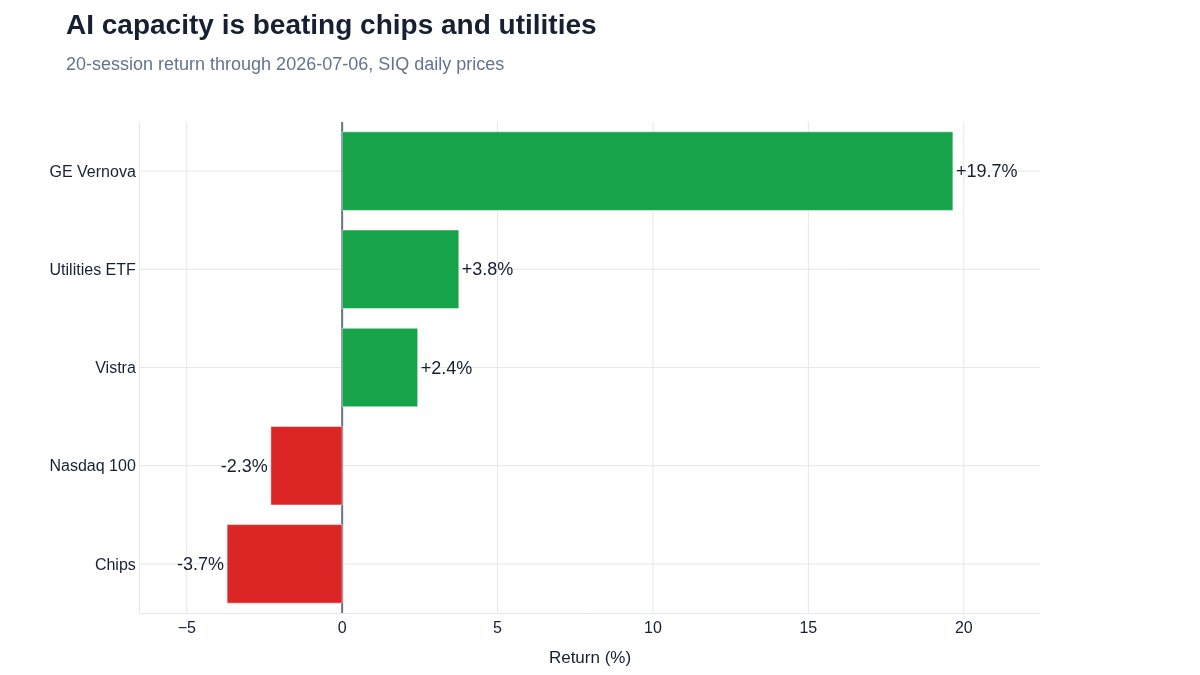
AI's cleanest rotation is not more chips. It is grid gear.
20 sessions: GE Vernova +19.7%, utilities +3.8%, chip stocks -3.7%.
If $GEV keeps leading while utilities lag, AI capacity is the trade - not just power demand.
AI exposure needs ballast that is not cash.
SIQ's Trading 212 strategy is +20.5%, with Marvell risk but Caterpillar, Google and Palo Alto in the sleeve.
If that mix keeps beating chip stocks ($SMH), leadership is changing shape.
AI's repair has a quiet split: spenders are bouncing, suppliers are not.
5 sessions: AI spenders +7.5%, SIQ's Compute Crunch sleeve -3.5%, chip stocks -7.0%.
If spenders keep leading suppliers, the trade is changing jobs.
Chips cracked, but SIQ's board is not one AI bet now.
Compute Crunch holds AI plumbing. TECH holds memory with 21% cash. Small Cap Discovery is the non-AI control group.
Which survives the Monday repair attempt?
The next SIQ receipt should not be the biggest return. It should be which behavior aged best: rebalanced AI plumbing, cash-buffered memory, or staying outside the crowd.
The market version is simple: if chips bounce and equal-weight fades, AI de-crowding was just a scare. If non-AI breadth keeps holding, the leadership map changed.