Not just a single galaxy, but an entire cosmic city is blazing in this week’s #HubbleFriday image. 😵💫
Those graceful streaks of light? They’re not just pretty arcs. They’re distorted portraits of galaxies that sit far, far behind the cluster. The cluster’s gravity is so immense that it bends spacetime itself, warping the path of light traveling toward us. This is gravitational lensing in action, nature’s own cosmic magnifying glass, revealing galaxies so distant and faint they’d otherwise be invisible.
Image credits: ESA/Hubble & NASA, H. Ebeling; Acknowledgment: L. Shatz
☀️TSUNAMI en el SOL
La mancha solar 4549 volvió a entrar en erupción el 8 de octubre, produciendo una llamarada solar de clase M 6,7, la anterior fue de M 1.4.
La explosión también impulsó ondas como un tsunami a través de la atmósfera del Sol. Fue un evento casi global.
[Imágenes del satélite GOES-19 de la NOAA (Administración Nacional Oceánica y Atmosférica) de los Estados Unidos]
4/4 El silencio de detectores como LZ no descarta la materia oscura; obliga a afinar la puntería. Los físicos ahora combinan estos tanques subterráneos con colisionadores como el LHC para rastrear señales mucho más sutiles.
El 85% de la materia del universo es invisible. A casi 1.5 km bajo tierra, en una antigua mina de oro en Dakota del Sur, el experimento LUX-ZEPLIN (LZ) utiliza un tanque gigante de xenón líquido para intentar cazarla 1/4 🧵
3/4 El higgsino surge de la supersimetría como la contraparte hipotética del bosón de Higgs. Encaja con la materia oscura, pero es casi indetectable: apenas interactúa con la materia ordinaria y deja señales extremadamente débiles.
“Beyond all the other risks, this was what really made the project possible – and that was pure luck.”
We got hold of the new physics laureate Francis Halzen right after he learned of his Nobel Prize. In this conversation, he speaks about the hurdles that he and his team had to overcome in the process of creating the neutrino detector on the South Pole – and how one of the crucial discoveries was ’totally unexpected.’
Halzen also talks about how his work on neutrino detection could lead to clues about the universe’s black holes.
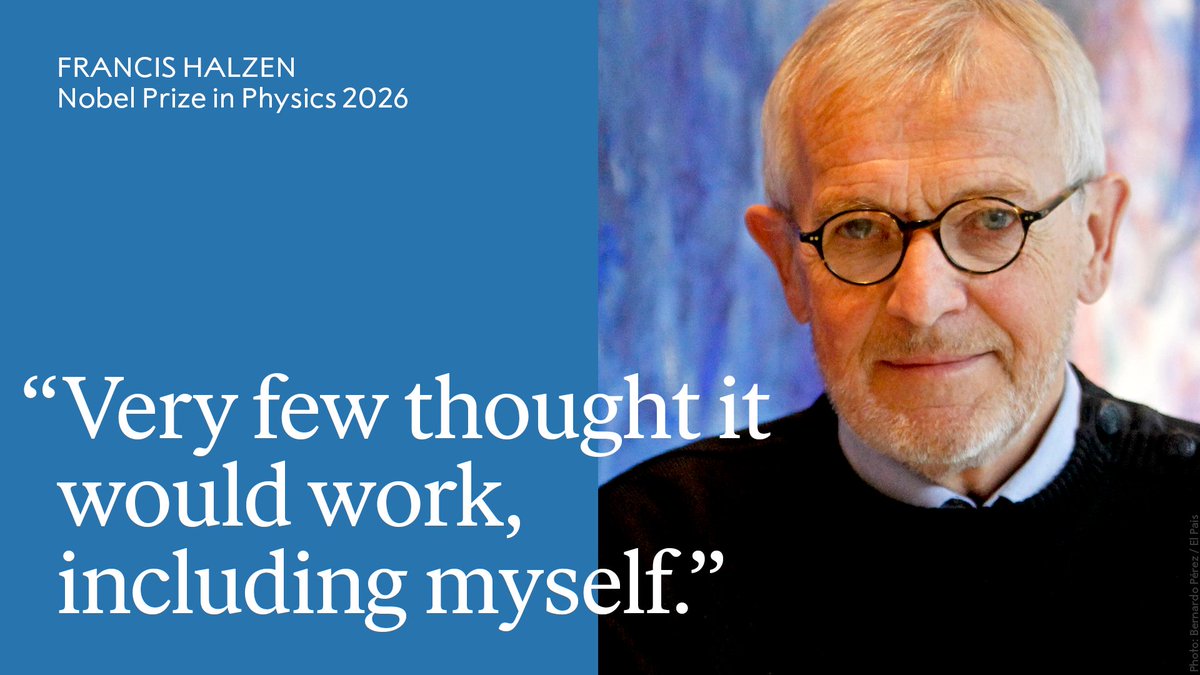
“I have to emphasise how lucky I was because when we staffed this project everybody realised this was maybe a good idea, but very few thought it would work, including myself. So this was kind of an adventure where success was not guaranteed."
Francis Halzen – newly awarded physics laureate – explained that the success of the IceCube Neutrino Observatory was due partially to luck and to the talent of all his collaborators.
Back in the 1980s, Halzen realised that the Antarctic ice could be ideal for ensnaring enough of these secretive neutrinos that researchers could learn more about their distant origins. He quickly convinced many others of his idea’s potential and, in 1992, a group of tenacious researchers and engineers made the first attempts to lower light sensors into the glacier at the South Pole.
The breakthrough came around twenty years later: the IceCube neutrino telescope registered neutrinos with properties that convinced researchers they originated in distant regions of space. The hunt for the universe’s neutrino sources had begun in earnest.
Ayer estuve en la inauguración de Misión Galáctica en el Centro Tolzú, Toluca. En la sala del INAOE están las maquetas de HAWC y del GTM. Una sorpresa ver que aparezco en la infografía de mexicanos trabajando para el espacio junto a colegas del INAOE.
#INAOE#HAWC
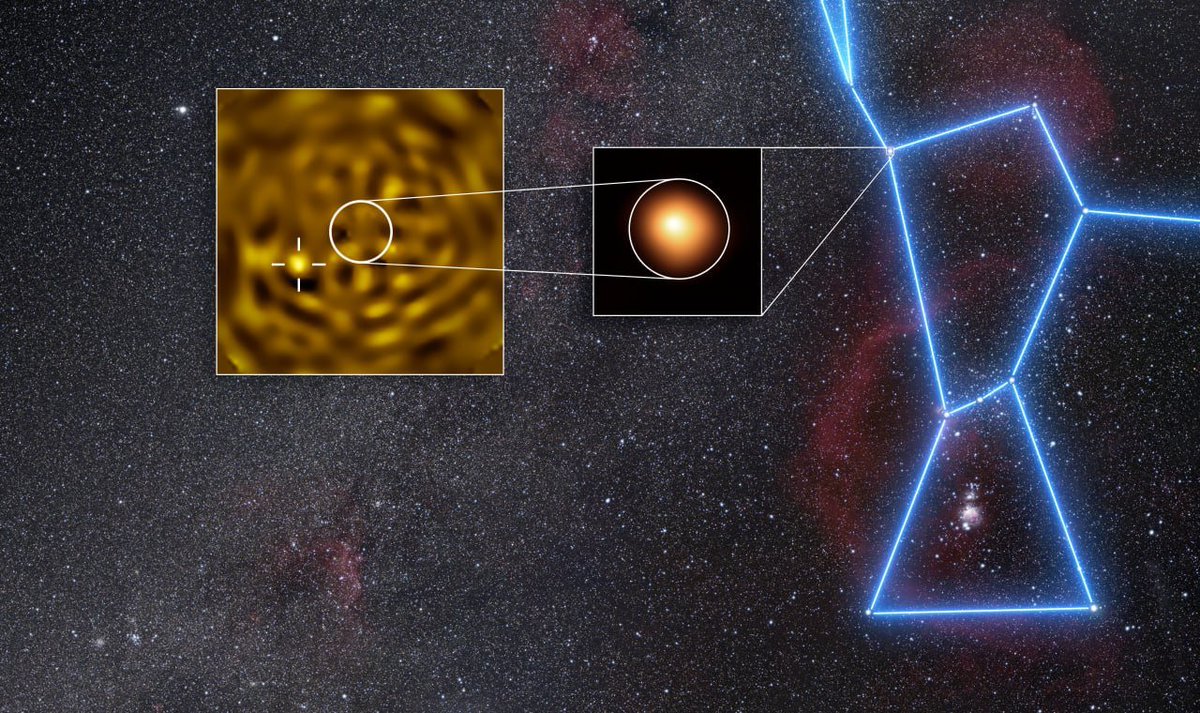
Astronomers Obtain Strongest Evidence Yet of a Companion Star to Betelgeuse ⭐️
Astronomers have obtained compelling evidence of a companion star to Betelgeuse—one of the most famous and brightest red supergiants in the night sky. The discovery, presented in the journal *Astronomy & Astrophysics*, marks the culmination of a search spanning nearly a century.
An international team of researchers used the European Southern Observatory’s (ESO) Very Large Telescope (VLT) to directly detect the suspected companion star, designated Betelgeuse B. Observations were conducted in December 2024, at a time when calculations indicated the companion would be at its maximum separation from Betelgeuse, making it easiest to spot.
Imaging was performed using SPHERE, a high-contrast instrument originally designed to search for exoplanets. It yielded the sharpest image of the companion to date. Although astronomers had previously reported a possible direct detection of the companion using the Gemini North telescope, these new observations have significantly strengthened the evidence that Betelgeuse is part of a binary star system.
The data also revealed that the companion is considerably more massive than previously thought. While its mass was once estimated to be close to that of the Sun, scientists now place it at 2–3 solar masses. The study's authors note that it is particularly surprising that such a bright and relatively massive object has only now been detected, despite centuries of observations of Betelgeuse.
This discovery is significant for the study of red supergiant evolution. Betelgeuse is considered one of the nearest stars destined to end its life in a supernova explosion. Astronomers must now determine how the presence of a companion might influence this process.
To conclusively confirm the discovery, scientists plan to observe the system again in about a year, when the companion will be on the opposite side of Betelgeuse. However, researchers note that there is now virtually no doubt about the existence of the companion star.
🌙
Hoy conmemoramos a Giordano Bruno, el filósofo quemado en la hoguera por la Inquisición en 1600. Su crimen: afirmar que el universo es infinito y no tiene centro. Murió por defender que la verdad y la razón no pueden ser encadenadas por el dogma. Una mente libre para la eternidad
Noticias cuánticas! El Premio Nobel de Física 2025 fue otorgado a John Clarke, Michel Devoret y John Martinis “por el descubrimiento del tunelamiento cuántico macroscópico y la cuantización de energía en un circuito eléctrico”.
Lo sorprendente: ¡la física cuántica a simple vista!
Hoy, 7 de septiembre de 2025, ocurrirá un eclipse lunar total, "Luna de Sangre", visible en gran parte del mundo, incl. México. Comienza esta noche, con totalidad ~20:00-21:00 CST. La Luna tomará un tono rojizo por la luz solar filtrada.
#LunarEclipse
🌠 ¡Llegan las Perseidas!
Del 17 de julio al 24 de agosto podremos disfrutar de una de las lluvias de meteoros más esperadas del año. 🌌
Máximo: 12 de agosto (150 meteoros/h)
Radiante: constelación de Perseo
#Astronomía
@WalmartMexico hice un pedido el 23 de mayo de llantas rin 18 y me mandaron rin 17. He llamado varias veces, me dieron un número de reporte, mandé las fotos que pidieron, pero sigo sin solución. Ya casi debo pagar la TC por algo que no me sirve. @Profeco ¿me pueden ayudar?
@WalmartMexico hice un pedido el 23 de mayo de llantas rin 18 y me mandaron rin 17. He llamado varias veces, me dieron un número de reporte, mandé las fotos que pidieron, pero sigo sin solución. Ya casi debo pagar la TC por algo que no me sirve. @Profeco ¿me pueden ayudar?
HAWC celebra su décimo aniversario! Durante esta década, HAWC ha detectado más de 6.3 billones de rayos cósmicos y ha identificado alrededor de cien fuentes celestes de rayos gamma de muy alta energía. Para más detalles: https://t.co/Tw94lOubOF
Regresar a la Luna es fundamental para los siguientes pasos de nuestra joven especie.
Ojalá podamos madurar rápidamente en el proceso. Parafraseando a Sagan, en esa bella pelotita azul, una mota de polvo en el Cosmos, reside la escala de todas nuestras tribulaciones de hoy.
detection could help unlock the secrets of powerful cosmic accelerators and the origins of ultra-high-energy cosmic rays.
Big news for neutrino astronomy! 🚀🔬 Read more in Nature: https://t.co/X4tVT1tN99
#Neutrinos#Astrophysics#KM3NeT#Science#CosmicMysteries
neutrino could be a signal from some of the most extreme astrophysical events in the universe—perhaps even the first cosmogenic neutrino ever detected! 🌌✨
Neutrinos are nearly invisible cosmic messengers, traveling across the universe without being deflected or absorbed. This
A groundbreaking discovery from the depths of the Mediterranean!
Scientists at the KM3NeT neutrino telescope have detected an ultra-high-energy cosmic neutrino, possibly the most energetic ever observed! With an estimated energy of up to 120 petaelectronvolts (PeV), this