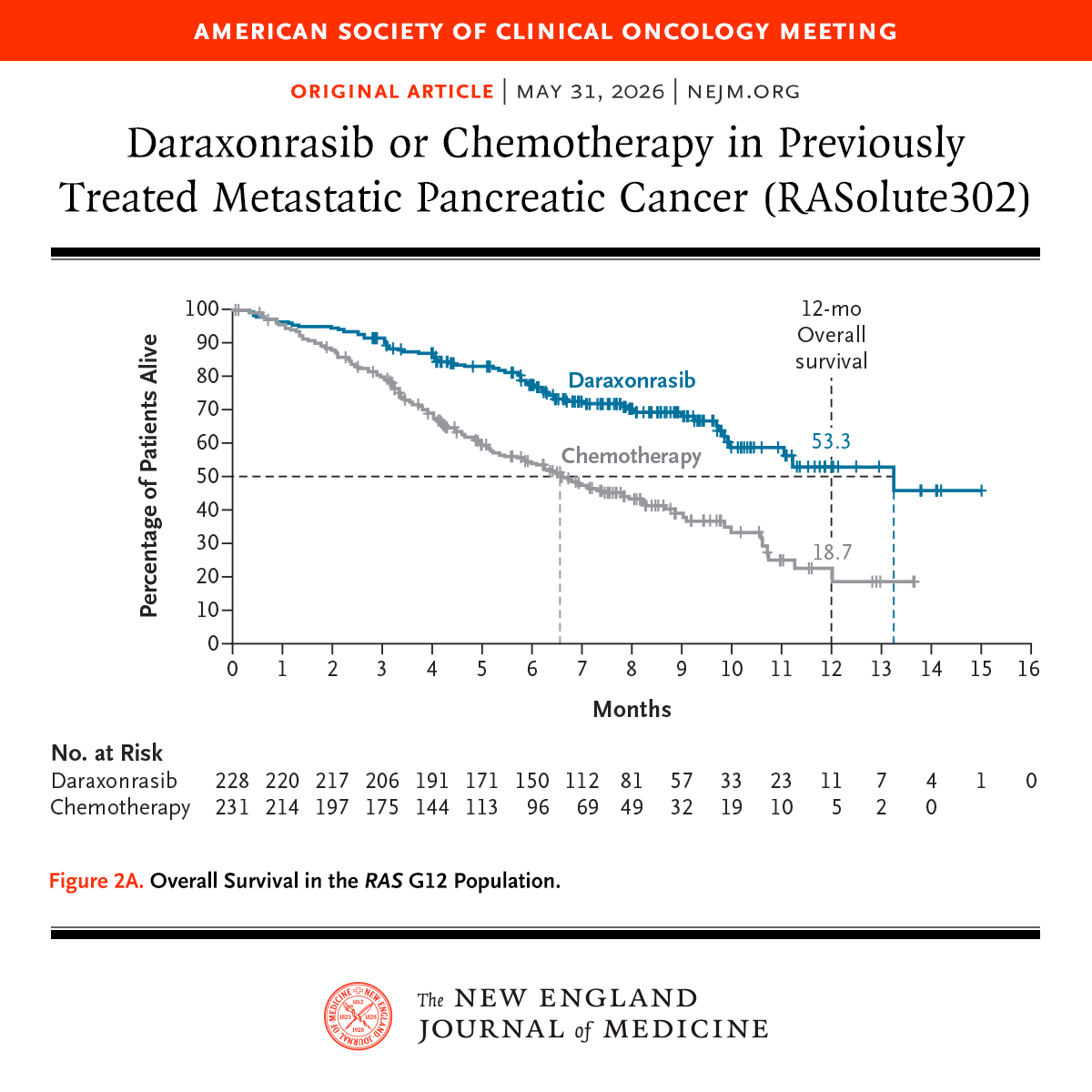
Presented at #ASCO26:
Among patients with previously treated metastatic pancreatic ductal adenocarcinoma, the RAS(ON) inhibitor daraxonrasib led to significantly longer overall survival and progression-free survival than chemotherapy. Full phase 3 RASolute 302 trial results: https://t.co/xwLWBZYRzq
@ASCO
Nice article in @nytimes by @SmithDanaG on the recent findings that circulating NAD levels do not decline with age in humans.
https://t.co/VForvv3j4l
These new data are important because the original model was always supported more by marketing narratives and extrapolation than by strong human evidence. For years, the claim that “NAD declines with age” has often been presented as established fact when, in reality, the data were limited and inconsistent.
To be clear, NAD biology absolutely matters. Understanding how NAD metabolism changes across specific tissues, disease states, and metabolic conditions remains an important scientific question. But absent convincing evidence that NAD broadly declines across tissues and organs during normal human aging, we should be willing to conclude that the broader hypothesis has failed. That’s how science is supposed to work. The burden of proof rests on those making the claims.
The case for widespread NAD precursor supplementation as a gerotherapeutic is further weakened by the fact that preclinical studies reporting benefits for lifespan and healthspan have often lacked robust reproducibility across laboratories and model systems. And in humans, there is still remarkably little evidence supporting broad NAD precursor supplementation for otherwise healthy people.
At the same time, I do think there are likely subsets of individuals with significant mitochondrial or metabolic dysfunction where NAD dyshomeostasis is real and therapeutically relevant. Those individuals may ultimately benefit from targeted interventions aimed at NAD metabolism. But the evidence increasingly suggests this is probably a small subset of people — not the average healthy aging adult.
Science advances by testing hypotheses against data, not by repeating narratives until they become accepted dogma.
Geneticist J. Craig Venter, best known for his role in sequencing the human genome, has died aged 79.
He spoke to Nature in 2023 about AI, sequencing the ocean – and why he had no plans to stop working.
https://t.co/FYq5jbMpxa
Dear Friends,
I want to share that I am no longer at Optispan, the company I co-founded in 2023 and have led since.
I’m proud of what we built together and grateful to the team for their work and commitment. I wish them continued success.
While I’m still considering what comes next, I remain 100% committed to the vision of helping as many people (and companion animals!) as possible achieve longer, healthier lives.
Robot BEATS top-tier table tennis players at their own game
Sony AI’s ‘Ace’ won 3 of 5 games against elite players in real-world play
Its 20-millisecond reactions and ‘impossible’ rapid backspin even stunned a former Olympian