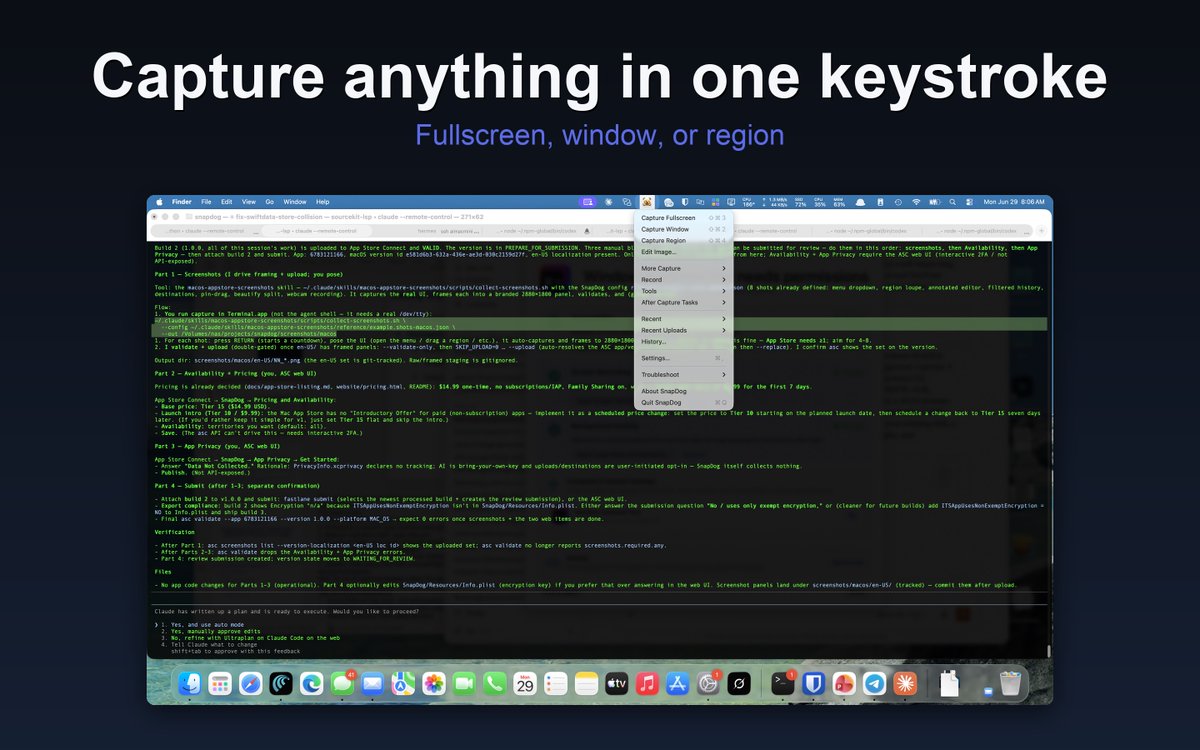
I built SnapDog, a native Mac app for screenshots, screen recording, and annotation, all from the menu bar.
📸 Region, window, or full screen, plus scrolling captures
🎥 MP4/GIF recording with webcam, click ripples, and system + mic audio
✏️ Arrows, blur, callouts, OCR
$14.99 one-time. No subscription, no account, no tracking.
https://t.co/thd2FDqfn9
The Bosgame M5s land soon: 128 GB of unified memory each. What should I benchmark first? Reply with any model you want in the lineup.
Biggest MoE that fits
Dense 70B+ model
Two-box RPC split
Watts per token
One of my 10 tasks broke every local model I ran: csv-ledger.
Scores /100: Ornith 35B 0, Qwen3.8 27B 0, Ornith 9B (mini) 0, Qwen 2B, 4B and Nemotron 12, best 25.
Rules: count each invoice_id once, void counts for nothing, 60-day unpaid math. Claude and Codex haven't run it.
Two Bosgame M5s (Ryzen AI Max+ 395, 128 GB unified memory) are on the way.
Day one, per box: llama.cpp on Vulkan, speed at 0/8K/32K depth, 1-8 streams, real watts, then a two-box split.
Community targets: ~95 tok/s on Qwen3-Coder-30B-A3B, ~40 on the 80B. Nothing measured yet.
I found a bug in my own benchmark setup. I tuned Ornith 35B in oMLX, but the settings entry was keyed Ornith-1.5-35B-A3B-oQ4e-mtp while oMLX serves mlx-works--Ornith-1.5-35B-A3B-oQ4e-mtp.
The log said turboquant_kv_bits=None. My 0.7.0 baseline wasn't what I thought.
Same 3 tasks, same auto-scoring:
Claude Opus 5.5: 100
Codex: 100
Ornith 35B, local on a MacBook Pro: 100
Ornith 9B, 16 GB Mac mini: 97
Qwen3.5 4B: 79
Only these 3 of my 10 everyday tasks have run on all five so far. One task, csv-ledger, broke every local model.
The fastest local model on my M4 Max was not the best one.
Nemotron Lightning 30B: 162 tok/s, scored 75.2.
Ornith 35B: 90.5 tok/s, scored 87.8.
Some runs were flagged noisy, and the 27B and Nemotron lost log-hunt to an 8K context cap. Speed or quality: which do you pick?
I upgraded oMLX to 0.8.0 expecting faster. On my MacBook Pro M4 Max it got slower, single stream:
Ornith 35B: 99.2 → 90.5 tok/s
Qwen3.5 4B: 112.5 → 93.6
Ornith 9B: 80.7 → 78.4
Quality held. Caveat: the old 35B run had KV quant off and a busy Mac. Like-for-like rerun next.
@korlando2251@loom Sorry Loom keeps crashing on you. I make SnapDog, a lightweight recorder for Mac and Linux: MP4 or GIF with a webcam bubble, $14.99 one-time purchase, no sub. https://t.co/iw9jiMp3FA. Which OS are you on?
@WarBornePhoenix Depends what you're recording. For quick demos or tutorials: I make SnapDog, a Mac menu-bar app. It records MP4 or GIF with a webcam bubble and click ripples, plus screenshots with annotation. $14.99 once, no sub. https://t.co/iw9jiMpBv8
@thecalbees Biased since I built it, but SnapDog: menu-bar screenshots with a real annotation editor (arrows, blur, step counters), OCR, and screen recording with a webcam bubble. $14.99 once, no account. https://t.co/9bZxxsNha1
Quiet Links, my browser golf game, got a real golfer yesterday. Shrinking the art from 70 MB to 9.6 MB made him invisible: the script scrambled the model's bytes. Fixed, with a test.
On a phone it ran at 1 fps. Phones now get a coarser course: 76 fps under 4x CPU throttle.
@ryangrowthh@kevinrose@vercel Mac user? I built SnapDog: $14.99 one-time. Screen + webcam bubble, mic + system audio, pause/resume, on-device transcription. Uploads to your own Dropbox, Drive, OneDrive or S3 and copies a share link. No hosted Loom-style viewer page, though. https://t.co/TVIAB6g3Uc
The American Contract
Americans can agree on one demand before they agree on a party.
Show us where the money goes. Show us what it buys. Show us who benefits.
Make that demand law. Every officeholder, federal and state, must submit the government to a comprehensive, independent audit. Start with the largest budgets: defense and healthcare. Work through the rest. Establish a baseline. Then publish a searchable discovery report every quarter.
Use the best AI available to follow contracts, payments and outcomes across agencies. Let the machines find patterns. Let human investigators test the evidence and make the judgments. Put the results where every citizen can see them.
Before the auditors count a dollar, define the job that dollar is supposed to do.
Is the defense budget meant to build weapons systems, or to make Americans secure? Is the healthcare budget meant to fund insurance companies, or to make Americans healthy? Those are different objectives. Write the objective down. Measure the result against it.
Then ask the hard questions. Where is the waste? Where is the fraud? Who took public money and failed to deliver? Who wrote the rules that kept a costly legacy system in place when a better way was already working?
Nothing struck me more while writing Greedy Bastards than the number of remarkably better ways people had already found to meet the basic objective. Learning. Health. Security. Finance. I went looking for solutions and found them. There is no shortage of best practices. There is a wall of resistance to adopting them.
Fraud is not an efficiency problem. When the evidence shows that someone stole from the public, refer the case for prosecution and recover the money. Publish what happened and what was done about it. Give the accused due process. Give the public an answer.
Imagine an audit finding a medical practice that keeps patients healthier for less, while federal payments keep rewarding a more expensive arrangement. The public sees both results. The people defending the old payments explain themselves in daylight. The officials who approved them do too.
That changes Washington’s argument. No party gets to demand another billion dollars for a system without showing what the last billion accomplished. No party gets to claim a tax cut will pay for itself and walk away from the bill. The ledger stays open.
Savings lower the burden on people who work. A rewritten tax code asks great fortunes to invest in productive capacity and measurable gains. Wealth that grows without making life better carries more of the tax burden. The government shows what it did with every dollar.
That is how trust returns: an objective, a payment, a result and a name attached to the decision. Americans can see what works. They can end what does not. They can hold thieves accountable and stop paying to preserve failure.
The result is better health, stronger security, lower costs and more room for people to build. America earns its claim to be a beacon of freedom by making its own power visible and answerable.
And the American contract will travel. Governments around the world protect old arrangements and lose public money to waste, fraud and abuse. A successful American audit gives their citizens a working model to follow or improve.
The contract fits on one page: Audit the government. State the purpose of every budget. Publish the evidence. Punish proven theft. Fund what works. Then do it again next quarter.
Subscribe: https://t.co/iSIGObUUqQ