So-called age verification for social media is spreading across the world, framed as an effort to create a safer internet for children. In reality, age verification lays the foundation for a fully controlled internet.
The age verification rush must be slowed down, and politicians need to recognize the consequences of different types of legislation and systems.
Age verification is the wrong approach to fix “the social media problem”
The big tech social media companies are bad. Their business model is bad; it is based on mass surveillance and manipulation, and they cooperate with governments in mapping entire populations. But age verification is fundamentally the wrong approach to preventing children from using big tech social media platforms. Introducing age verification is based on coercion; the state forces social media companies to verify their users’ identities. But the big tech social media platforms already know which of their users are children. Their business model depends on knowing this. They know how old users are, and they know exactly what type of person they are. As age verification is based on coercion, politicians could instead force platforms to stop doing the things politicians consider harmful to children, or force them to block children (again, they know who they are) from using their services. But instead, politicians seek to massively invade everyone’s privacy and undermine democratic rights on a global scale. In other words, the latter is the real objective – they do not want to protect children; they want to impose control.
Slippery slope of age verification
It is undeniable that age verification threatens freedom of expression, risks increasing mass surveillance, and is likely to lead to censorship. It will not only shrink the online world and reduce young people’s right to privacy (for example, if VPN services were to be restricted); but also risks becoming a significant step toward a controlled internet for everyone.
Most age verification is identity verification
Most countries are now considering introducing age verification systems, meaning that everyone would have to identify themselves either to the service/website they want to use or to a third party capable of linking them to their activity on that service or website. This is not age verification but identity verification, and the consequence is therefore that freedom of information is restricted (you can no longer visit regulated websites anonymously) and that you can no longer post anonymously on social media. This is a major problem in countries like the UK and Germany where the police conduct raids on people’s homes for posting content on social media that the authorities dislike. Or in the United States, where authorities are trying to pressure tech companies into revealing the identities behind accounts protesting ICE. Social media identity verification removes important tools for activists in countries where criticizing those in power is dangerous.
Restrictions on app store or operating system level
Some countries are looking to impose identity verification at the app store level or even within the operating system itself. This is an exciting experiment, since this is possible to circumvent using open-source operating systems. Some countries are already looking to include open-source systems. Since open-source systems cannot be controlled, politicians would ultimately need to ban devices that are not controlled by the state. The end point: telescreens like those in Orwell’s 1984, devices that both monitor you and broadcast only the information approved by the state.
The Zero-Knowledge Proof (ZKP) alternative and the EU
The EU has presented its own age verification app as “completely anonymous”. The idea is to use Zero-Knowledge Proof (ZKP) cryptography to break the link between the age credential issuer (EU governments) and the regulated services/sites. Currently, the EU app does not have ZKP functionality, contrasting Ursula von der Leyen’s claim that the app ”is technically ready to be used”. But more importantly, the app is currently designed to always function without ZKP technology; if ZKP is unavailable, the app falls back to a non-ZKP model. Even if fully developed ZKP technology could be implemented in the future, it would remain an optional extra feature that countries may choose to disable and that the EU could remove at any time.
Read more on our site.
https://t.co/wTVKHMS1zg
We have not restricted subscription payments, and such transactions do not fall under the daily foreign spend budget. However, we have noticed that, for various reasons, some subscription payments have been declined by merchants.
If your subscription payment has declined, please contact us directly, and we will immediately provide the appropriate solution.
I usually have trouble thinking of what to get my loved ones as gifts. So made a small app where they can add their wish lists and I can choose what to give them. Items are claimed anonymously so the gifts remain a surprise till the big day
https://t.co/AMakuKYF0X
@kramusthafa Hi sir, you might not have gotten this info from the whatsapp group yet. Once data is shared with the platform gov can request data from the platform. 2024 marks a record amount of requests under the current presidency.
https://t.co/M5gAuInQSU
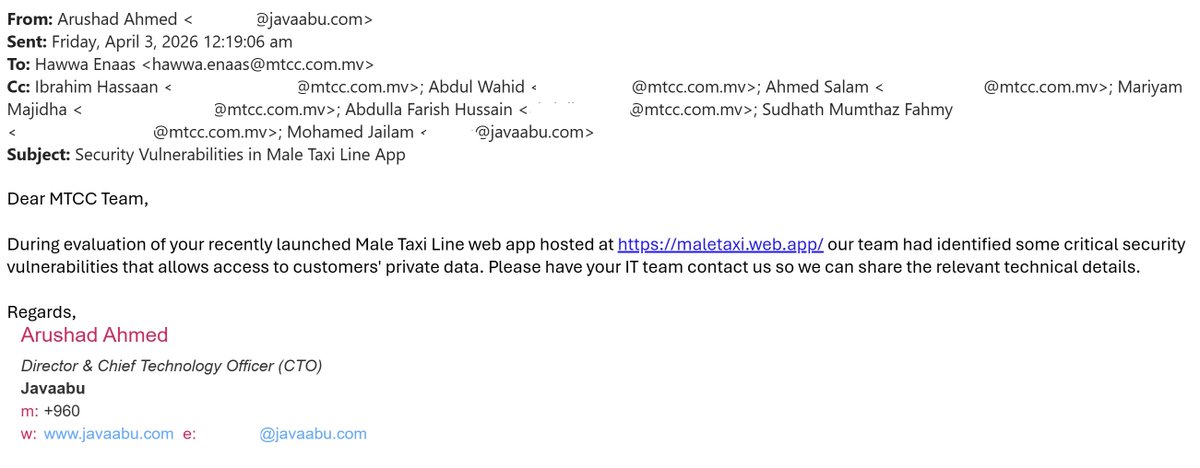
Arushad sent an email to MTCC raising concerns about issues with the app/web link. Instead of addressing those issues, Salam was terminated under the suspicion that he had shared the link with Arushad, even though the link was already publicly accessible to begin with.
It is sad to see someone like Salam been sacrificed just to “make an example” out of him and to scare everyone else into silence.
It won’t work and one day the truth behind the vehicle procurement & the app dev process will come to light and be properly investigated, a day everyone involved, including Litus, FixedMaldives, the minister, and the MD will be held accountable.
1/
Dear @MTCCPlc MD @CEOMTCC,
It has come to my attention that MTCC IT Division Head, Mr. Ahmed Salaam had recently been terminated from his position on the basis of an email I had sent to your company on 3rd April, 2026 12:19 AM. I've attached a screenshot of the email.
The funny thing is non electronic passports issued by the Maldivian Immigration won’t work on the E-Gates also made by the Maldivian Immigration. Thus is Maldives 2.0
A key step forward in improving urban transport in Malé City.
@MTCCPlc will soon launch “Male Taxi” — a reliable, app-based service that will operate strictly on Government-published fares, ensuring fairness, availability, and convenience for the public.
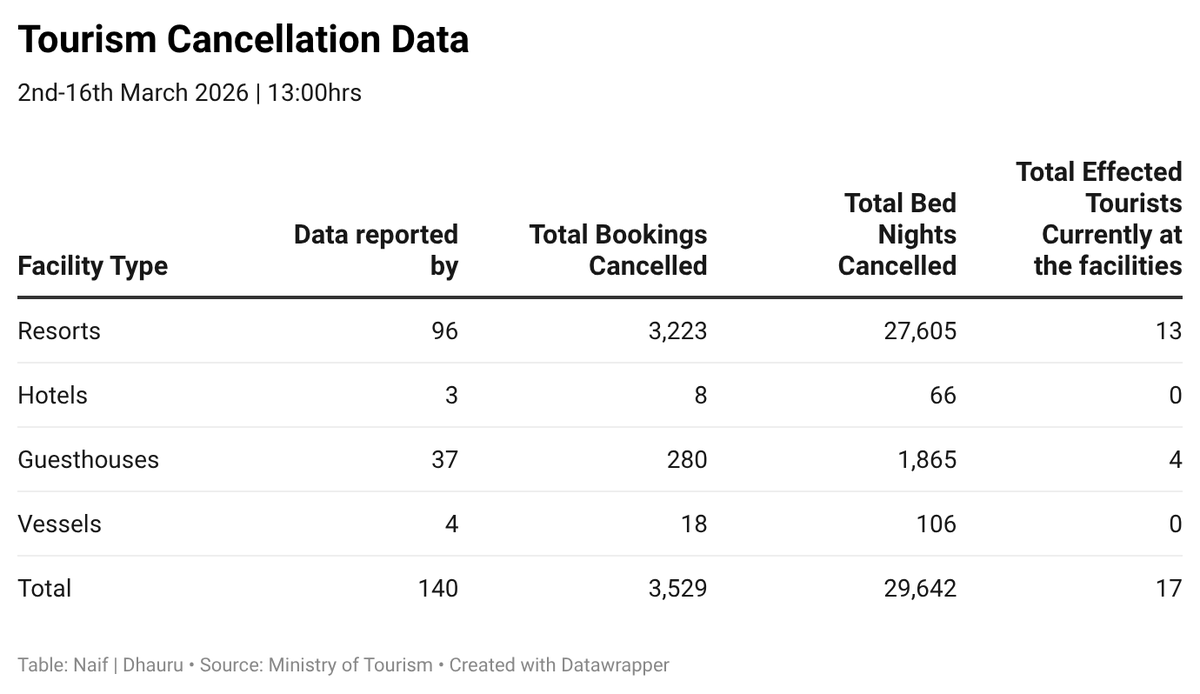
📉The fallout from the ongoing Middle East conflict is hitting Maldives tourism hard. In just 14 days (Mar 2-16), 140 facilities have reported 3,529 cancelled bookings, wiping out nearly 30,000 bed nights. Resorts are bearing the absolute brunt of it. 🔗 https://t.co/UFGzNabVRI
Had the same experience of getting overcharged by this same exact taxi. Even reported it to @MoTCAmv . They even got back to me saying they are looking into it and will meet with the driver. Sad to see bro back at it again
On 13 March 2026, a mother took a van from the airport taxi stand and asked the driver to drop her son and five of his friends, all under 17, to Male’. She also told the driver to call her so she could transfer the fare directly.
Her son later called to say the driver Mohamed Wafir (AB1B-T2494) was asking for 170 MVR, while the usual van fare from the airport to Male’ is 110 MVR. When the boys questioned the fare, the driver became upset.
The driver shouted at the boys and dropped them near the bridge, saying that if they were paying 110 MVR he would take them back to where he picked them up from. The mother had already transferred 170 MVR at the time. But he still kicked those underage boys out of the van and left.
This is not the proper way to treat children.
@hrcmv@PoliceMv@taxidrivers_mv@DriversAssocMV
The same company is developing the software to replace the Xpat system in Maldives. Replacing software without refining the process and weeding out the corrupt cannot stop human trafficking.
Surely we aren’t going to continue with the same vendor right?
https://t.co/U7uyJwJu8e
Bangladeshi workers pay recruitment fees of up to US$6,600 to work in Malaysia, significantly higher than those paid by other migrant groups, only to face exploitation and trafficking, Bloomberg reports.
Several migrants allege that senior Malaysian officials are aware of the abuses and personally profit from the recruitment fees, including through involvement with Bestinet.
https://t.co/TWwK0eJgS3
🧵1