Anthropic pays engineers $750,000+ a year to understand how LLMs work.
Stanford just put a 2 hour lecture that covers 80% of it for FREE.
Bookmark this. Give it 2 hours today.
This is the Lonely Castle, a 2,000 year old tomb in Hegra, an ancient city in Saudi Arabia.
It's a perfect example of "rock-cut architecture" — when you carve a whole building out of stone.
And there are plenty more places like it, all around the world...
A demo of subtractive color mixing with a CMY cube.
Cyan, magenta, and yellow film color opposing sides.
When white light passes through two different colored sides, both wavelengths are subtracted and produce either red, green, or blue.
Using the right AI tools is like having your own personal army of robots.
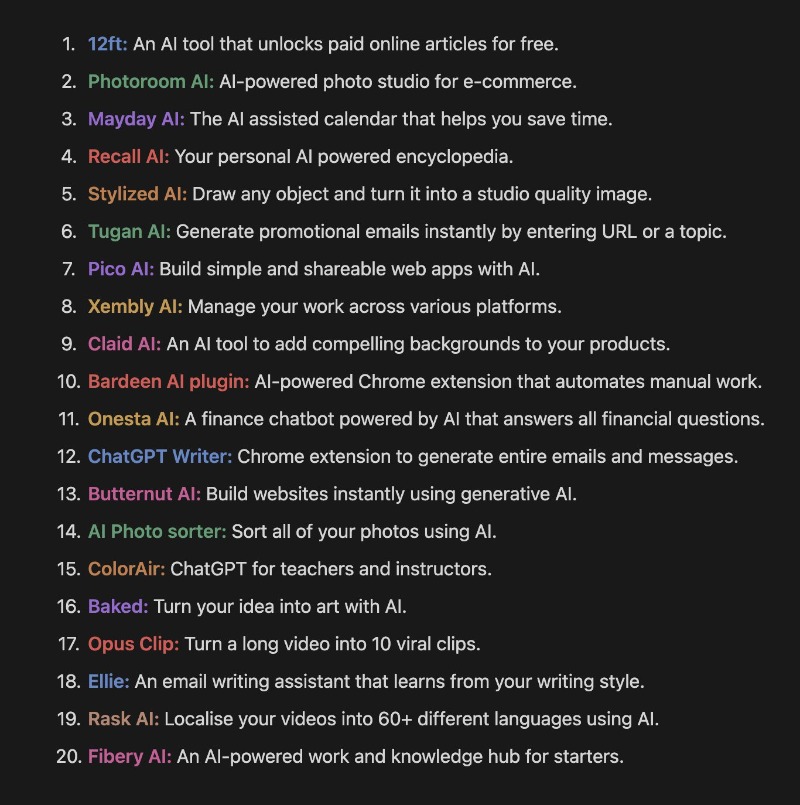
20 AI tools to supercharge your productivity:
If you want tools and insights about AI, follow along for more.
World's First Particle Accelerator ⚛
The world’s first particle accelerator, the cyclotron, was invented by Ernest O. Lawrence in 1929–1930 at the University of California, Berkeley, and patented in 1932. A cyclotron accelerates charged particles outwards from the center of a flat cylindrical vacuum chamber along a spiral path. The particles are held to a spiral trajectory by a static magnetic field and accelerated by a rapidly varying electric field. Lawrence was awarded the 1939 Nobel Prize in Physics for this invention.
The cyclotron was the first “cyclical” accelerator, meaning that it could accelerate particles many times by making them follow a circular or spiral path. The energy gained by the particles was limited by the maximum electrical potential that could be achieved across the accelerating region. This potential was in turn limited by electrostatic breakdown to a few million volts. In a cyclotron, by contrast, the particles encounter the accelerating region many times by following a spiral path, so the output energy can be many times the energy gained in a single accelerating step.
The cyclotron was the most powerful particle accelerator technology until the 1950s, when it was superseded by the synchrotron. Despite no longer being the highest-energy accelerator, they are still widely used to produce particle beams for nuclear medicine and basic research. As of 2020, close to 1500 cyclotrons were in use worldwide for the production of radionuclides for nuclear medicine. In addition, cyclotrons can be used for particle therapy, where particle beams are directly applied to patients.
[Image courtesy: Lawrence Berkeley National Laboratory]











![PhysInHistory's tweet photo. World's First Particle Accelerator ⚛
The world’s first particle accelerator, the cyclotron, was invented by Ernest O. Lawrence in 1929–1930 at the University of California, Berkeley, and patented in 1932. A cyclotron accelerates charged particles outwards from the center of a flat cylindrical vacuum chamber along a spiral path. The particles are held to a spiral trajectory by a static magnetic field and accelerated by a rapidly varying electric field. Lawrence was awarded the 1939 Nobel Prize in Physics for this invention.
The cyclotron was the first “cyclical” accelerator, meaning that it could accelerate particles many times by making them follow a circular or spiral path. The energy gained by the particles was limited by the maximum electrical potential that could be achieved across the accelerating region. This potential was in turn limited by electrostatic breakdown to a few million volts. In a cyclotron, by contrast, the particles encounter the accelerating region many times by following a spiral path, so the output energy can be many times the energy gained in a single accelerating step.
The cyclotron was the most powerful particle accelerator technology until the 1950s, when it was superseded by the synchrotron. Despite no longer being the highest-energy accelerator, they are still widely used to produce particle beams for nuclear medicine and basic research. As of 2020, close to 1500 cyclotrons were in use worldwide for the production of radionuclides for nuclear medicine. In addition, cyclotrons can be used for particle therapy, where particle beams are directly applied to patients.
[Image courtesy: Lawrence Berkeley National Laboratory]](https://pbs.twimg.com/media/F1zzUg3WwAABPDo.jpg)


