2043: I bought Elon's solar battery ☀️
Day 1: snow in the living room
Day 2: whole city blacked out — except us
Day 3: flying cars to the Starport. $20M Starship → $2,000 if you bring your own power 🚀
Unlimited energy. Dad's paying.
#SpaceX#Starship#ElonMusk#AI
2028: I bought the Tesla Roadster 2. It fell out of the sky. 🚀
2033: I bought a robot. Even the SKY had traffic.
2038: I bought a brain chip. Now the whole class can hear my thoughts. 🧠
Which year would you live in? 👇
🤖 AI-generated comedy short
#Tesla#TeslaRoadster #ElonMusk #Neuralink #Optimus #AI
Hindsight PE - How Cheap Was Tesla?
As low as 4 or 5 times future earnings!
I'll explain...
Many investors like to look at the Price/Earnings (PE) ratio - a short-cut method to evaluate how cheap or expensive a company is - but this measure only looks at one year's worth of earnings (usually net profit for the next 12 months).
So, for example if Tesla's current market cap is $675 billion and its earnings over the next 12 months are $10 billion, then its PE ratio is about 68. Whether this is too high or not is another discussion, but it's safe to say that the lower the PE ratio the better.
For a long-term growth company like Tesla rapid growth in earnings may not materialize over the next 12 months - it may take several years.
So let's look at how cheap Tesla's stock was using something I call Hindsight PE - this measure compares the future earnings of a company to its price from one to five years prior.
You can think of it this way: If an investor had perfect foresight, how cheap could that investor have purchased the stock one to five years earlier?
Or another way to think about it: If an investor who doesn't have perfect foresight, but understands the growth waves that were to come and had more patience than the nits on Wall Street, how cheap could that investor have acquired the stock?
Since we can only answer this question in hindsight, I call it Hindsight PE.
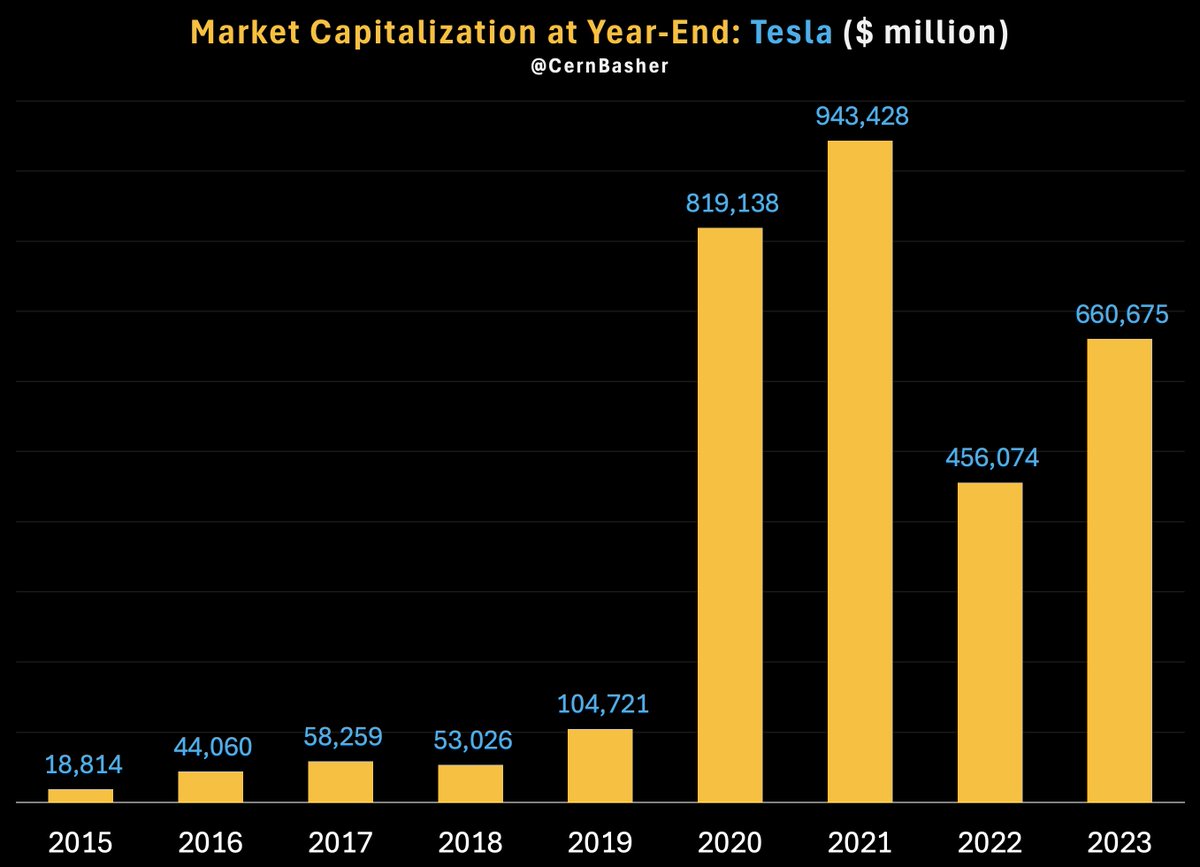
Here is the year-end market capitalization of Tesla from 2015 through 2023.
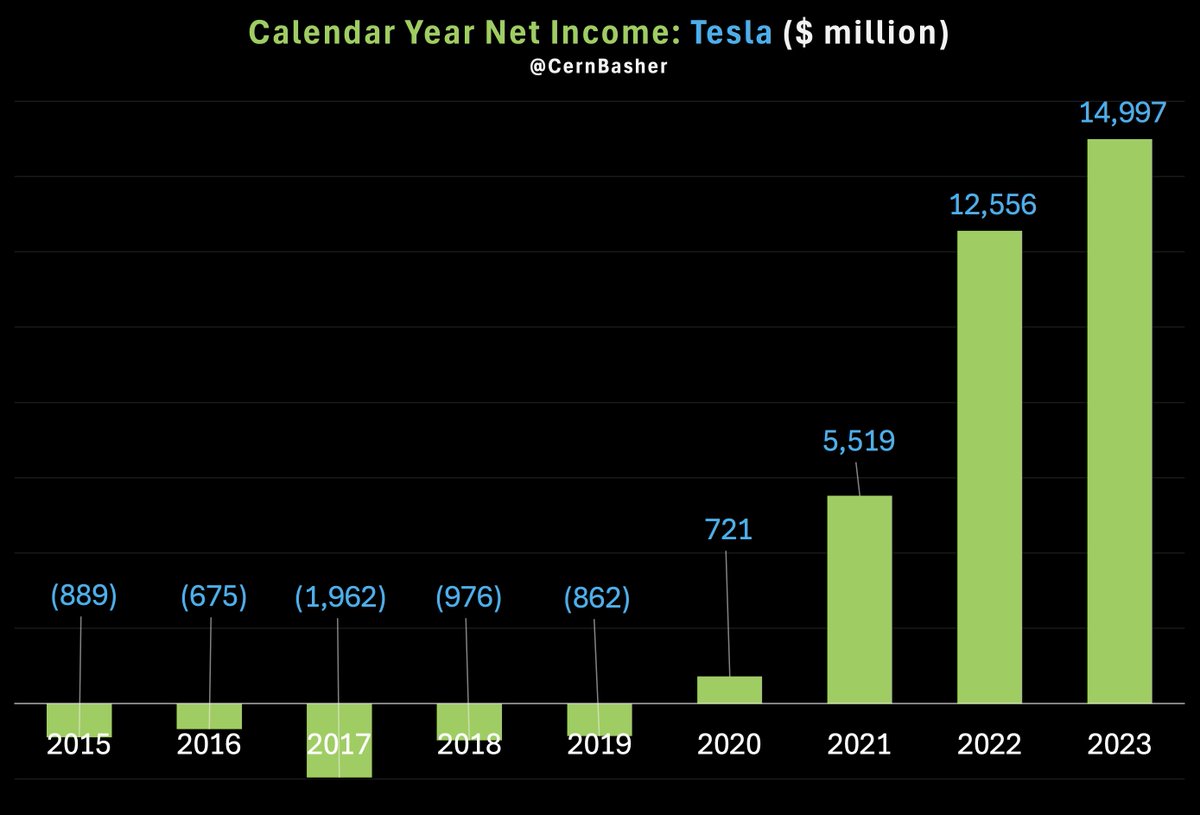
Here are the profits that Tesla produced each year.
And here is a table that shows the Hindsight PEs for Tesla.
Let's look at 2023 in some detail:
In 2023 Tesla had net income of almost $15 billion.
--> If you purchased the stock at the end of the year in 2022, the 1 yr PE ratio would have been 30. Your investment return would have been a respectable 1.5x - no Wall Street money manager would get fired for that.
--> If you purchased the stock at the end of the year in 2021, the 2 yr PE ratio would have been 63. Your investment return would have been 0.7x.
--> If you purchased the stock at the end of the year in 2020, the 3 yr PE ratio would have been 55. Your investment return would have been 0.8x.
--> If you purchased the stock at the end of the year in 2019, the 4yr PE ratio would have been just 7. Your investment return would have been 6.3x.
--> If you purchased the stock at the end of the year in 2018, the 5yr PE ratio would have been only 4. Your investment return would have been 12.4x. Few on Wall Street earned this kind of return, as they don't look this far ahead.
If you got this far, here's the bottom line...
Individual investors can get ahead of Wall Street by looking out four or five years, rather than just one year - effectively purchasing a stock at a massive discount before Wall Street wakes up.
So you have a choice:
1) Wait for the revenues and earnings from Tesla's AI-powered businesses (Robotaxi and Humanoid Bots) to show up in the quarterly reports - by that time the stock will likely have already run up considerably, but there will still be some gains to be had, or
2) Invest with foresight, knowing that massive growth in revenue and earnings is likely to come from Tesla's AI-powered businesses - giving you a much lower Hindsight PE and much higher growth potential.
Both choices are viable*. Number one is less risky. Number two offers greater potential upside.
* Not specific investment advice - please do your own research or consult with an investment advisor.
continued...