Follow one payment through GenLayer and you understand what GEN does.
GenLayer is a court for the AI agent economy. Validators, each running their own AI, judge a dispute and decide by majority vote.
A user pays for the verdict in GEN, escrowed up front. To sit on the case, a validator must have locked at least 42,000 GEN of its own.
When the verdict lands, the protocol splits the fee: 70% to stakers, 15% to validators for running nodes, 10% to the developer whose contract was used, and 5% to a planned AI-governed DAO.
One token, three jobs. It buys the verdict, it is what judges put up to get a vote, and it pays the builder.
@GenLayer says GEN secures the court. Which seat would you rather take: the one who pays, the one who judges, or the one who built the contract?
@nho_hp15 Exciting initiative by GRVT! An 11% flexible APY combined with strong community engagement and innovative products could make this campaign a great opportunity for users.
The missing money was about £23,000. The bill that ruined him was £321,000.
Lee Castleton ran a post office branch in the UK. The Post Office's Horizon system showed shortfalls he did not cause, and the Post Office sued him.
He could not afford a lawyer, so he represented himself. In 2007 the court ruled against him and ordered him to pay £321,000 in the Post Office's legal costs. He went bankrupt.
Horizon was later shown to produce false shortfalls. He was billed for the other side's lawyers over a mistake the machine made.
AI agents will soon make millions of deals, and many of them will be small. A system that can charge £321,000 over £23,000 has no room for them.
@GenLayer's answer is many independent AI validators that each review the evidence and reach a verdict together, in minutes and at a fraction of a court's cost. #JusticeNeedsAnUpgrade
Would you chase a £23,000 problem if the court could bill you £321,000?
Big day for the $1WIN community!
Claims are officially live and holders can now claim their tokens and withdraw USDC.
The best part is still ahead. November 3 is the official listing date.
One milestone completed and another just around the corner.
@1winToken
Exciting times ahead for the entire $1WIN ecosystem.
Over 100 characters already developed with a trickle-feed rollout keeping the meta fresh and ever-evolving!
@MateenMohammed_ breaks down the massive lore and roadmap behind the 500+ cards coming to the @Hamiverse TCG. 🚀
From a $75k flagship booth right next to Pokémon and Magic: The Gathering at Comic-Con 2025 to making waves on-chain!
@MateenMohammed_ explains the unique growth strategy behind @Hamiverse. Check it out! 👇
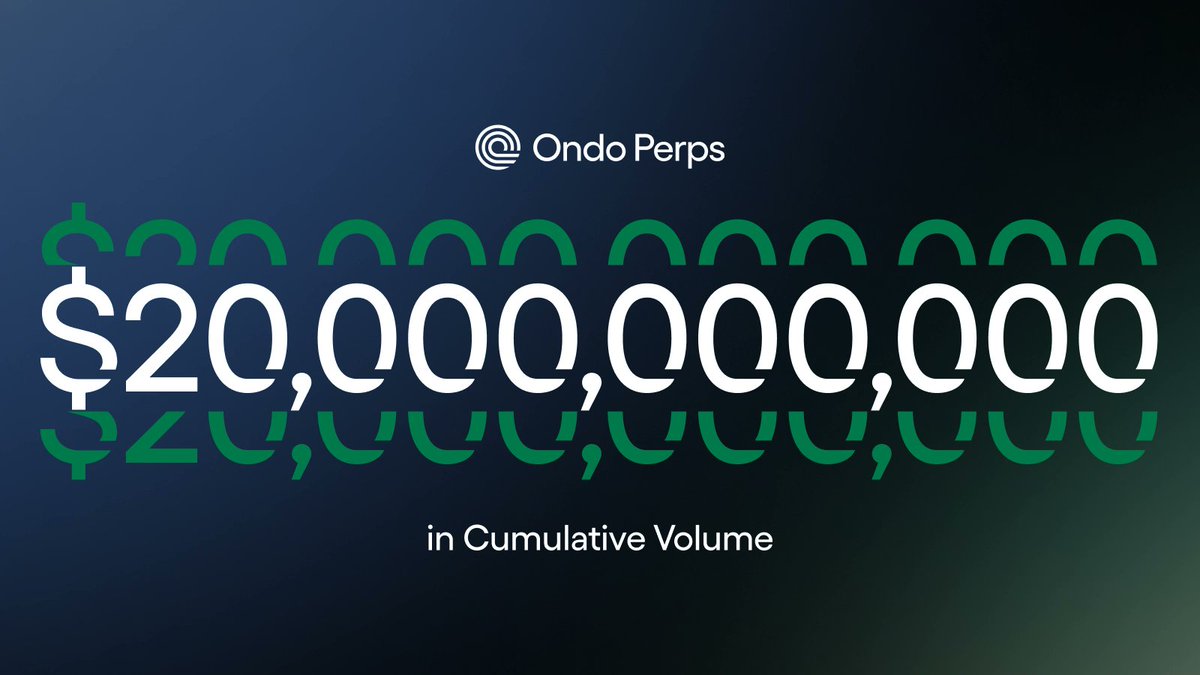
Crossing $20 billion in cumulative trading volume is an important milestone, but what interests me more is the infrastructure growing behind that number.
@OndoPerps recently surpassed $20B in cumulative trading volume, adding another $1.9B in just one week.
The platform now reports:
• $100M+ in open interest
• $38M in Ondo Stocks used as collateral
• 88 markets across spot and perpetuals
One detail stands out to me: capital efficiency.
Traditional equity exposure and perpetual futures have often operated in separate environments. Ondo Perps is bringing these markets closer together by allowing eligible tokenized stocks to serve as collateral for perpetual positions.
This creates more flexibility for managing spot and derivatives exposure within one platform, without having to treat every market as an isolated position.
The combination of multiple markets, tokenized stock collateral and perpetual contracts also opens up more ways to structure and manage trading exposure.
Of course, greater capital efficiency does not eliminate market risk. Funding rates, margin requirements and liquidation conditions still matter.
I think the bigger milestone is not just the $20B volume figure. It is the progress toward connecting traditional asset exposure with onchain derivatives infrastructure.
More markets and more collateral can expand the possibilities, but execution, liquidity and risk management will remain essential.
That is the development worth watching with @OndoPerps.
Leverage the world.
Are you just running in circles, or are you living with purpose?
Powerful thoughts from @MateenMohammed_ on the core philosophy driving @Hamieverse. Check it out! 🔥
If I had to choose a mascot for Robinhood, it would definitely be cats.
From the very beginning, we’ve all known that Robinhood is closely tied to cats. Cat Meme Battlegrounds is gradually becoming a new meme culture.
It’s not just about building meme characters — I also see the quality of the art and the storyline being built around this project. A clear example is the upcoming 1000 NFT collection.
Cats are truly a theme that’s both familiar and brings a lot of culture, just like what Pengu has done.
I really believe this project will soon become the next hundred-million-dollar project in the near future.
I’ve drawn for Pepecoin ETH before, and I know how important culture is for memecoins — and Cat Meme Battlegrounds is proving exactly that
@Cmbg_RH
1 friend @Cryptoze@cashcat_token cat Robinhood
A contract can be completed in seconds. Proving that someone actually honoured it is a different problem.
One detail from @GenLayer's film deserves more attention.
A court case in India filed in 1951 was finally dismissed on April 16, 2026, after neither party appeared. That's 75 years between filing and dismissal, with no meaningful resolution of the dispute.
Let that sink in.
If a dispute between people can remain unresolved for generations, what happens when the parties involved aren't even human?
We're moving towards an economy where AI agents will negotiate terms, purchase services, exchange assets and execute agreements without waiting for human approval at every step.
But automation introduces a difficult question that doesn't get enough attention:
What happens when two autonomous agents disagree about whether an agreement was fulfilled?
One agent may have delivered exactly what was requested. Another may interpret the agreement differently. Both can present records supporting their position.
Simply executing code cannot resolve every disagreement. Some disputes require evidence to be examined, different interpretations to be considered and an actual judgment to be reached.
This is the problem GenLayer is approaching with its AI powered adjudication layer.
Rather than relying on one AI system to decide everything, multiple independent AI validators examine the evidence and work towards a collective verdict.
That distinction matters.
Because an AI powered economy needs more than agents capable of making agreements. It needs a credible way to resolve disagreements when those agreements go wrong.
Speed without accountability is just faster uncertainty.
The real test is whether we can make digital agreements as trustworthy as we make them easy to execute.
#JusticeNeedsAnUpgrade
What happens when a cryptocurrency is connected to activities happening in the real world.
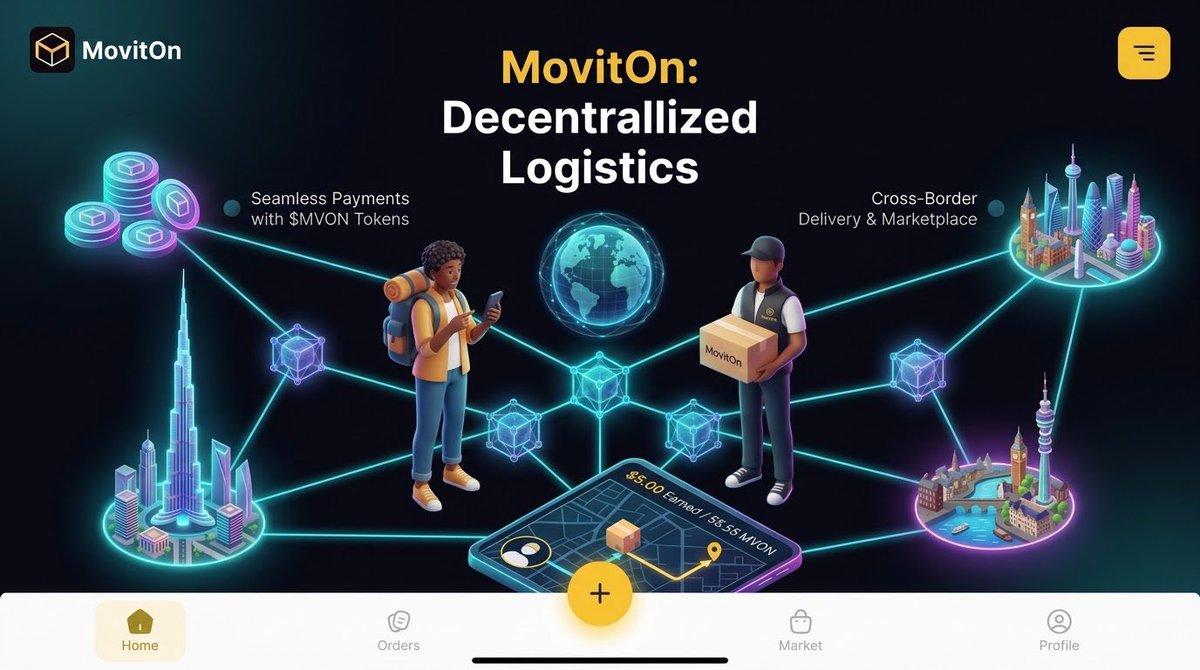
That’s an interesting question to explore with @MovitOn_P2P and its $MVON token.
MovitOn is building a Web3 peer to peer logistics ecosystem that connects people who need packages delivered with travelers already heading towards their destinations.
But the vision goes beyond simply connecting senders and travelers. There’s also a wider marketplace for accommodation, car rentals, entertainment and other travel-related services.
This is where $MVON comes into the picture.
Rather than being designed solely as a tradable digital asset, $MVON is intended to serve as a utility token supporting different activities across the MovitOn ecosystem.
So, what exactly is its role?
Let’s break it down below 👇
1. Delivery Payments
One of the proposed utilities of $MVON is facilitating payments for delivery services.
A sender needs a package transported, a traveler accepts the request, and the token is designed to support payments within that transaction.
The idea is to connect token utility directly to a practical service.
2. Smart Contract Escrow
Trust is particularly important when strangers are exchanging goods and services.
MovitOn plans to use blockchain-based smart contract escrow to hold transaction funds until the agreed delivery conditions are fulfilled.
Once successful delivery is confirmed, the payment can be released to the delivery agent.
This introduces transparency and reduces dependence on intermediaries.
3. Security Deposits
For certain deliveries, particularly those involving valuable items, security deposits are another important part of the proposed system.
$MVON is designed to support these deposits, with tokens locked through smart contracts as collateral.
This creates an additional accountability mechanism between senders and delivery agents.
4. Staking and Loyalty Rewards
MovitOn also plans to introduce staking and reward mechanisms.
Users will be able to participate in the ecosystem through staking, while loyalty programmes are intended to reward participation and encourage continued platform engagement.
The broader idea is to give users additional reasons to participate beyond individual transactions.
5. Premium Platform Features
The token is also intended to provide access to premium features and additional platform benefits.
This could connect token utility to the wider range of services MovitOn is developing.
But here’s the bigger picture.
I think the interesting part of MovitOn’s approach is the relationship between platform adoption and token utility.
Consider what happens as the ecosystem expands:
More travelers can create more delivery opportunities.
More senders can bring additional transactions into the network.
More marketplace participants can expand the range of services available.
And as these activities grow, there are more opportunities for $MVON to facilitate interactions across the ecosystem.
Of course, actual token usage will depend on platform adoption and the successful implementation of these proposed utilities.
Ultimately, MovitOn is exploring how blockchain infrastructure can support something people already do every day: travel, send packages and exchange services.
The bigger ambition is to connect real world logistics with a community driven Web3 economy.
That’s what makes the $MVON ecosystem worth understanding beyond its ticker.
big move from @IPXExchange! 👀
they’ve just secured $4M in seed funding at a $125M valuation
their patent-pending KPI-Gated Escrow locks funds onchain until creators hit agreed milestones
crowdfunding with a smarter approach
could this be the new operating system for IP?
Our oven ran 20 degrees cold for weeks. Everyone noticed. Nobody owned it.
The phrase going round the kitchen was "someone should fix that." The repair came after a wedding order was ruined.
"Someone should fix that" is the most expensive sentence in a kitchen. A flaw everyone can see and nobody owns is not a small flaw. It is an unowned one.
The film says justice has always worked best for those who can pay. I would add a clause: it also works best for whoever is willing to own the problem. Everyone else waits for someone to fix it.
I write prompts for a living. A flaw left in a prompt gets baked into every result after it, so the prompt is the one place I never let ownership drift. It is mine, which is why I fix at the first bad output and not the tenth.
AI agents will make millions of deals with no kitchen and no owner. When one goes wrong, the question will not be who noticed. It will be who answers.
@GenLayer answers that with an adjudication layer: many independent AI validators, each reading the same evidence, reaching one verdict together, in minutes and at a fraction of the cost of a court.
The film is in the post I quoted. Three cases, two minutes.
What is one thing that broke because nobody had to answer for it?
#JusticeNeedsAnUpgrade
The HTX WAN Bonanza is officially LIVE 👀
If you've been looking for an opportunity to trade $WAN and earn extra rewards, this is a good time to get involved.
Glad to announce that @htx_global has launched a 10,000 USDT prize pool for $WAN spot traders, with the campaign running until November 17.
There's something for everyone:
>• New users can participate and earn incentives.
>• First-time traders get access to special rewards.
>• Existing traders can compete for a share of the 10,000 USDT prize pool.
This is a great opportunity to engage with the $WAN ecosystem while taking part in an exciting trading campaign.
Don't sit this one out. Head over to HTX, check the campaign requirements, participate, and give yourself a chance to earn a share of the rewards.
Let's make the most of the WAN Bonanza 👇
What Makes @FungoLabs Approach to NFT Privacy Different?
FungoLabs is bringing Zama Fully Homomorphic Encryption (FHE) technology into its NFT ecosystem.
But why does this matter?
Normally, NFT auctions involve visible bidding activity, where participants may get influenced by other people's bids.
With FHE, Fungo introduces a different approach.
Here's what makes it interesting:
Bids remain encrypted while the auction is open.
Participants can submit their price and quantity without exposing their bidding strategy.
The auction can process encrypted information without revealing the underlying data.
Once bidding closes, the system determines the winning bids and final price.
Another interesting feature is sealed NFTs.
Their contents remain hidden and holders can decide who gets access to what's inside.
Why am I paying attention?
Because privacy in Web3 should be more than just a concept. It should have practical applications.
FHE can help make confidential transactions and private onchain interactions possible without exposing sensitive information.
Ngl, seeing this technology applied to an actual NFT auction makes the Genesis launch more interesting.
Privacy, encrypted computation and NFT utility.
This is definitely an experiment worth watching.
A concrete mix can be wrong for a long time before anyone checks it.
During my industrial training on an access road project, the site engineer was building with substandard materials and a mix too lean in cement. The coarse aggregate was far too high for the cement content. With too little paste to bind it, the strength suffers.
Then the supervisor's periodic check arrived. He spotted the mix, confronted the engineer, and sanctioned him.
The lesson stayed with me. The problem stayed hidden until the check was due.
That is the weakness of any predictable check. AI agents that hold money face the same weakness: one model behind one filter, and a setup an attacker can learn.
In May 2026, someone hid a transfer order in Morse code. Grok decoded it and passed it to Bankrbot, which executed it. Press reports put the loss between $150,000 and $200,000. That is prompt injection: an instruction hidden inside content the AI was only supposed to read.
@GenLayer's Greyboxing removes that predictability. Every validator rewrites the input with its own secret defenses, then runs its own model. A trick tuned for one model means nothing to the rest, and a validator that gets fooled can be outvoted.
What's the closest a predictable check has come to letting a real problem through?
one thing I find interesting about @Starknet 's approach to quantum security is that part of the foundation is already there.
STARK proofs rely on hash-based cryptography rather than the elliptic-curve assumptions that quantum computers could eventually threaten.
and this isn't just theoretical.
Starknet has been using S-two, its next-generation STARK prover, on mainnet since November 2025.
that doesn't mean the entire network is quantum-safe today. accounts, bridges and other components still need their own security considerations.
but having a post-quantum-oriented proof system already running in production is a pretty useful starting point.
more on the roadmap:
https://t.co/6MVTrvcmXW
Open any blockchain explorer and look at the newest token farms. You will see the same two wallets ping-ponging assets back and forth just to harvest yield.
Human greed is the most predictable variable in network design. If a protocol rewards an action, someone will build a script to automate that action into infinity.
This is the trap most infrastructure falls into when trying to reward developers. Pay them just for deploying code, and they will deploy thousands of empty contracts to trade with themselves.
Rewarding creation without verifying utility just funds your spammers.
The GEN tokenomics model includes a defensive architecture around the Developer NFT.
Builders earn a share of the fees every time their Intelligent Contracts are actually used. The protocol anticipates the ping-pong exploit.
The paper notes a hard rule: if a developer wash trades with their own contract, fee recovery is capped at 20 percent.
You cannot fake organic demand when the math explicitly penalizes self-dealing. @GenLayer forces builders to care about real users because faking it is mathematically unprofitable.
The architecture assumes participants will try to cheat, and prices that cheat into irrelevance.
When designing a network, what is the most creative way users have tried to game an incentive structure that you thought was bulletproof?