Binance, the largest digital asset platform serving over 300 million users, has launched US stocks and ETFs trading, advancing their vision to become a multi-asset financial super app.
This product expansion, powered by Alpaca’s Broker API, enables @binance users to:
✅ Invest in over 7,000 US-listed stocks and ETFs for as little as $5
✅ Trade nearly around-the-clock for select equities
✅ Access global traditional markets via a familiar crypto-native interface
✅ Build diversified, long-term strategies without navigating separate traditional brokerage platforms
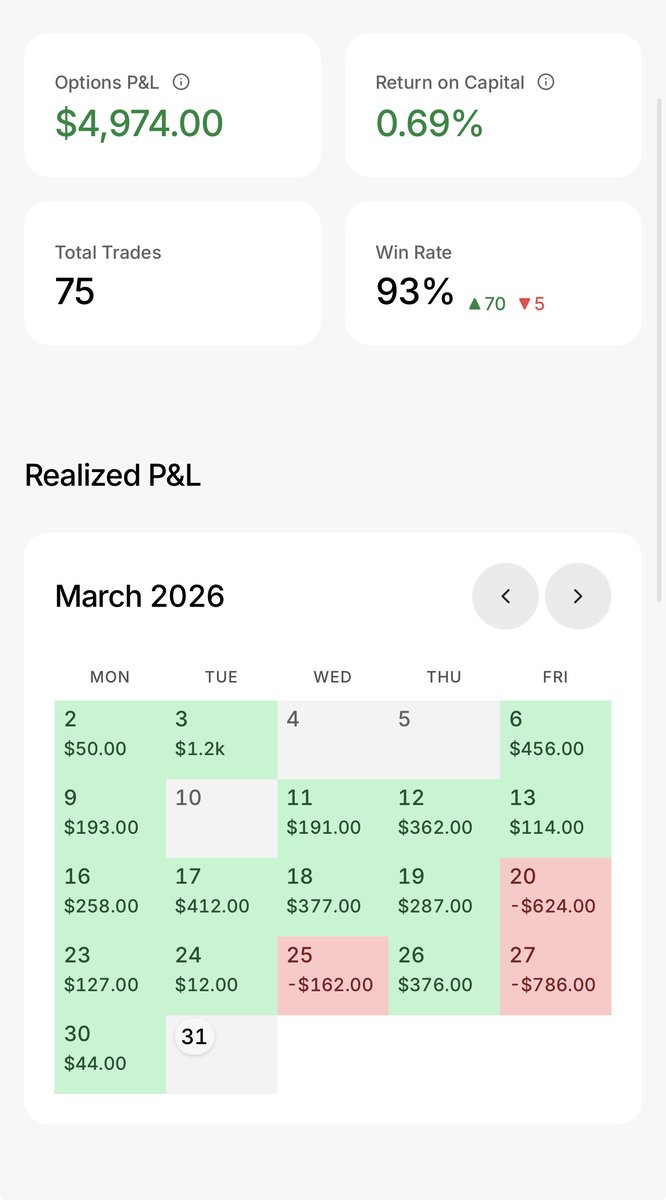
Genuinely curious, since earning premiums and prioritizing safer trades with far OTM covered calls and cash secured puts make it easier to earn premiums, what may be holding you back from doing it? Is it lack of funds, knowledge, time or something else?
#money#stocks#options #investing #finance $TSLA $NVDA $AMZN $CRWV $GOOGL $HOOD
Same here.
By way of background for those who care, I spent a lot of time last week with senior members of the Anthropic team to understand what they do to ensure Claude is good for humanity and was impressed.
Everyone I met was highly competent and cared a great deal about doing the right thing. No one set off my evil detector. So long as they engage in critical self-examination, Claude will probably be good.
After that, I was ok leasing Colossus 1 to Anthropic, as SpaceXAI had already moved training to Colossus 2.
AI agent first financial services 🤖
@AlpacaHQ API usage growth up nearly 4x QoQ ⚡
APIs are becoming the foundation of
financial services 🦾🦾🦾
https://t.co/sPB85SLG7h
Traders blow up their accounts because they chase returns over risk management.
But that’s not how long-term wealth is usually built.
Institutions and banks like @JaneStreetGroup and @jpmorgan survive across decades because they are highly aware of risk controls, position sizing, and liquidity. They are not trying to hit one lucky trade. They even turn down deals that are profitable but fragile. That feels boring in good times, but it is exactly what protects them in crises.
That’s the philosophy behind @PutHouseAI. To prioritize capital preservation before maximizing upside.
I treat risk as a function. Every trade has to pass through risk checks before it considers entering.
This strategy of systematic covered calls and cash-secured puts has been backtested over 14 years of market data since 2012, which is why it’s intentionally conservative. The goal is to trade when the probability of profit is high, around 80 percent or higher, and avoid the trades that can wreck the account.
The backtest is not meant to prove guaranteed returns. It is used to stress test rules across different volatility regimes, including fees, spreads, and exits.
And losses still happen. That is part of the business. Think about it like an insurance company paying out claims. The goal is to make losses survivable by expecting them and stress testing before it happens.
Here’s how it avoids overextended setups:
RSI range
I use a tight neutral band of 45 to 55. This filters for calmer, less extended market conditions and avoids entering when price is already stretched. Wider ranges sound appealing, but they can pull you into more volatile trades.
Stock universe
I focus on high-quality, high-growth names across themes like AI, robotics, data centers, crypto, and self-driving cars. I personally invest in $TSLA, $GOOGL, $MSFT, $AMZN, $MSTR, and $RIVN. I’m also waiting on $META, $TSM, and $NVDA for better entry points.
I’m aware of survivorship bias, so it’s designed around risk controls first, not assuming today’s winners keep winning forever. At the same time, I don’t think you can ignore the profits, distribution, and market power of these companies.
Entry
Targeting 0.05 to 0.15 delta keeps trades conservative and meaningfully out of the money. Pushing higher delta is how you can quietly increase risk.
Exit rules
- Take profits at 40 percent.
- Cut risk if delta reaches 0.30.
These rules are easy to override when trading manually. Automation contains the risk, removes hesitation, and prevents one bad emotional decision from turning into a huge loss.
VRP filter, IV/RV
Minimum IV/RV ratio is 1.10. If you ignore this, you’re not getting paid enough for the risk.
DTE, days to expiration
The target range is 7 to 14 days.
This was chosen from backtesting because it balances theta decay against gamma and price movement risk. Shorter duration can collect faster decay, but gamma risk rises quickly. Longer duration gives more time, but capital stays tied up and the trade can drift against you for longer. The 7 to 14 DTE range is the middle ground I found most practical.
Position caps
- Cash-secured puts: up to 2 per symbol, with total CSP capped at 15 percent of account equity.
- Covered calls: up to 5 per symbol, with each symbol capped at 80 percent of shares held.
There are also additional guardrails to help avoid over-concentration in a single name. Without caps, concentration risk creeps up fast.
Other filters
Beyond that, it checks liquidity, IV, spreads, open interest, volatility conditions, earnings and events, and whether there’s already an underwater position there.
What this does not do
It does not guarantee profits.
It does not avoid every loss.
It does not assume a high probability of profit means no risk.
The plan is to offer more aggressive presets over time for users who want more control. But the default setup will stay conservative to prioritize risk management.
Covered calls and cash-secured puts are simple strategies. The edge is risk management, automation, and staying alive long term to reinvest profits and let compounding build wealth for you.
#stocks #options #investing #trading #finance
Apple’s move to pick a hardware veteran like John Ternus shows they are betting the entire company on the chip-to-software stack for the AI era. It is a bold play that rewards deep internal expertise, but ignoring a more diverse background in services or OS could backfire if the market shifts away from hardware-bound moats.