Where in Christianity are you allowed to celebrate the death and suffering of your brother in Christ, the destruction of another Christian place of worship, and an invasion?
I hope it is now clearer why a Turk can't be a Christian. Not because someone can't convert to Christianity, since Jesus called everyone, but because Turkish national identity is structurally and ideologically engraved with Islam. If you become a Christian, you have to leave your Turkish identity behind, otherwise it would be an oxymoron.
For 600 years the Christian was a slave to the Turk and had to pay taxes, until the Christian nations rebelled, as in the Balkans, and won their freedom, with the Church almost always playing a big role.
Then the Christian became a bogeyman to the Turk. That's why Anatolia was "cleared" of Christians.
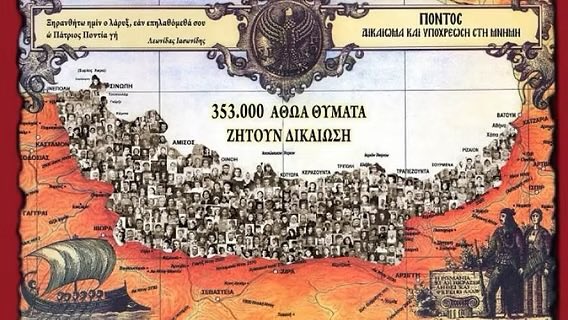
Now you have to decide whether to celebrate or mourn the massacre of your brothers in Christ. The same choice applies to denying or acknowledging the Armenian and Greek genocides, which were ideologically motivated by Turko-Islamic thinking against the "bogeyman," the rebellious unbeliever. It applies as well to celebrating or mourning the fall of Constantinople, the conversion of Hagia Sophia, and much more...
Today at 9:05, Türkiye falls silent, and I stand in silence with it.
88 years after his passing, Mustafa Kemal Atatürk’s example speaks directly to our moment. A soldier who knew the cost of war better than anyone, he chose to build: a republic from the ruins of empire, institutions in place of grievance, and a creed that still guides this nation: “Peace at home, peace in the world.”
That is the work before us now. Across a region still searching for stability, his lesson holds. Sovereignty and dignity are won by courage, and secured by the harder courage of turning adversaries into partners.
ANNOUNCEMENT
Of the Diocesan Delegates' Assembly Of the Diocese of the Armenian Church in Germany
The Diocese Representative Assembly of the Armenian Church in Germany issued an official statement following its meeting in Cologne on November 7–8, 2026. Attended by approximately 60 clergy and lay delegates representing 17 Armenian church communities across Germany, the Assembly addressed key diocesan matters while expressing deep concern over the growing tensions between the political authorities of Armenia and the Armenian Apostolic Church.
[...]
The Armenian Apostolic Church is much more than simply a religious institution. For centuries, it has been and continues to be the spiritual home of our people, the primary guardian and transmitter of the Christian faith, the Armenian language, culture, and national identity. Throughout the course of history, especially in times of existential threat, the Armenian Church has provided our people with spiritual leadership, a sense of unity, and hope. Its special historical, national, and spiritual mission has also received clear recognition in the Constitution of the Republic of Armenia.
Accordingly, we are convinced that relations between the State and the Church must be based on mutual respect, a clear demarcation of competencies, and constructive cooperation. The constitutionally guaranteed separation of the State and religious organizations simultaneously implies full respect for the Church's independence and its freedom to manage its internal affairs according to its own rules and canons.
Therefore, we expect the political authorities of the Republic of Armenia to respect the autonomy of the Armenian Apostolic Church guaranteed by the Constitution of the Republic of Armenia and to refrain from actions that endanger its independence. Likewise, we expect that criminal charges brought against clergy members be investigated strictly on the basis of the principles of a state governed by the rule of law, by the judicial system, and with full preservation of the presumption of innocence.
[...]
The Diocese of the Armenian Church in Germany expresses its loyalty to the Mother See of Holy Etchmiadzin and to His Holiness Karekin II, Supreme Patriarch and Catholicos of All Armenians, and prays for the unity, steadfastness, and spiritual strength of our Mother Church. We pray for all responsible leaders of the State and the Church, that God may grant them wisdom, prudence, and readiness for sincere dialogue.
Let us heed the exhortation of the Apostle Paul: 'I appeal to you, brothers, by the name of our Lord Jesus Christ, that all of you agree, and that there be no divisions among you, but that you be united in the same mind and the same judgment.' (1 Cor. 1:10).
Cologne, November 8, 2026
Diocesan Delegates' Assembly Of the Diocese of the Armenian Church in Germany
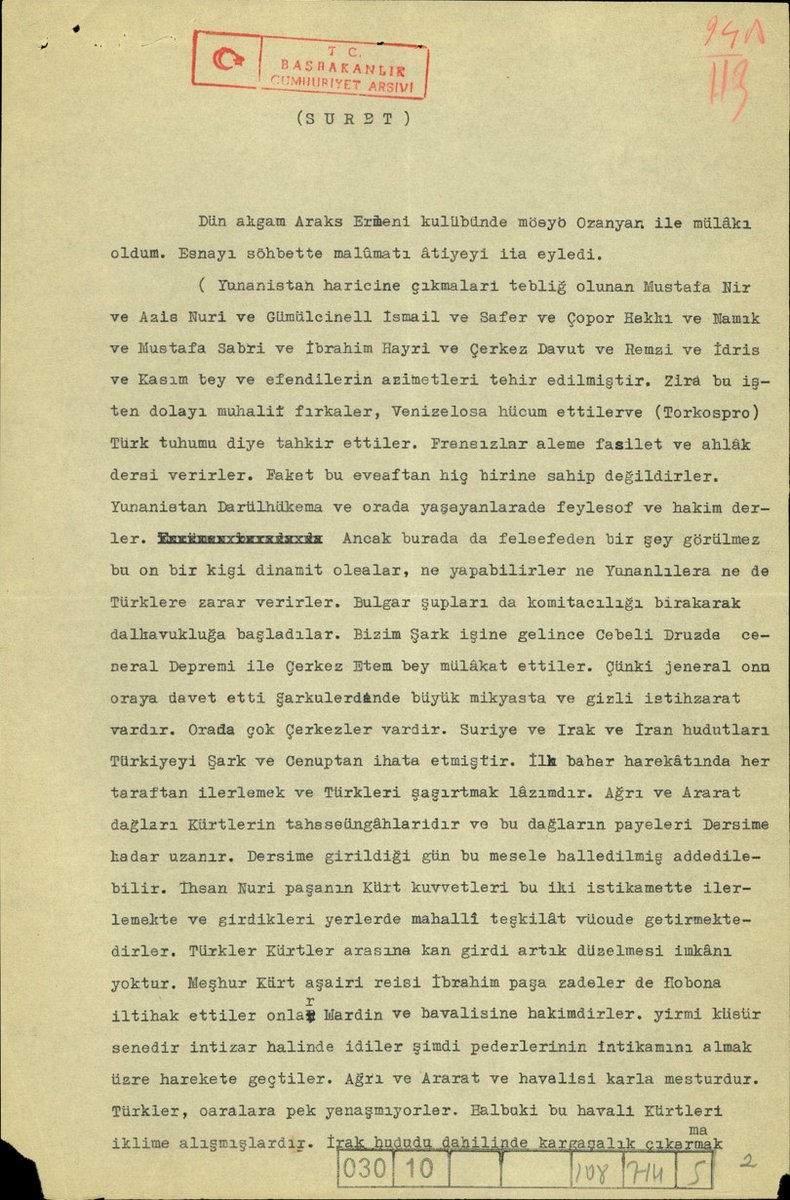
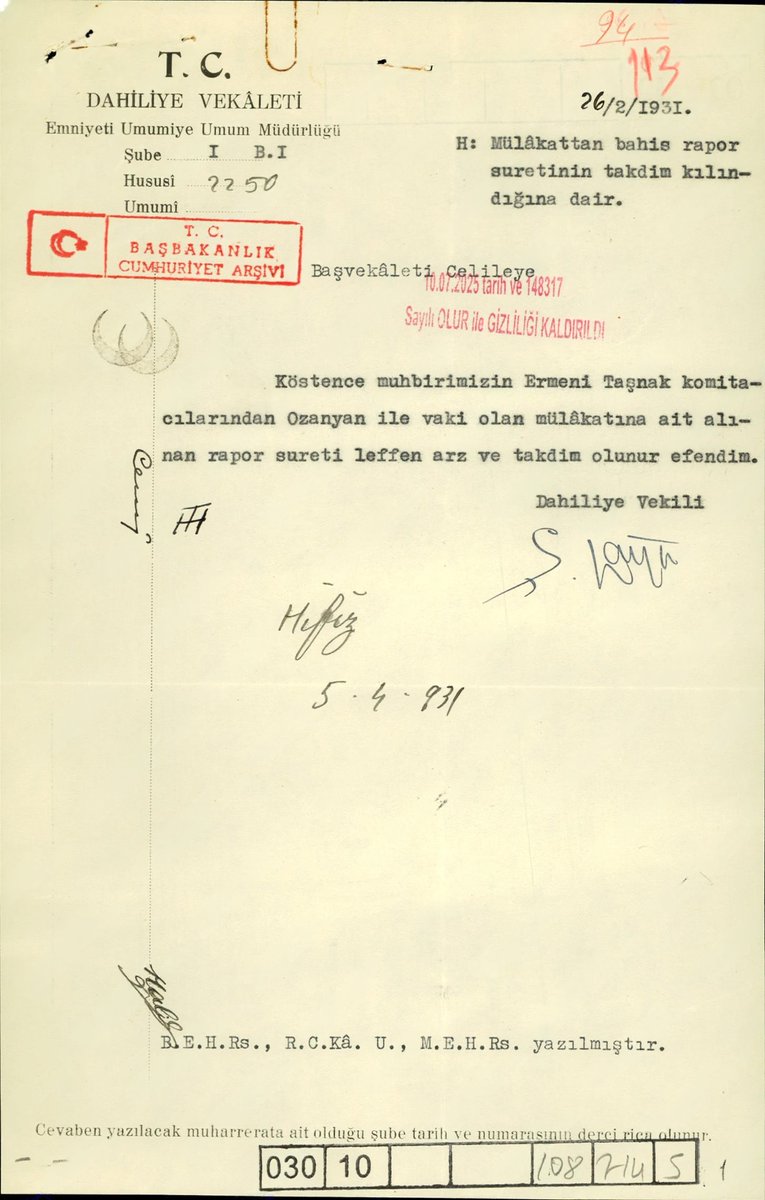
Turkish intelligence report from 26.02.1931, Constanta, of an interview between a Turkish agent and a Tashnag member with the cryptonym “Ozanyan” in Romania. The key points are summarized above, and the full translation is in the second post.
Our ancestral homeland is the Eastern provinces of Anatolia. Possessing this area is our ultimate ambition (aksa-yı emel). The Kurdish uprising is a fine opportunity; let them work, and we will help and reap the benefits of their labor, what a sweet deal! We applaud the uprisings and turmoil that will aid our success. Especially if Britain and France have a finger in the pie, we rejoice since success is one hundred percent guaranteed. In summary of summaries, I say that the years 1931 and 1932 are bringing us news of happiness and success.
Ozanyan sees the Kurdish rebellions in Western Armenia as an opportunity, because the two nations that cooperated in the genocide of the Armenians are now fighting each other. That would weaken both and open a path for the Armenians, who have gone through the genocide.
He was asked about an internal Turkish incident in Izmir and Manisa, where Islamist rebels beheaded a Turkish soldier. He answered:
Mind you, I am an Armenian, but I think like a human being: I simply cannot forgive them for sawing that young officer (Kubilay) with a saw despite all his pleas; such savagery cannot be. Despite being of the same race and the same religion, such brutal conduct is called monstrosity. Those who leave Turkey so far behind are always those turbaned ones whose heads deserve to be chopped off! When there is freedom, turbaned ones are seen in the demonstrations. When there is a Republic, many turbaned ones are found in the torchlight processions. Very well, then the faith healers rise up, Sharia is demanded there, and again the turbaned ones show up in the front rank. It is all out of greed for lucrative posts and fodder, just to fill their filthy stomachs.
And he adds that they could have assassinated Mustafa Kemal many times but decided not to because he was fighting the radical Islamists:
Mustafa Kemal's avoiding assassination until now is especially due to the path he has taken against these worldly demons. The Dashnaks (Tashnaksaganlar) have not taken a bad decision against Mustafa Kemal Pasha until now. Because if they had, he was coming to Istanbul every year and could have been destroyed a thousand times.
He quotes a Turkish proverb, prompted by these rebellions:
“The Turks have a proverb: ‘O Lord, grant a Turk no opportunity, lest he rise up. May a thousand and one maces never be missing from his neck.’ That is how the Turk is governed.”
He then talks about the Iraqi government letting the Turks carry out an operation against the Kurds in Turkey, as long as there are no disturbances at the border, very similar to today’s politics. He then says the Tasnags own the Iranian government and that the Syrian one should be next:
Ağrı, Ararat, and their surroundings are covered in snow. The Turks do not dare approach those parts; however, the Kurds of this region are accustomed to the climate. The Iraqi government has secretly notified the leaders that it will remain indifferent to the Kurdish operation, provided that disturbances are not created within the Iraqi border. As for the Iranian government, it is in the hands of our Dashnaks (Tashnaksaganlar). That leaves only the Syrian border; let us see how the fickle French will manage it...
The whole translation:
Yesterday evening, I met with Monsieur Ozanyan at the Araks Armenian Club. During the conversation, he provided the following information:
The departure of Mustafa Nir, Aziz Nuri, Gümülcineli İsmail, Safer, Çopor Hakkı, Namık, Mustafa Sabri, İbrahim Hayri, Çerkez Davut, Remzi, İdris, and Kasım Bey, along with the other gentlemen whose deportation from Greece was notified, has been postponed. This is because the opposition parties attacked Venizelos over this matter, insulting him by calling him 'Torkospro' (Turkish seed). The French give the world lessons in virtue and morality, yet they possess none of these qualities themselves. They call Greece the 'House of Sages' (Darülhükema) and those living there 'philosophers and sages'; yet no trace of philosophy is seen here either. Even if these eleven people were dynamite, what could they do? They can harm neither the Greeks nor the Turks. The Bulgarian rebels (Komitadjis) have also given up their rebel activities and turned to flattery.
As for our Eastern affair: General Depréme and Çerkez Ethem Bey held a meeting in Jabal al-Druze, as the general had invited him there. There are also extensive and secret preparations among the Easterners. There are many Circassians there. The borders of Syria, Iraq, and Iran have surrounded Turkey from the east and south. In the spring operation, it is necessary to advance from all sides and confuse the Turks. The Ağrı and Ararat mountains are the strongholds (tahassüngah) of the Kurds, and the extensions of these mountains reach all the way to Dersim. The day Dersim is entered, this issue can be considered resolved. İhsan Nuri Pasha's Kurdish forces are advancing in these two directions and establishing local organizations wherever they enter. Blood has now come between the Turks and the Kurds; there is no possibility of reconciliation. The sons of İbrahim Pasha, the famous Kurdish tribal leader, have also joined Hoybun. They dominate Mardin and its surroundings. They have been waiting for over twenty years and have now taken action to avenge their father.
Ağrı, Ararat, and their surroundings are covered in snow. The Turks do not dare approach those parts; however, the Kurds of this region are accustomed to the climate. The Iraqi government has secretly notified the leaders that it will remain indifferent to the Kurdish operation, provided that disturbances are not created within the Iraqi border. As for the Iranian government, it is in the hands of our Dashnaks (Tashnaksaganlar). That leaves only the Syrian border; let us see how the fickle French will manage it... As long as the Turks reconcile with the Russians, Germans, and Italians, they should not expect good treatment from the British and French. Today, Turkey's Eastern and Southern borders have become gangrenous.
In Damascus, a Mawlid was recited at the tomb of Saladin, and speeches were delivered. Stating that Saladin was a Kurd, they accepted him as a spiritual ideal and sought help from his spirituality. They recognized Seyyid Abdülkadir, Seyyid Mehmet, and Sheikh Said, who sacrificed their lives for Kurdish independence, as revered figures and martyrs. Their photos will be enlarged, distributed to the Kurds, and kept in every household.
The participation of all Kurds, both spiritually and materially, in the Kurdish movement has been decided upon and communicated to the Hoybun centers in America. There are more than three thousand Kurds in America. If each gives one dollar, it amounts to three hundred thousand dollars a month, which equals six hundred thousand Turkish liras. This is a fortune, and much can be accomplished with it.
I asked his opinion about the Menemen Incident, and he answered as follows:
I asked his opinion about the Menemen Incident, and he answered as follows:
"According to the reports we receive step-by-step, the Martial Law Court (Divan-ı Harp) is active. They announced that the trials would be public, but they are not carrying this out. The People's Party members say they will execute all the hoxhas; their leaders are reported to be Sheikh Esat, the preacher Hakim, and among the ulema, Sadık, İbrahim, Mehmet, and Rüştü Efendis. Sheikh Esat is a Naqshbandi sheikh from Ardabil. He is said to be a descendant of Shah Ismail Safavi, over ninety years old, and wealthy. In fact, Derminyasya reminded me in a letter of Sultan Selim's words: 'O Redhead Ardabil! See and learn who I am!', after which he says that this business will not end with the execution of a few people, but rather will increase the feeling of revenge, and that they have not forgotten to take advantage of this.
Martial Law Commander Fahrettin Pasha submitted his resignation due to his religious feelings, but it was not accepted. The President (Mustafa Kemal Pasha), who was unable to complete his tour because of this issue and returned to Ankara, departed on January 25 to complete his trip. Let us see what else will come of this. Whichever government treats its people well will be at peace; it must pamper the feelings of the people and relieve their poverty. A month ago, Turkish newspapers wrote that the people in the İzmir area were sustaining their lives with wild pears (ahlat). A month later, the Menemen and Manisa incidents occurred. Though the Turks have a proverb: 'O Lord, grant no opportunity to a Turk, lest he arise / May a thousand and one maces never be missing from his neck'. That is how the Turk is governed.
Mind you, I am an Armenian, but I think like a human being: I simply cannot forgive them for sawing that young officer (Kubilay) with a saw despite all his pleas; such savagery cannot be. Despite being of the same race and the same religion, such brutal conduct is called monstrosity. Those who leave Turkey so far behind are always those turbaned ones whose heads deserve to be chopped off! When there is freedom, turbaned ones are seen in the demonstrations. When there is a Republic, many turbaned ones are found in the torchlight processions. Very well, then the faith healers rise up, Sharia is demanded there, and again the turbaned ones show up in the front rank. It is all out of greed for lucrative posts and fodder, just to fill their filthy stomachs.
Mustafa Kemal's avoiding assassination until now is especially due to the path he has taken against these worldly demons. The Dashnaks (Tashnaksaganlar) have not taken a bad decision against Mustafa Kemal Pasha until now. Because if they had, he was coming to Istanbul every year and could have been destroyed a thousand times.
I told you what I thought as a human being; now let me speak as an Armenian: Our ancestral homeland is the Eastern provinces of Anatolia. Possessing this area is our ultimate ambition (aksa-yı emel). The Kurdish uprising is a fine opportunity; let them work, and we will help and reap the benefits of their labor—what a sweet deal! We applaud the uprisings and turmoil that will aid our success. Especially if Britain and France have a finger in the pie, we rejoice since success is one hundred percent guaranteed. In summary of summaries, I say that the years 1931 and 1932 are bringing us news of happiness and success."
Hrant Dink estimated that at least one million people of Armenian origin lived in Turkey, many unaware of their ancestry.
In 2013, @UniBogazici and @HrantDinkFnd hosted a conference in Istanbul on Islamised Armenians, briefly opening a window to discuss this long-suppressed history.
https://t.co/PTaV7m4Be7
Source:
- https://t.co/Tzk32sqdqz
- https://t.co/x9WBTcNk0r
- Nicola Migliorino: (Re)constructing Armenia in Lebanon and Syria: Ethno-cultural Diversity and the State in the Aftermath of a Refugee Crisis, pp. 45-75
“Turkophilia” and the Cure: Language, Memory, and Burj Hammoud.
There is an affliction of “Turkophilia” lodged inside us, and it is the cruelest kind. Even in these days, when Armenia has reluctantly extended a hand of reconciliation to our enemy, no matter how much hatred we may feel, nothing changes. This plague is in our blood. It is a terrible thing to be unable to erase the traces of the enemy from your memory. However hard you try to bury it underground, there come moments when it raises its head from within, against your will, and leaps to the tip of your tongue.
Six hundred years... Dozens of Armenian generations opened their eyes and saw the Turk above their heads. They learned adaptation, being the meek and obedient subjects of the Ottoman Empire, as a form of prudence and caution. They lived like sheep surrounded by packs of wolves. Then they slowly awoke from their five-century slumber and remembered that they too once had an independent country, kings and princes. How long could one remain a sheep? One had to become a wolf against the wolf, and even more, a sheepdog that strangles wolves. Behold, Zeitun! And so the era of awakening began. Not only those in power but even many members of the wealthy Armenian class did not look kindly on this awakening.
They wrote, they spoke, they organized demonstrations, and even took up arms. They struck and were struck; they trusted the new constitution, made peace, embraced, and in the end were undermined, driven from their homes and homelands. They became victims of torture and cruelty unseen in human history, and painted the deportation roads, all the way to the deserts of Deir ez-Zor, with their blood. The survivors took refuge in tin shacks, and their first task was to build a wooden church with a zinc-covered roof, and to place a wooden cross on top of it. On the desert sands, the mother teaching her child the alphabet listened in the church to the priest’s sermon in Turkish and worshipped the God of the Armenians.
Refugees in the camps were to some extent set apart by differences regarding their cultural background, including their regional, social and linguistic origins; many of the Cilician refugees were not primarily Armenian speaking (or could only speak Turkish).
The habit of speaking Turkish, especially in Syria and Lebanon, continued until the 1950s and 1960s of the last century, then gradually declined. But “Turkophilia” did not decline; simultaneously, an anti-Turkish hostility, in a sense a necessary one, also grew. Armenian youths prevented Armenians from entering cinemas that showed Turkish films; yet they could not prevent the watching of Turkish films broadcast on television in homes.
We find the solution to this in Lebanon, in Burj Hammoud. In this neighborhood, Turkish goods are banned. The Tashnag Party (ARF) is active here.
Schahgaldian has observed in particular the role of the Tashnag party in the early development of Armenian education in Lebanon. The party’s emphasis on education had its ideological foundations in the view that the Armenian youth was ‘wandering’ and had lost ‘purity’ of heart; according to the party it was ‘necessary to prepare the youth spiritually and mentally, for they must symbolize that revolutionary character which is the party’s heritage, for they must always be ever-ready soldiers of the ARF (Tashnaktsutyun) willing to work everywhere and under all circumstances’. The party objectives in education were pursued particularly through the opening and running of schools and educational councils. In the words of Schahgaldian, ‘the only mission of such schools was the creation of a new breed of Armenians in the image of what the party considered “true Armenians”, conscious of their history and culture, well-versed in their mother tongue and dedicated to the ideals of Armenian nationalism’.
When there are Turkish events or anti-Armenian initiatives in Lebanon, Lebanese Armenian youth organizations, such as the Tashnag Party’s Lebanese Youth Federation and the Zavarian Student Association, organize protests to defend Armenian rights.
According to Varanda Yakubian, a member of the Central Executive Board of the Lebanese Youth Federation, Tashnag youth are deeply attached to their roots and to Armenianness:
“Because we live in the diaspora, we are especially concerned with the issue of preserving Armenianness (hayapahpanum). We want to keep our Armenian-populated areas more Armenian, so that we do not abandon our Cause to oblivion and Armenianness does not vanish in the diaspora.”
The 23-year-old Armenian girl who speaks of boycotting Turkish goods notes that this is only a tiny part of the work of preserving Armenianness:
“Today Turkish products are infiltrating every region of Lebanon. In Lebanon, especially in Burj Hammoud, where Armenians live, we find a great many Turkish products. We are sure that the Turkish economy will not be weakened by one less chocolate, one less plate or one less garment. But if I now promote Turkish goods and my child sees it, the awareness that this is a Turkish product will not awaken in them. As long as our Cause is not resolved, the Turk is our enemy. So we must contribute to our Cause in every way; in particular we must awaken the youth, so that they do not bring in or sell Turkish goods, do not watch Turkish films, do not listen to Turkish music, and do not even travel to Turkey.”
You are a disingenuous and intellectually dishonest charlatan who pushes talking points to validate your own preconceived notions on how Christians are treated in Israel.
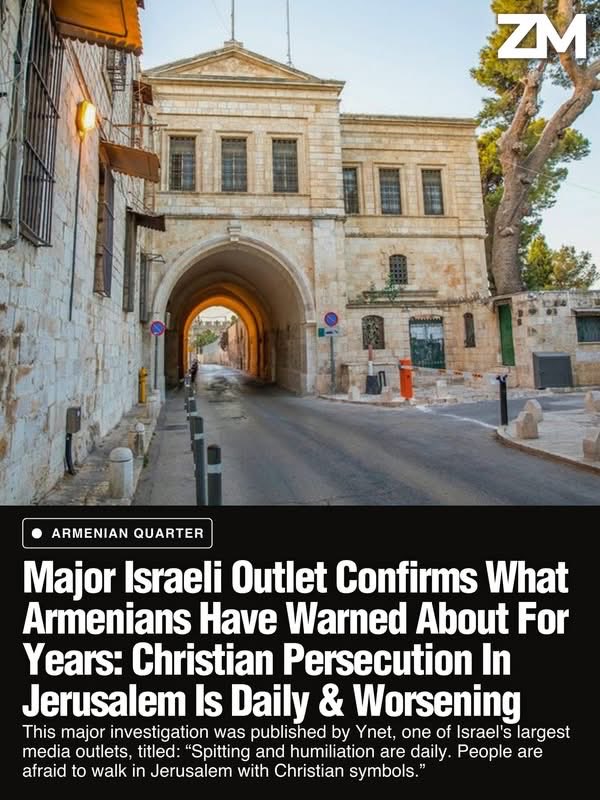
The Armenian Patriarchate of Jerusalem, as well as the Armenian community, have for years reported on anti-Christian harassment that is only increasing year by year. As have the Greek and Latin Patriarchates of Jerusalem, all three custodians of the holiest sites in Christianity.
The Israeli-run watchdog organization, Religious Freedom Data Center (RFDC), that monitors anti-Christian attacks, also corroborates all the evidence gathered by all involved parties, including Israeli Jewish volunteers of the RFDC.
A single video doesn't prove fuck-all when stacked against the overwhelming evidence painstakingly gathered over many years.
According to Ridvan, who became Christian ten seconds ago, the 1,700-year-old Christian Armenian presence in the Holy Land is lying.
I've personally reported on more than 100 spitting incidents.
Go sell your bullshit hasbara somewhere else. We're all stocked up here.