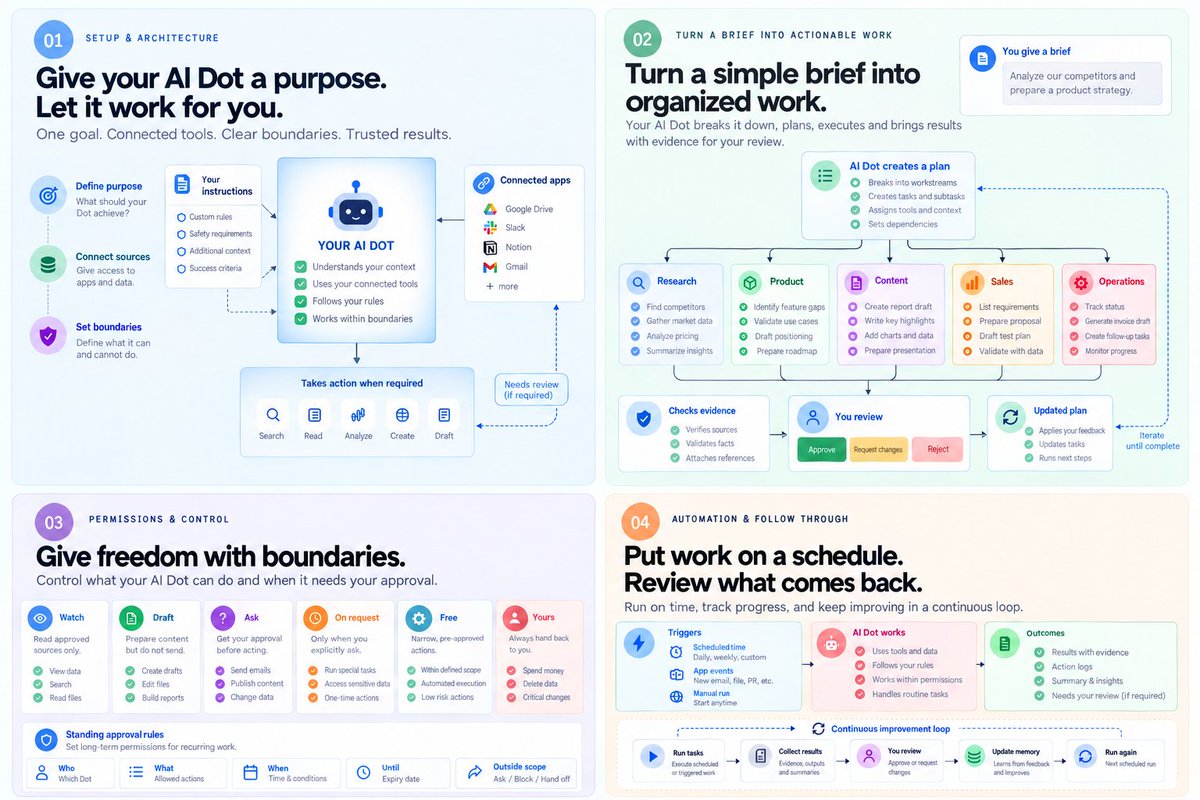
We're building something different:
AI that can actually own a piece of work.
Give it a goal.
Give it context.
Give it the right tools.
Set the boundaries.
Then let it work.
It plans the work, executes what it's allowed to do, returns evidence, asks when a human decision is needed, and carries approved context into the next run.
We're building an agentic AI work-management platform around that idea.
Not just AI that answers.
AI that keeps the work moving.
More soon.
Everyone says fine-tuning an AI model needs a big budget and an ML team.
It doesn't. You can do it on a free GPU in ~45 min.
I built a free hands-on lab that walks you through it, cell by cell:
→ train ~1% of a 1.5B model
→ watch loss fall 4.0 → 1.2 live
→ see it hallucinate, and learn why
No signup. Link below 👇
https://t.co/yFlRs6cbjd
Copy each cell into free Google Colab, run, done. What concept did you avoid because it sounded harder than it was?
I trained 1.18% of a 1.5B-parameter model on a free GPU and changed how it writes in 37 seconds. Then it confidently invented facts. Here's what that taught me about fine-tuning. 👇 What concept did you avoid because it sounded harder than it was?
9) The model was never the hard part.
The hard parts:
Idempotent jobs
Signed state across OAuth hops
Timezone-aware delivery
Non-blocking analytics
Building agents? What's your hardest non-AI problem? 👇
#AIAgents#PlatformEngineering
1) No portal. No tab-switching.
We built an AI agent that runs HR ops entirely inside Slack.
Change a manager, request time off, approve requests, update quarterly goals: one button or modal.
11 interaction families. 1 dispatcher. Full write-back to HR systems of record.
🧵
8) Around the edges: managed schedulers for directory sync, celebration and onboarding nudges, and follow-ups.
Delivered at 9 AM in each recipient's timezone.
Idempotent jobs, so retries converge instead of double-sending.
4) Multi-tenancy taught me the scariest phrase in enterprise AI: “ACL collapse.” A migration silently dropping permission boundaries. Nobody catches it until a customer does.
2) Foundations: async FastAPI, error handling around flaky model APIs, and a provider-agnostic LLM layer. Never let one vendor hold your product hostage.
1) Spent the last year going deep on agentic platform integration — making AI agents survive enterprise reality. 12 stages. Here’s what actually mattered. 🧵