As someone who grew up in premiere and after effects, and who now uses AI a lot for work, I really think that creatives should play around a lot more with frontier models (i.e., Codex, Claude).
These models are really good now. They understand if you say “add a light refraction” or “blend this film debris” or “adjust the easing to XYZ” or “give this a parallax 2.5d effect.”
And they can do more than that! If you have a vision for how the animations should come on screen and specify that you want it to be mixed-media but aren’t quite sure what the final look is yet, these models can spin up mock ups for you to choose and iterate on faster than it would take to get a third of the way through keyframes.
And what ends up happening is that you became a creative director of sorts. Your lifetime collection of references are all unlocked at once. Every creative idea and combination becomes possible if you can just describe it.
Creatives can scoff at the replies here because they don’t quite match the craft of the original. But some of them aren’t far off! Especially when you realize most of these are by people who said “hey Claude, please copy this.”
Now imagine what YOU could do? AI is putty in the hands of the creative, ready for you to shape and mold.
If the numbers show most power users were already using auto review, then that’s a huge win and I’d count that. For me auto-review came out of nowhere.
And for decisions api, I think since that’s already “been released” at dev day, it feels like a bit of a cop out. But if they came out with it and said “it’s also implemented in Codex and makes Codex 30% faster” I’d count that too!
I love the 28 days of codex christmas and all but can someone eli5 why OpenAI doesnt give benchmarks to Astra, set to max and ultrafast, and let it rip?
Day 1/
We have optimized the default speed to be ~50% faster across GPT-6 Astra and GPT-6.1 Sol through the subscription across all our products and partners using Sign in With ChatGPT (including OpenCode, Pi, Amp, Devin, ...).
No changes needed on your end and this should be felt within the next two hours.
Another dub for ai-native gen-z over the angry ai-adopter boomer generation
> Offers no rebuttal to a skill like /retro except for “you’re not gonna remember to use that.” As if you can’t…put it on a schedule? Even cron jobs existed in boomer times
> Posits potato works 10-12 hours a day without acknowledging that creating a system of high quality verification actually does enable tons of automation. The beauty goes into crafting these kinds of verification loops. But of course boomer would never trust AI
> “…and this how you end up with things like gstack” is not a takedown. Are you mindlessly installing these things? You may not care for its solution to memory. That’s fine. But say your goal was to get into YC. Would you just “trust the ai” or would you perhaps at least peruse the knowledge Garry worked hard to make accessible?
“AI would just find this and have told me.”
Voila, you’ve created a skill from first-principles.
uh…okay? I’m usually a huge fan of all things Codex, but this is comical. So you’re telling me to use this, a worse version of bypass mode (from the user experience) over bypass mode? Also, isn’t there already an “approve for me” mode?
Day 2.1/
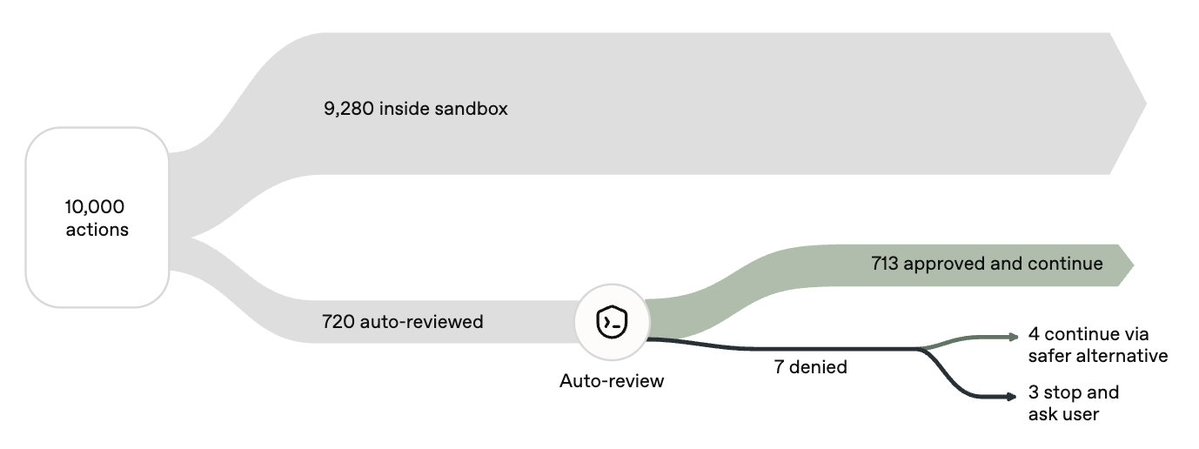
We have made Auto-review free for all users signed in through a ChatGPT account. You can enable it in settings > permissions > auto-review. Auto-review improves upon the default sandbox setting that requires you to approve everything, which is prone to decision fatigue unless you spend a lot of time configuring specific rules.
It allows you to run long tasks while having a second agent review all actions taken by the primary agent. Its only goal is to prevent high-risk actions from being taken and to protect against unwanted actions that are not aligned with the original user intent. This Auto-review feature is now free and does not draw usage from your plan.
Got the $500 @OpenAI plan and ultrafast is actually insane.
Used Astra high to help me with an old, highly disorganized (where the context lives across so many places), decently sized project (25 gb), that I promised myself I’d eventually get to.
Ultrafast indexed that and we got started working on it in literally a minute.
So cool to be working on this project again. But after ~15 minutes of working with Astra to clean up the project, it burned 10% of my usage 💀
Switched to fast and yeah it sucks to go back lol. But if Sol can do ultrafast, I think they for sure came back against Opus with this
Got the $500 @OpenAI plan and ultrafast is actually insane.
Used Astra high to help me with an old, highly disorganized (where the context lives across so many places), decently sized project (25 gb), that I promised myself I’d eventually get to.
Ultrafast indexed that and we got started working on it in literally a minute.
So cool to be working on this project again. But after ~15 minutes of working with Astra to clean up the project, it burned 10% of my usage 💀
Switched to fast and yeah it sucks to go back lol. But if Sol can do ultrafast, I think they for sure came back against Opus with this
For sure. We actually did consider just buying more subs, but we did internal benchmarking before deploying it across all these docs and for our (well-defined) tasks Sonnet 5 scored the same as Opus 5.5 and used 3-4x less usage. And that was before Sonnet 5.5. So might as well! I could see the need for Opus if it were a more complex review task though, with more ambiguity etc
Re: using Sonnet over Opus
Across two research projects, I have thousands of assets to review, on one project images, another documents. After applying ml solutions, there are still things we would need undergrad RAs to painstakingly review. But no need because I have Opus manage heaps of Sonnet subagents with overnight runs
I don’t understand the hype. I’ve been using exclusively Fable 5.1 and now I’m using exclusively Opus 5.5. Why do I care about Sonnet?
Am I using Claude Code wrong? Can someone explain this to me like I’m non-technical?