Unpopular opinion: Material 3 Expressive beats Liquid Glass.
Glass looks amazing in screenshots. Expressive is what I actually want to use all day. Bolder shapes, bigger touch targets, easy to read.
@jabbottiii Congrats on shipping your first Kotlin app to Google Play! Getting that first release live is a huge milestone. I'm building Frames for Pixel in public too, always fun connecting with other Android devs.
@ai_euge@antigravity Yea separating the model choice from reasoning effort and orchestrator mode would make that menu way faster to scan. I'm in Antigravity daily building a 16-bit 2D game with Gemini 4 Carbon and a cleaner picker would be a nice quality of life bump.
@joreilly AppFunctions going stable plus an on-device agent API is a big combo. Feels like the first real path to apps exposing actions to agents without needing a whole backend. Hope that ML Kit version conflict gets sorted soon, reading this one now
@_mohansolo Yea a fresh quota reset plus 22% more mileage from caching is a great way to head into the weekend. Time to push my 16-bit 2D game a bit further in Antigravity!
@fullstacklover I think it depends on how much platform polish you want. I'm building Frames for Pixel natively with Jetpack Compose and Material 3 Expressive because nothing quite matches native Android feel, though Kotlin Multiplatform is great if you need both.
@samsheffer The Android app improvements in AI Studio are the sleeper item on this list for me. Going from a prompt to a real Kotlin + Compose project is a bigger deal for Android devs than people are giving it credit for
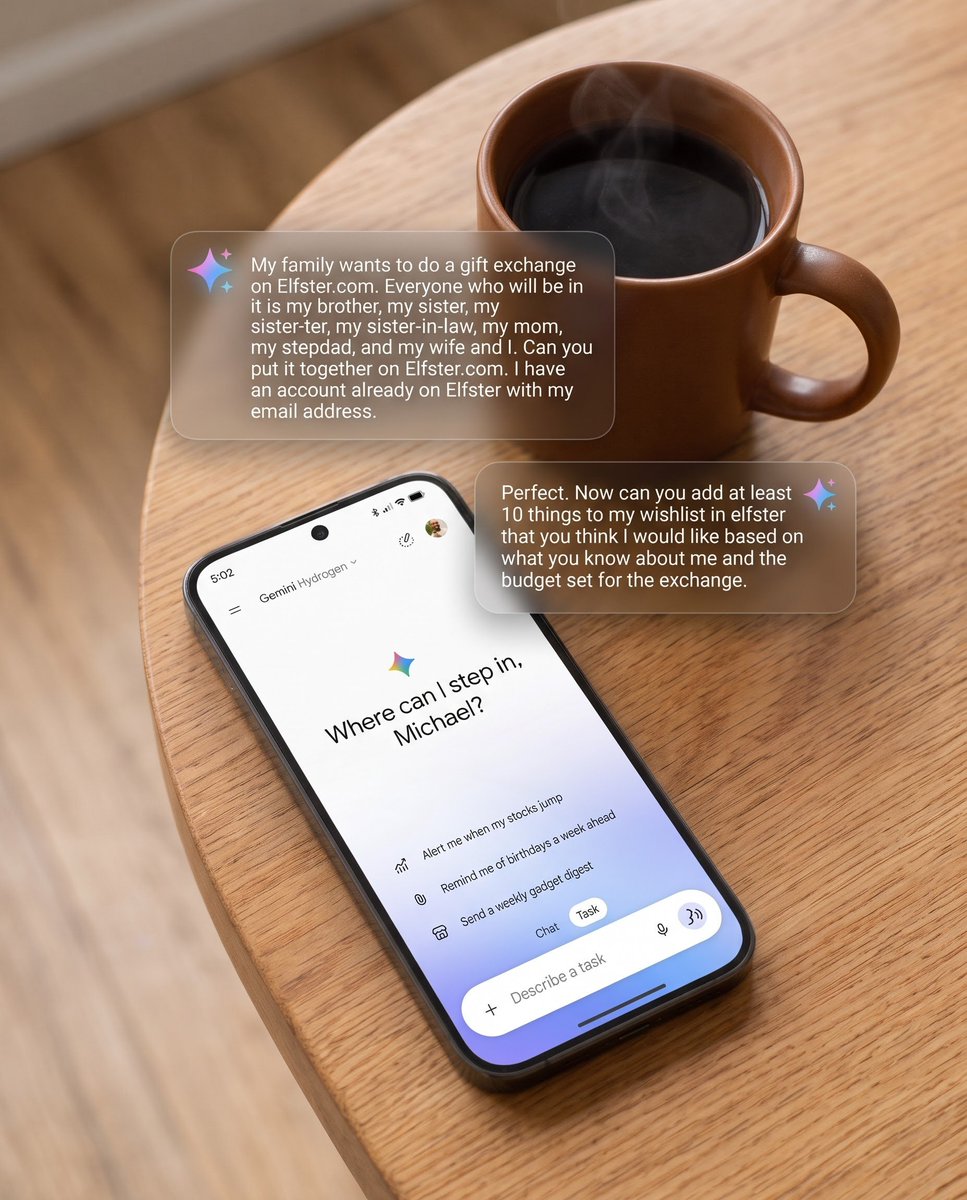
I just used Tasks in @GeminiApp to set up our entire family gift exchange on Elfster, and the workflow honestly blew me away.
I started with one prompt asking Gemini to organize an exchange for my brother, sister, sister-in-law, mom, stepdad, wife, and me. Because @Google Contacts is connected, it automatically found everyone's email addresses on its own.
Before touching the site, Gemini asked smart clarifying questions to lock in the details:
1. What budget we wanted to set
2. Confirming it pulled the right emails
3. Whether we were doing it in person or by mail
4. Suggesting a rule so couples wouldn't draw each other
Then it used its computer to open Elfster, sign into my account, title the exchange, enter every email, and apply the couple exclusion rule.
Once the @elfster confirmation email hit my inbox, I gave it a second task: add at least 10 items to my wishlist based on what it knows about me and our budget.
It scanned my memory and added a new book from an author I enjoy along with content creation gear that fit the exact price limit. 🎁
What's the most practical multi-step task you've handed off to an AI assistant lately?
I am not joking when I say that I test, test, and even re-test everything. 😆
Throughout my career, I have learned that rigorous testing is often the secret ingredient in ensuring that AI and collaborative development projects are executed correctly.
This perspective or came through my professional experience as a junior developer working alongside seasoned engineers in the fields of web architecture and engineering.
Unboxed the Google Pixel Tag and green Bellroy Leather Pixel Tag Case. Fast Pair connects it to Find Hub in seconds, and the size is super compact (about the size of a Blistex tube).
Are you picking up a Pixel Tag, or sticking with your current trackers? 🔑
@androiddevapps The screenOrientation portrait being ignored on large screens part is what's going to catch a lot of apps. April 2027 sounds far away but adaptive work is never just a layout tweak. It's state, insets, and testing on real big screens
@AndroidDev I think stable FlexBox and Grid is the real headline here. Adaptive layouts without nesting Rows and Columns forever. Native ProgressiveBlur is a nice bonus for wallpaper previews in Frames for Pixel 👀
@AndroidDev The performance skill running static checks on a PR is the one I want to try first. Catching Compose perf issues before review instead of after the jank shows up is a big deal
Connecting my Google Cloud Console to my Google Play developer account changed how I ship @Android apps.
Instead of downloading AAB files and manually clicking through release tracks, I can deploy builds straight from @Google Antigravity in seconds. It turns a repetitive multi-step chore into one smooth command and saves a ton of time on updates. 🚀
Devs, what part of your app release checklist do you wish you could automate next?
The #Material update for #JetpackCompose, version 1.5.0 is now stable and with this it means Material 2 is officially deprecated - you should migrate your apps to Material 3.
https://t.co/85YfYg6QZ4
Hot take: AI Studio building real Kotlin + Compose apps doesn't threaten Android devs.
Anyone can prompt an app now. Knowing why it janks, how to fix it, and how to make it feel right on a phone and a tablet is the actual job.