What happened in Delhi should not be treated as though it is some shocking new revelation about this government. It isn't. What we witnessed is part of a pattern that has existed for years.
The difference is that, until now, it was happening to what many people considered the "other India." It happened to Muslims. It happened in villages and remote regions, far from the comfort of India's metropolitan centers.
Homes were demolished. Communities faced violence. People were subjected to arbitrary state action. But much of urban India looked away because it believed those events had nothing to do with them. As long as the excesses were happening somewhere else, many chose silence.
There was a comforting illusion that our children are safe, they are getting education, they will have jobs, they will have secure lives, and the government will never treat them that way.
But now it is happening to your children. It is happening to students. It is happening to English-speaking, urban, middle-class young people. And suddenly, many are shocked.
I have immense respect for these young people. They are demonstrating something deeply important. They are not indifferent to the future of this country. They are asking questions. They are demanding accountability. They are refusing to be misled. They care about the kind of India they will inherit and the kind of society they want to build. They are rejuvenating the idea of India we forgot. They are owning the imagery of Gandhi. That sense of idealism deserves appreciation.
Perhaps this moment is an eye-opener. The same machinery that people ignored when it targeted others has now reached their own doorstep. If you believe this government will spare your children simply because they are urban or Hindu, you are making a dangerous mistake. Arbitrary power eventually reaches everyone. You were exalting the "Narendra Modi, lath bajao" slogan when it was directed at others, and now?
Where does this audacity come from? From the firm belief that it no longer has to answer to the people. A pliant media suppresses scrutiny, electoral institutions are compromised, constitutional bodies have been captured, immense wealth amplifies power, and opposition leaders are systematically targeted and weakened. And the agency of people is celebrated with lathis.
The question before the people of India is simple: Do you want a country where your children can be beaten for raising their voices? Or do you want a democracy where dissent is respected and citizens are treated with dignity?
This culture of brutality, repression, and excess must be challenged before it becomes irreversible. The time to draw that line is now.
Gandhi is alive and also his method of satyagraha : Rather than inflicting pain on the opponent, the satyagrahi (practitioner) willingly accepts suffering without retaliation. This is to awaken the oppressor's moral conscience and melt their resistance.
Only this time "Gandhi" is not against the foreign colonial rulers, but against the silence and insensitivity of his own elected people.
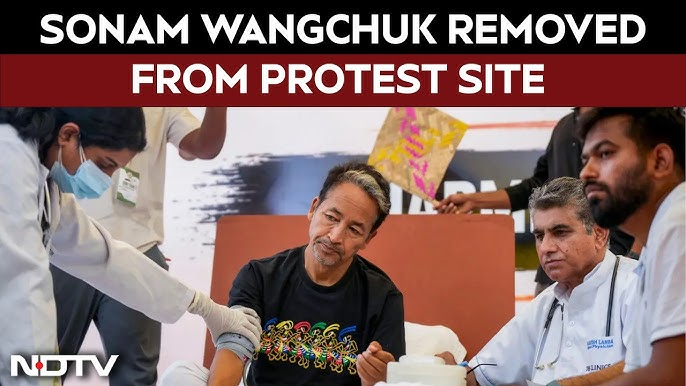
AAP leaders have taken over the CJP protest. This is the main reason Sonam Wangchuk ended his hunger strike.
The protest got big public support only because of Sonam. AAP now wants to use that support for their own benefit.
Sonam must have felt that after fasting for 21 days, these politicians were coming just to take the credit.
कुछ खबरें परेशान करती हैं बेहद परेशान। क्या अरविंद केजरीवाल, आम आदमी पार्टी को यह पता नहीं था कि दिल्ली के पूर्व एलजी वी के सक्सेना के कहने पर सोनम वांगचुक और कॉकरोच जनता पार्टी का मेल मिलाप हुआ और सोनम भूख हड़ताल पर बैठे?
अगर यह जानकारी नहीं थी तो यह बड़ी राजनीतिक भूल है अगर यह जानकारी थी तो पूरा प्रदर्शन बड़ी राजनीतिक चाल है। यह वही सक्सेना हैं जिन्होंने आम आदमी पार्टी और खुद अरविंद केजरीवाल पर बेहद गंभीर आरोप लगाए
जो केजरीवाल की सरकार जाने की एक बड़ी वजह थे। कुछ सवाल जरूरी है।
एलजी सक्सेना ने सोनम से सीजेपी की सिफारिश क्यों की?
क्या सोनम ने जेल से छूटते ही एलजी से मुलाकात की थी?
केंद्र सरकार द्वारा सोनम के खिलाफ मामला हटाने में सक्सेना की क्या भूमिका थी?
Recent remarks by Shri Sonam Wangchuk have raised several questions that deserve transparent answers both from him and CJP organisers.
Shri Wangchuk said that he was forced (vivash) by the Lieutenant Governor of Ladakh Shri Vinai Kumar Saxena (previous Delhi LG) to meet Abhijit Deepke. This raises certain questions.
The people of India deserve clarity on a few issues:
1. Why the LG of Ladakh forced him? "Vivash" as he uses the word.
2. Why was such a meeting considered necessary?
3. On whose instructions was this meeting held?
4. Was there any political purpose behind facilitating the meeting?
5. Why Sonam Wagchuk came under pressure (vivash) to meet Dipke?
6. What was discussed during that meeting?
7. How did LG Ladakh came in contact of Dipke?
8. Why Dipke met Sonam Wangchuk through LG of Ladakh?
9. On whose instructions was Dipke working?
10. Did Sonam Wangchuk tell Dipke that LG pressed him for the meeting?
These are legitimate questions that can only be answered through transparency, not speculation.
We have all been praying that Shri Sonam Wangchuk should not lose his life. The Delhi High Court, too, expressed serious concern over his deteriorating health and directed the health ministry to ensure that hospitals remained prepared to provide medical care if required.
When it became clear that his condition had reached a critical stage and continuing the fast posed a grave risk to his life, the Delhi Police, acting in line with the spirit of the High Court's directions, shifted Sonam Wangchuk to a hospital. In that sense, the administration upheld the court's concern for preserving life.
This was the right step. It was essential his life could not be allowed to slip away. Ensuring that he received medical attention was both appropriate and necessary.
The government had shown little indication that it would respond either to Wangchuk's worsening health or to growing public pressure. This was clear from the day one that the sacrifice of one man will never deter the Hon'ble PM to hold a dialogue. People of India must see, who they have elected and put in power.
The CJP, the youth wing of Aam Aadmi party which turned Sonam Wangchuk into a political scapegoat, can now proceed without the moral pressure that his fast had created. Sonam Wangchuk had become a powerful symbol.
Praying for his good health and quick recovery.
When this man arrived in India, he claimed the Opposition was incompetent and created the impression that he would bring about change in the country.
Then, he started making Reels, Giving interviews and growing his Follower count.
Sonam Wangchuk got entangled with this clown, While Wangchuk is observing a hunger strike, This man sits there eating samosas and drinking Starbucks coffee.
Now, he is questioning why Rahul Gandhi isn't supporting him, Even though he had previously stated that Rahul Gandhi is not the solution for the country.
Sonam Wangchuk should call off his strike and stop turning such people into Stars.
Rahul Gandhi is raising the voice of students more effectively, Tomorrow he is in Dehradun, Lakhs of students will join him, The People of India should support RG, Dharmendra Pradhan must have to resign.
Sonam Wangchuk Is on a Hunger Strike. But This Is Not the Failure of Gandhian Politics. Written by @gurdeepsappal ji
---
Sonam Wangchuk is on a hunger strike.
The Modi government appears unmoved.
His supporters are now appealing to Rahul Gandhi and other opposition leaders to come out in support of him. At the same time, many commentators have begun celebrating what they call the "failure" of Gandhian methods. Others argue that Gandhi's techniques succeeded only because the British were a "civilized" adversary; against someone like Hitler, Gandhi would have failed. Still others have revived the old "safety-valve" theory—that the British deliberately promoted Gandhi to neutralize revolutionaries.
Every one of these claims is fundamentally flawed.
Gandhi Never Used Fasting Against the British
The first fact that must be understood is that Gandhi never undertook a political fast against the British government.
He was never under the illusion that he could simply stop eating and expect the colonial state to surrender. Gandhi was far too politically sophisticated for that.
So why did he fast?
Before answering that, it is worth recalling how, barely fifteen years ago, India witnessed perhaps the greatest political fraud committed in Gandhi's name. By giving Anna Hazare a Gandhi cap, placing him on a fast, and presenting him as the "new Gandhi," an entire generation was encouraged to believe that fasting alone constituted Gandhian politics.
It does not.
Wearing a black coat does not make someone a lawyer. Hanging a stethoscope around one's neck does not make someone a doctor. Likewise, merely sitting on a hunger strike does not make someone Gandhi.
Anna Hazare was never Gandhi—a fact that has become obvious with time.
Sonam Wangchuk is different. His lifelong work and achievements cannot be dismissed. Yet despite those accomplishments, he too appears to have fallen into the trap of oversimplifying Gandhian methods. Today he finds himself repeatedly colliding with the wall of an insensitive government while insisting that his movement is "non-political" and "neutral," only to eventually appeal to Rahul Gandhi and other political parties for support—while simultaneously lecturing them on morality.
It is an attempt to have the benefits of politics without acknowledging politics itself.
Gandhi's Fasts Were Directed Inward, Not Outward
This becomes clear when we examine Gandhi's own fasts.
He undertook roughly seventeen major fasts during his public life. Not one of them was directed against the British government.
That was no coincidence. It reflected a profound political understanding.
Gandhi's fasts were inward-looking.
They were aimed at his own people, his own followers, his own society, and the moral conscience of communities with whom he shared ethical bonds.
In 1918, during the Ahmedabad textile workers' strike, Gandhi fasted not against British rulers but to strengthen workers whose resolve was weakening.
In 1947, as Calcutta burned in communal violence, Gandhi fasted not against any government but to awaken the conscience of Indians killing one another.
His famous 1932 fast leading to the Poona Pact was not directed at the British either. It was aimed at persuading Dr. B.R. Ambedkar and orthodox Hindu leaders to reach a compromise over separate electorates. The British merely stood by as spectators.
This is how fasting works.
A fast influences those who are morally connected to you—those who cannot bear responsibility for your death.
It does not work against an enemy that feels no moral obligation toward you.
It does not move an authoritarian state simply because you refuse food.
Therefore, the Modi government's indifference is not evidence of the failure of Gandhian politics.
It is evidence of using the wrong Gandhian instrument against the wrong target.
What Was Gandhi's Weapon Against the State?
If fasting was inward-looking, Gandhi's weapon against political power was something entirely different.
It was Satyagraha and Non-Cooperation.
These were outward-looking strategies directed squarely at state power.
Their logic was simple: no government can function without the cooperation of the governed.
Boycott foreign cloth.
Refuse to pay unjust taxes.
Withdraw participation from colonial courts and institutions.
Refuse administrative cooperation.
When millions participate, the machinery of the state begins to seize up.
That is how political pressure is created—not by hoping that power will suddenly develop compassion for an individual fasting in isolation.
Binding all these methods together was Ahimsa.
Non-violence was not merely an ethical aspiration. It was simultaneously a philosophy and an extraordinarily sophisticated political strategy.
Philosophically, Gandhi believed that unjust means could never produce a just end. Means and ends were inseparable.
Strategically, non-violence deprived oppressive regimes of moral legitimacy. Every blow landed on an unarmed protester transferred moral authority from the ruler to the ruled and shifted public opinion in favour of the oppressed.
Ahimsa was the framework.
Fasting and Satyagraha were different instruments within that framework, each designed for different circumstances.
The Myth That Gandhi Would Have Failed Before Hitler
This popular argument misunderstands Gandhi entirely.
Gandhi himself knew that Satyagraha depended upon the moral relationship between the protester and the opponent.
That is not a weakness.
It is its very definition.
The real question is not, "What would Gandhi have done against Hitler?"
The real question is, "What is the appropriate political instrument against a regime that recognizes no moral obligation?"
Gandhi never claimed that every opponent could be confronted using the same method.
Reducing Gandhi to little more than "fasting" and then declaring him ineffective against Hitler reflects a shallow understanding of both Gandhi and political strategy.
The "Safety-Valve" Theory Is Historical Propaganda
The second myth is even more dangerous.
According to this theory, the British promoted Gandhi in order to sideline revolutionaries and create a harmless outlet for popular anger.
History says otherwise.
If the British genuinely treated fasting as a harmless safety valve, they would never have allowed Jatin Das to die.
In 1929, Jatin Das remained on hunger strike inside Lahore Jail for sixty-three days.
Despite recommendations for his release, the British refused—fearing that he would become even more popular outside prison.
Force-feeding destroyed his lungs.
He died on the sixty-third day.
More than half a million people joined his funeral procession.
Terrified by the public response, the colonial government later stopped returning the bodies of revolutionary prisoners to their families to prevent similar demonstrations.
Governments do not fear funeral processions of people they supposedly use as "safety valves."
The claim collapses under its own weight.
Congress Also Paid in Blood
Equally offensive is the claim that only revolutionaries sacrificed their lives while Gandhians remained safe.
The Gandhian path was never comfortable.
During the Quit India Movement of 1942, the British government's own figures recorded 1,028 people shot dead, over 3,000 seriously wounded, and more than 100,000 imprisoned.
Congress estimated the true death toll to be far higher.
Villages were burned.
Women were assaulted.
Public floggings became routine.
Thousands of ordinary Congress workers gave their lives.
To claim that Congress never bled for India's freedom is either historical ignorance or deliberate falsehood.
The difference was never between who sacrificed and who did not.
The difference lay in using the right political instrument at the right political moment.
Revolutionaries fasted knowing the state would show no mercy.
Gandhi attacked the state through organized mass non-cooperation.
Both demanded sacrifice.
Neither depended upon compassion from the ruler.
Why This Hunger Strike Is Not Gandhian
Here lies the central contradiction.
Appealing to others—to political parties, governments, or public figures—to come and end one's fast is fundamentally different from Gandhi's politics.
Gandhian struggle was built upon sacrifice.
It demanded collective action rather than solitary suffering.
It demanded fearlessness before repression.
It demanded accepting consequences without pleading for rescue.
That is why Gandhi and his closest associates never sought mercy.
The first condition of joining Gandhi was renunciation: the renunciation of falsehood, comfort, privilege, convenience—and, if necessary, life itself.
Gandhi's Forgotten Principle: Transparency
Perhaps the most neglected aspect of Gandhi's politics was transparency.
His Satyagrahas were conducted entirely in the open.
He publicly declared which law he intended to violate.
He explained why.
He broke it openly in daylight.
There were no hidden agendas.
No secret political calculations.
This transparency itself became a source of moral power because it prevented the British from portraying his campaigns as conspiracies.
The Anna Hazare movement collapsed precisely because this transparency was absent.
Its real political objectives remained concealed.
The forces operating behind it were never honestly acknowledged.
As those layers gradually emerged, Anna disappeared from public life while Arvind Kejriwal became another conventional politician.
Today's movement risks carrying the burden of that same deception.
Its objectives remain insufficiently transparent.
Its political alignments remain unclear.
AAP activists increasingly appear behind pseudonymous accounts.
Yet the movement simultaneously insists upon calling itself "non-political" and "neutral."
That language itself echoes the long-standing RSS project of discrediting democratic politics by persuading citizens that politics is inherently corrupt.
Once people lose faith in politics, they gradually lose faith in democracy itself.
That has always been the deeper danger.
A Contradiction in Moral Appeals
The movement now appeals to Rahul Gandhi as though supporting it were his moral obligation.
Yet those making this appeal remain largely silent about Rahul Gandhi's own campaigns on issues such as NEET and the sustained protests led by Congress's student and youth organizations.
This selective expectation further weakens the claim of political neutrality.
Transparency—the central Gandhian test—is missing.
That is why many people who felt betrayed after the Anna movement now approach this agitation with caution.
When objectives remain unclear and political positioning ambiguous, the moral clarity required for mass participation simply disappears.
Gandhi's Name Deserves Better
To describe this hunger strike as proof that Gandhian politics has failed is intellectually dishonest.
Invoking Gandhi's name is easy.
Understanding which instrument belongs in which political context is far more difficult.
That discipline is what made Gandhi effective.
And that discipline is precisely what is missing here.
Transparency is missing.
Faith in democratic politics is missing.
Clarity of purpose is missing.
For these reasons, this hunger strike should not be cited as evidence of the failure of Gandhian methods.
It is, instead, an example of misapplying them.
Saving PM Narendra Modi by shifting the blame to Rahul Gandhi is not serving the genuine interests of the people. It is encouraging that people can see behind the smokescreen.
Image: AI generated
#SonamWangchuk
Are the gloves off now???
Is it mandatory for every political party and leader to join this protest?
If this is truly a "protest with no political colour," is it appropriate to expect political parties to participate?
Is the acceptance of this protest among the people zero that we now have to call mainstream political actors ?
Has this movement failed to generate the political momentum of its own? Where are the 24 million followers of this movement?
Wouldn't the neutrality and sanctity of such a movement be better preserved by keeping political actors out?
What was the original aim of the movement to ask for Pradhan's resignation or take aim at Rahul Gandhi?
And most importantly, where is the call directed at the Prime Minister of India? Why isn't pressure being created on the government, which ultimately has the authority to act?
Sonam Wangchuk ji @Wangchuk66 we also demand magnanimity from your side to share stage with other children who are also protesting and some on hunger strike ?
Why should the stage be reserved for you and your cockroaches?
Please share the limelight with them, otherwise it will display "pettiness".
-----
This is new india where accountability is demanded not from the government of the day but to the opposition.
Long live mother of so called democracy.
It is deeply heartbreaking to see the condition of Shri Sonam Wangchuk ji @Wangchuk66 . He is not just a respected public figure but someone who has consistently raised important issues concerning Ladakh, the environment, and constitutional rights. On a humanitarian basis one should be concerned about his health.
We have always stood with Sonam Wangchuk ji. Rahul ji has repeatedly expressed support for his Ladakh cause, and when he faced legal action, lawyers and leaders associated with the Congress party stood by him and fought his case. Our solidarity with him has never been in question.
However, there is one disagreement, but with the method being adopted today. This is my personal opinion.
The political climate in India has changed. These are not ordinary times where a hunger strike alone can move those in power. We are dealing with a regime that has repeatedly shown that it is willing and proud to ignore prolonged protests, peaceful demonstrations, and moral appeals. They are immoral people. They demean the protestors calling them aandolan jeevis parasites. This regime did not move when 700 farmers died during the protest.
History tells us that fasting and moral persuasion have their place. But every political moment demands its own strategy. Today, silence alone is not enough. The times demand the language and method of resistance. They demand a louder, more organised, and more combative democratic movement that reaches the people, challenges propaganda, and mobilises public opinion.
My appeal to Sonam Wangchuk ji is this, please do not risk your life in the hope that this government will suddenly develop a conscience. Your voice is far too valuable to be lost in silence. Also dissociate from forces which have put you in this condition.
Please use your credibility for a proper use, mobilise people, organise rallies, public meetings, discussions, and democratic campaigns across the country. Speak directly to citizens and help building a mass movement. That is the language authoritarian governments fear the most. They are not interested in some silent suffering. They fear an awakened and organised people.
My sympathy and respect for Sonam Wangchuk ji remain unwavering. Please break you fast. Our common cause deserves to be fought with every democratic tool available, and today, the most powerful tool is a strong, vocal, and organised people's movement. Hope this appeal reaches you.
We are an emotional people, and undoubtedly, that is one of our greatest strengths, but not always. Today, a lot of us are inspired by the image of two "crusaders" standing together, fighting for some "cause", and we instinctively extend our solidarity to them.
But we have seen this deception before. Go back to 2013.
Back then, it was Anna Hazare and Arvind Kejriwal. Anna was projected as the moral force of the nation; many even called him the "incarnation of Gandhi." Kejriwal was presented as the devoted follower, the ideal disciple. It was sold as a guru-shishya partnership that would transform Indian politics.
But here we are in 2026. Today, the script looks strikingly familiar. Once again, there is an attempt to create an "Anna Andolan 2.0." The faces may be different, but the political storytelling is the same. It assumes that people have short memories.
Before getting carried away, ask yourself a few simple questions.
What happened to the Anna Andolan?
What happened to Anna Hazare?
And what happened to Arvind Kejriwal?
What happened to their promises?
Arvind Kejriwal, the man who promised to stay out of politics entered politics. The man who said he would live simply, travel in a Wagon R, and reject VIP culture and security eventually came to be associated with controversies over his official residence, enhanced security, and the privileges of power. The same man also fought in court over his entitlement to a Type VIII government bungalow. His simplicity left the city? Anna Hazare has receded from the national political stage. Today, he surfaces only occasionally with warnings of protest, which are defused by Fadnavis.
These two figures orchestrated a "coup" againt the Congress and plunged the country into a dark chapter of its history. Many of the problems that people hoped would be solved have aggravated. Our social fabric has become deeply fractured, and repairing it may take generations.
I want to say again that I have nothing personal against any individual associated with these protests. My appeal is directed only to the people of India.
Watch carefully and question this "political safety valve" created to control the public anger. Ask yourself, who truly benefits from when the anger is diffused by such gimmicks. You will find the answer.
In the end, let me say this once again, the @INCIndia Indian National Congress is the only democratic force with the organisational depth, national reach, and political resolve to challenge the BJP and unseat Prime Minister Narendra Modi. It's time to break out of the vicious cycle you've been trapped in.
Join us and help shape India's future. Do not fall for distraction AGAIN. Repost and let the truth travel.
India has a tendency of falling for false heroes. They completely ignore and forget the sacrifices of the real people who quietly dedicate themselves to public service, not for power or praise, but because they believe it is their duty towards the people.
But people have a tendency to fall for false heroes. We are an emotional nation which is good, but when those emotions are manipulated, they become our greatest vulnerability.
So my request and appeal to the people of India is, please see clearly. You have burnt your hands enough. Look for the real heroes. They are around you. They are in front of you. It is you who has to recognize them, support them, and strengthen them.
The opposition cannot do it alone. Opposition parties are not some all-powerful entity. The opposition becomes powerful and gets strength from the support of all of you. You expect a lot from the opposition, but you must ask yourself, how much are you supporting it?
Ideally, even if you have already voted for a government, by supporting the opposition you are demanding better for yourself. It's that simple. The government is not going anywhere, but by standing with the opposition, you make the government more accountable. Whatever issues the opposition is raising are not for its own personal benefit, they are for your betterment.
If you're not supporting them, if you're not giving them strength, how can you expect the opposition to do it on its own? We cannot do it all alone.
We do not have the kind of support structure that the BJP had during the UPA years. They had the media. They had the country's institutions with them. Today, what do we have? We do not have the institutions. We do not have the distribution network of the mainstream media. We have these supporting structures against us. We just have ourselves and the people who support us.
So if you lend us your support, if you strengthen our hands, if you support our causes, which are, in fact, your causes, you will make this country better. Otherwise, you will continue to remain trapped in the same vicious cycle. You have a chance to come out of it.