Can Upadacitinib Help in Refractory Bullous Pemphigoid?
A case report and literature review describes a 74-year-old woman with treatment-refractory bullous pemphigoid who achieved rapid clinical improvement with upadacitinib.
Her BPDAI score decreased from 103 to 36 within 2 weeks and to 29 by week 4, with complete clinical remission maintained at 4 months.
These findings highlight the potential of JAK1 inhibition as a steroid-sparing strategy in refractory BP, although further studies are needed to establish its efficacy and long-term safety.
DOI: https://t.co/Hg34G3lQtD
#Dermclub_Research
@ssdds_org
The SSDDS Dermatology Club is pleased to announce that applications are now open for dermatology research opportunities!
We welcome students and aspiring researchers interested in contributing to dermatology research.
Researcher Application:
https://t.co/QFMYheaCBh
Research Supervisor Application:
https://t.co/7Xzs21eial
📅 Application Deadline: November 30, 2026
We encourage interested applicants to take advantage of this opportunity and contribute to advancing dermatology research!
@ssdds_org
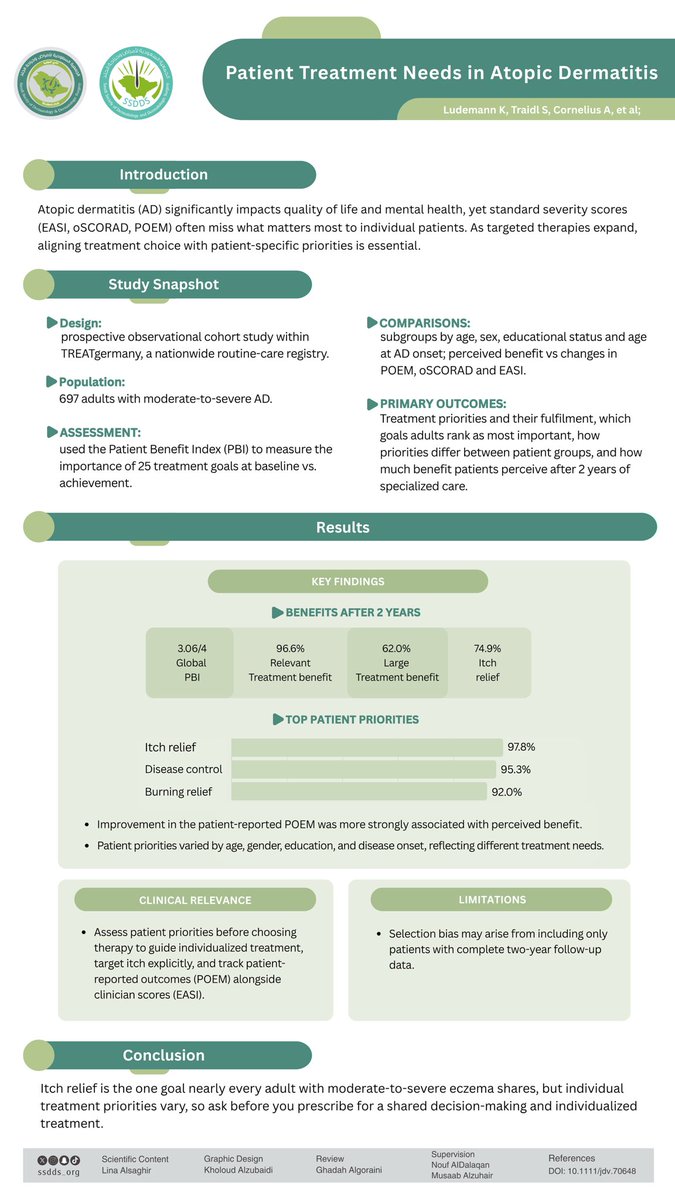
What Matters Most to Patients with Atopic Dermatitis?
A prospective cohort study found itch relief to be the top treatment priority in adults with moderate to severe atopic dermatitis. Patient reported outcomes were more closely associated with perceived treatment benefit than physician assessed severity scores, highlighting the importance of patient centered care.
📖 DOI: https://t.co/kHUGSj2Hv6
#Dermclub_Research
@ssdds_org
Can Switching Biologics Improve Psoriasis Control?
A recent meta-analysis of 24 RCTs involving 12,661 adults found that switching biologic classes improved psoriasis control, but it was not significantly more effective than continuing the same biologic in direct comparisons.
Switching to IL-23p19 inhibitors was associated with better control, while switching from TNF-α to IL-17A inhibitors increased serious adverse events.
These findings highlight that treatment decisions should be individualized, considering the biologic pathway and infection risk.
DOI: 10.1001/jamadermatol.2025.2714
@ssdds_org
How Should Systemic Therapy Be Selected in Atopic Dermatitis?
A recent review discusses biologics and oral JAK inhibitors for moderate-to-severe atopic dermatitis, with treatment selection guided by age, severity, comorbidities, prior response, patient preferences, and safety.
Dupilumab remains a first-line option from 6 months, with IL-13 inhibitors, nemolizumab, and JAK inhibitors offering additional strategies.
DOI: 10.1016/j.jaad.2026.01.075
#Dermclub_Research
@ssdds_org
When Does Acute Urticaria Progress to Chronic Urticaria?
A systematic review of 16 studies involving 52,564 patients found progression rates of 5.8%–36.0%.
No consistent predictors were identified, and early systemic corticosteroids did not prevent chronicity.
These findings support symptom control and appropriate follow-up over aggressive treatment.
DOI: 10.1001/jamadermatol.2026.1901
#Dermclub_Research
@ssdds_org