Game theory confirms that the most dangerous opponent in any given interaction is the one whose next move you cannot reliably predict.
A fully predictable strategy is a perfectly exploitable one. Your opponent will immediately attempt to play the best response to your strategy.
And a skilled opponent will accomplish this without great effort.
But unpredictability forces them to hedge.
Now they're forced to make assumptions.
Their calculated best response is no longer objective. It may not even resemble the truth at all.
Suddenly, they begin to struggle, each prediction costing them valuable mental energy.
That's your advantage.
Mix your strategies.
Be unpredictable.
🇭🇰Hong Kong Targets July Launch for New Gold-Clearing System
Hong Kong is planning to launch a new government-backed gold-clearing system by July, according to people familiar with the matter, as part of its push to become a global bullion trading hub. The system will mirror London’s clearing infrastructure and support unallocated gold accounts, allowing faster and more scalable settlement without requiring ownership of specific bars.
The initiative is designed to strengthen Hong Kong’s role in gold trading, financing and storage, with invitations extended to China-friendly central banks and participation from major banks including ICBC, Bank of China, HSBC, JPMorgan and UBS. Hong Kong has also signed a cooperation agreement with the Shanghai Gold Exchange and plans to expand gold storage capacity to 2,000 tons within three years.
The Financial Services and the Treasury Bureau said preparations are in the final stage, with trial operations expected within the year. (https://t.co/nGjOAy2ucT)
Want to be ahead of 90% of people?
Learn game theory.
It's used in economics, business, biology, political science, and much more.
Why?
Because it teaches you systems thinking, a skill most people learn far too late.
And it's applicable everywhere.
The one who learned to apply game theory will inevitably come out on top.
Nobody is talking about what actually happened in the market yesterday.
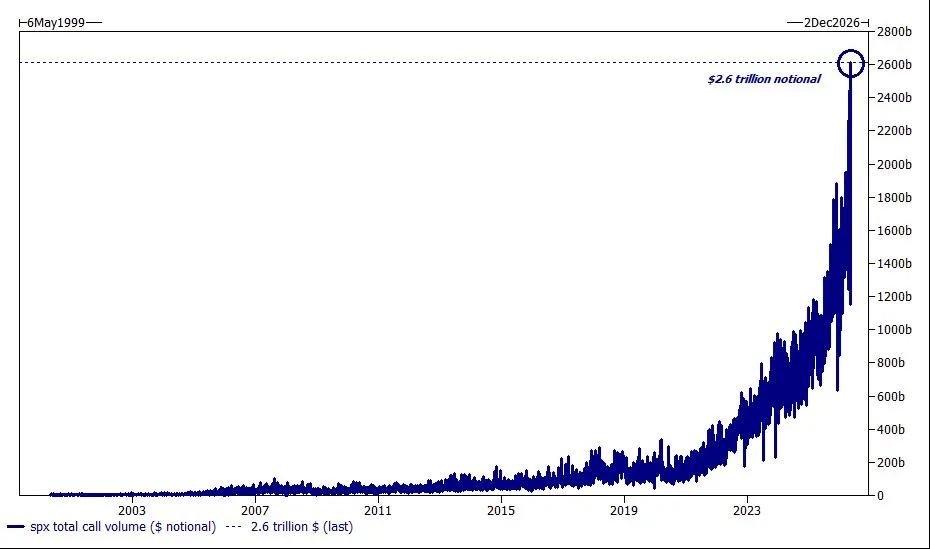
$2.6 trillion in S&P 500 call options traded in a single day. One day. The highest number ever recorded in market history. The chart goes back to 1999. Nothing comes close.
Here is what that means in plain English. A call option is a bet that prices go higher. When traders buy millions of these bets at once, the market makers who sold those bets are forced to buy the actual stocks to protect themselves. That buying pushes prices up, which makes more people buy calls, which forces more stock buying. The loop feeds itself.
The market goes up not because of fundamentals. It goes up because of pure mechanical force.
60% of all S&P options traded yesterday were calls. Not a normal day. Not even close.
Goldman Sachs had a name for it. Their own traders called it a "semi-irrational chasing mode." That is Wall Street's polite way of saying the market has lost its mind a little.
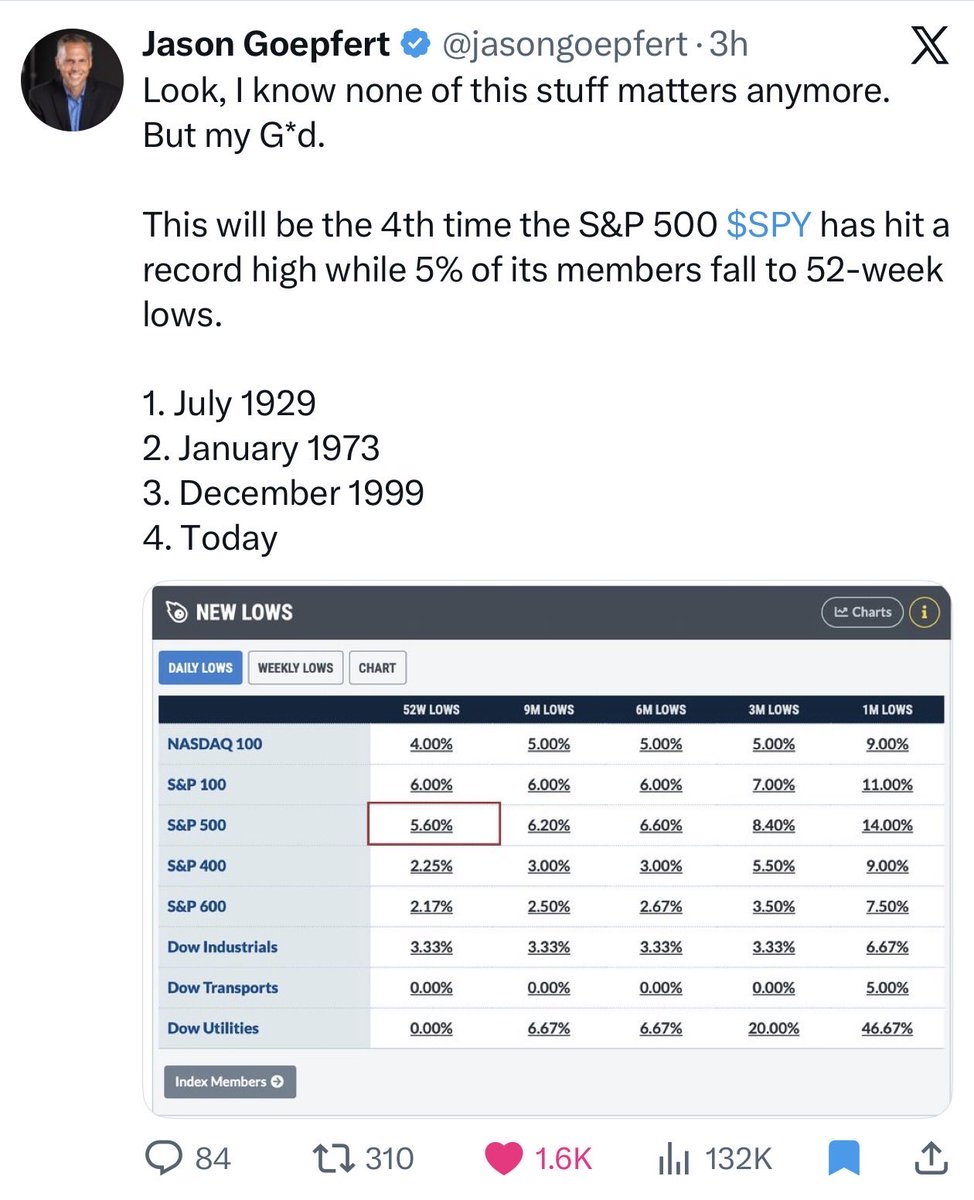
The Philadelphia Semiconductor Index RSI just hit its highest level since 1999. That was the dot-com peak. Nobody is saying this is 1999. But the market itself is drawing the comparison.
Here is the risk nobody wants to say out loud. When options expire or positions unwind, the mechanical buying stops. And it can reverse just as fast as it started.
The rally is real. The all-time highs are real. But $2.6 trillion in one day tells you this move is running on jet fuel, not fundamentals.
What happens when the tank runs empty?
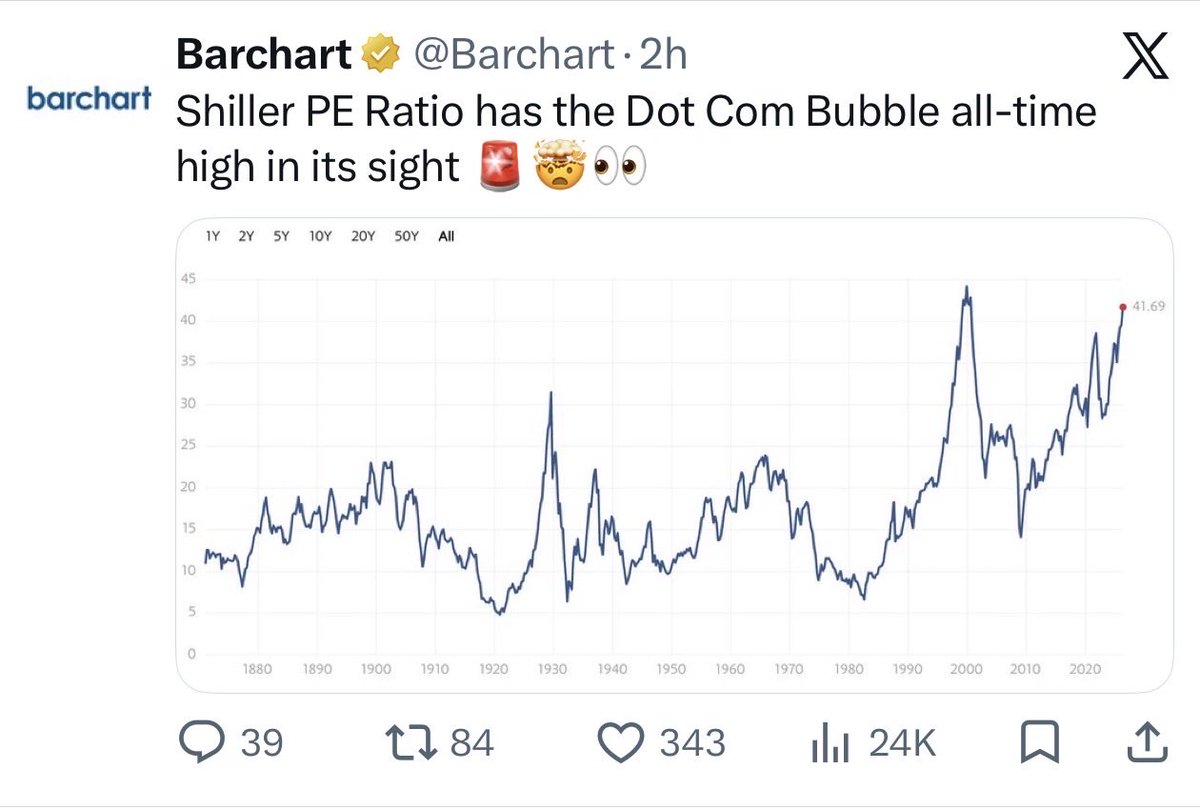
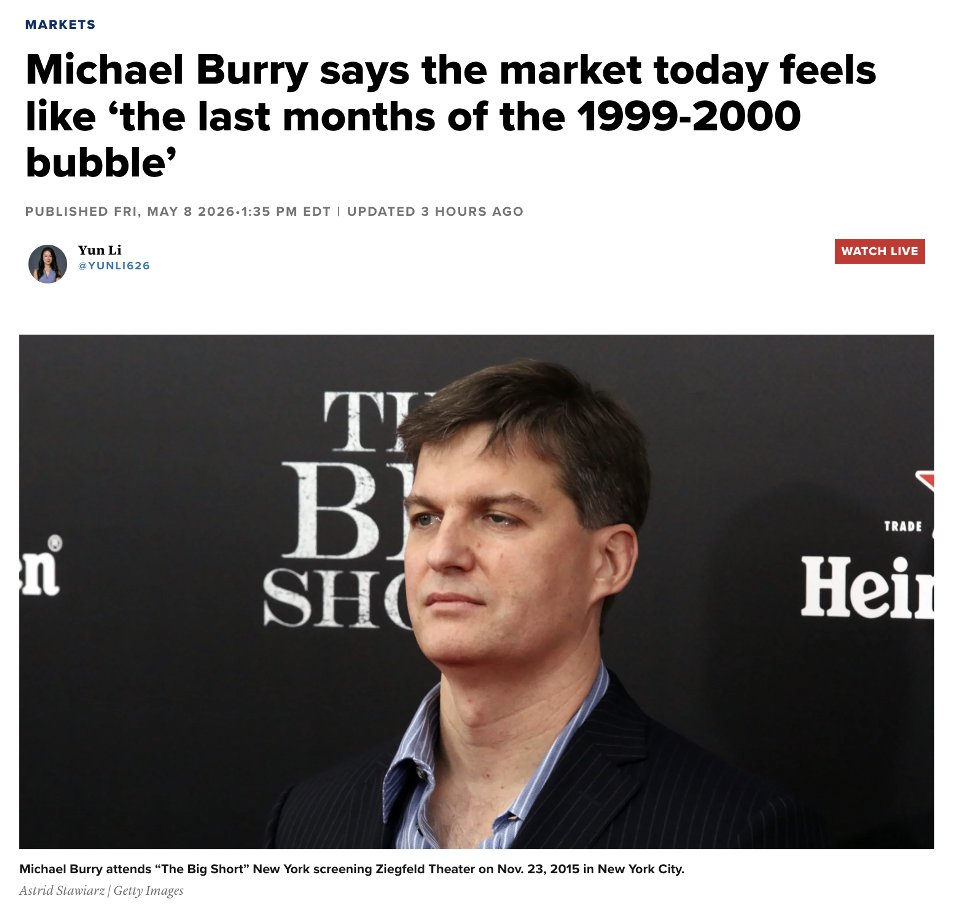
JUST IN 🚨: Michael Burry, the man who has predicted 50 of the last 2 market crashes, says the current stock market feels like the last few months of the Dot Com Bubble 🤯👀
NIEMALS long in einen historisch überbewerteten Markt.
Erst recht nicht, wenn diese Überbewertung mit der größten Krise der Menschheitsgeschichte zusammenfällt.
Wer 1999/2000 dachte „das Internet ist die Zukunft”, lag fundamental zu 100% richtig. Und verlor trotzdem 50% über die nächsten zwei Jahre. Direkt vor dem Crash rallyte der S&P nochmal 12% auf neue Highs, der finale Köder, bevor die Falle zuschnappte.
Was bei der „minus 50% S&P” Zahl untergeht: Das ist Survivorship Bias. Cisco war 2000 die wertvollste Firma der Welt. Fiel 89%. Steht 26 Jahre später nicht wieder auf Allzeithoch.
Amazon fiel 95% und brauchte fast ein Jahrzehnt für Break-Even. Hunderte Unternehmen kamen nie zurück. Wer den Index hielt, verlor 50%. Wer in den Stars der Bubble saß, oft 80 bis 95%.
Und das war der freundliche Vergleich. Der Nikkei stand 1989 auf einer ähnlichen Konzentration, bevor er kippte. Break-Even nominal: 2024. Real, inflationsbereinigt, bis heute nicht erreicht. 35 Jahre.
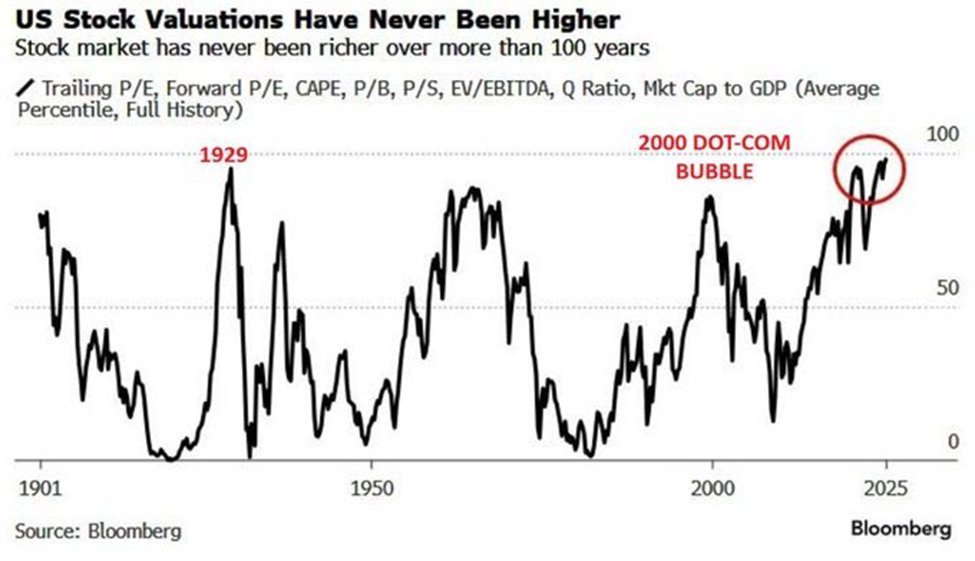
Heute: Shiller CAPE bei rund 38, ein Niveau, das historisch nur 1929 und 2000 überschritten wurde. Buffett Indicator über 200% des US-BIP. AI-Capex der Hyperscaler bei über $400 Mrd. allein 2025, teilweise kreditfinanziert. Margin Debt auf Rekord. Institutionelles Cash auf Mehrjahrestief. Jede einzelne dieser Metriken stand schon mal so. Nie zur selben Zeit.
Wenn das Muster hält, ist der eigentliche Schmerz nicht der Crash. Es sind die zwei Jahrzehnte danach.
.@elonmusk just crossed $800 billion — roughly 2.7% of the entire US GDP. The last person to hold that much of the American economy? John D. Rockefeller in 1913. It took a century for anyone to match him. Rockefeller had oil. Musk has the future.