Why the rich pay zero LTCG on MFs.
Why retail pays 12.5%.
Section 54F.
Section 54F isn't a "secret trick the rich use."
It's a section. In the Income Tax Act. Since 1982.
Sell mutual funds, stocks, gold, ESOPs.
Reinvest the net proceeds in a residential house.
2 years to buy. 3 years to build.
LTCG tax: zero.
Conditions:
→ ₹10 crore cap on the house
→ Don't own >1 other house
→ 3-year lock-in on the new house
They interviewed the founder of Dubai, Sheikh Rashid, about his country's future.
He said:
"My grandfather rode a camel, my father rode a camel. I drive a Mercedes, my son drives a Land Rover, and my grandson will drive a Land Rover, but my great-grandson will have to ride a camel again...”
"Why?"
“Hard times create strong men, strong men create easy times. Easy times create weak men, weak men create hard times. Many won't understand, but we need to raise warriors, not parasites
@PoisonedWell267@historyinmemes Europeans weren't exactly known for pristine water quality back then either (cholera outbreaks anyone?). He just had the wealth and the entourage to do something about it. Respect the commitment to his own standards, even if it sounds extra today 🙌
@PoisonedWell267@historyinmemes let's be real, He wasn't chasing street chai vibes. He was hauling 9,000 liters of Ganges water across the ocean in massive silver jugs because ritual purity and cultural standards mattered more to him than whatever was coming out of London taps in 1902.Diff era, diff priorities.
A father told his daughter, "Congrats on your graduation. I bought you a car a while back. I want you to have it now."
Before I give it to you, take it to a car dealer in the city and sell it. See how much they offer.”
The girl came back to her father & said: "They offered me $10,000 dollars because it looks very old"
Father said: "Ok, now take it to the pawn shop".
The girl returns to her father & said: "The pawn shop offered $1,000 dollars because it's a very old car & a lot of work done".
The father told her to join a passionate car club with experts & show them the car.
The girl drove to the passionate car club.
She returned to her father after a few hours & told him, “Some people in the club offered me $100k because its a rare car that's in good condition.”
Then the father said, "I wanted to let you know that you are not worth anything if you are not in the right place. If you are not appreciated, do not be angry, that means you are in the wrong place. Don't stay in a place where no one sees your value ."
The moral of the story : Know your worth and know where you are valued. A diamond doesn't shine on the bottom of a cave.
That one neuron connects to about 7,000 others. Your brain has 86 billion of them. Do the math and you get somewhere around 100 trillion connections inside your head. More connections than stars in 1,500 galaxies.
And each connection point is way more complicated than anyone expected. A Stanford lab found that every single connection contains about 1,000 tiny switches that can store memories and process information at the same time. So your brain is running roughly 100 quadrillion switches right now, while you read this sentence.
The wild part is the power bill. Your brain runs on 20 watts. That’s less energy than the light in your fridge. The world’s fastest supercomputer needs 20 million watts to do the same amount of raw calculation. A million times more power for the same output.
We’re still nowhere close to understanding how any of this works. In October 2024, a team of hundreds of scientists finished mapping every single connection in a fruit fly’s brain. Took six years and heavy AI help. That fly brain had 140,000 neurons. Yours has 86 billion. Google and Harvard also mapped a piece of human brain last year, a speck smaller than a grain of rice. That speck alone contained 150 million connections and took 1,400 terabytes to store. The lead scientist said mapping a full human brain at that detail would produce as much data as the entire world generates in a year.
A tiny worm had its 302 brain cells mapped back in 1986. Almost 40 years later, scientists still can’t fully explain how that worm’s brain keeps it alive. Your brain has 86 billion of those cells, each one wired to thousands of others, each wire packed with a thousand switches, all of it humming along on less power than a lightbulb.
A very insightful article! A must read for those who want to shape their lives for better.
Three different points/quotes in the article which I really like-
1- “If you want a specific outcome in life, you must have the lifestyle that creates that outcome long before you reach it”
2- “High intelligence is the ability to iterate, persist, and understand the big picture. The mark of low intelligence is the inability to learn from your mistakes.”
3- “The best periods of my life always came after a period of getting absolutely fed up with the lack of progress I was making.”
In October 1917, an immigrant passenger ship carrying Italians to New York was caught in a violent Atlantic storm. Among those aboard were Antonio Russo, a twenty-eight-year-old carpenter, and his five-year-old daughter, Maria. Antonio’s wife had died in childbirth two years earlier. America was his last hope—to escape poverty and give his daughter a future Italy could not.
At 2:00 a.m., towering waves smashed over the decks. Water flooded the lower compartments where third-class passengers slept. The ship began to list sharply. Screams filled the corridors as people surged toward the stairs, pushing and trampling in panic. Antonio lifted Maria from their bunk and fought forward, holding her above the rising water. But the crowd was too dense, the flooding too fast, the angle of the ship too steep.
Antonio understood the terrible truth: they would not reach the lifeboats.
Minutes remained.
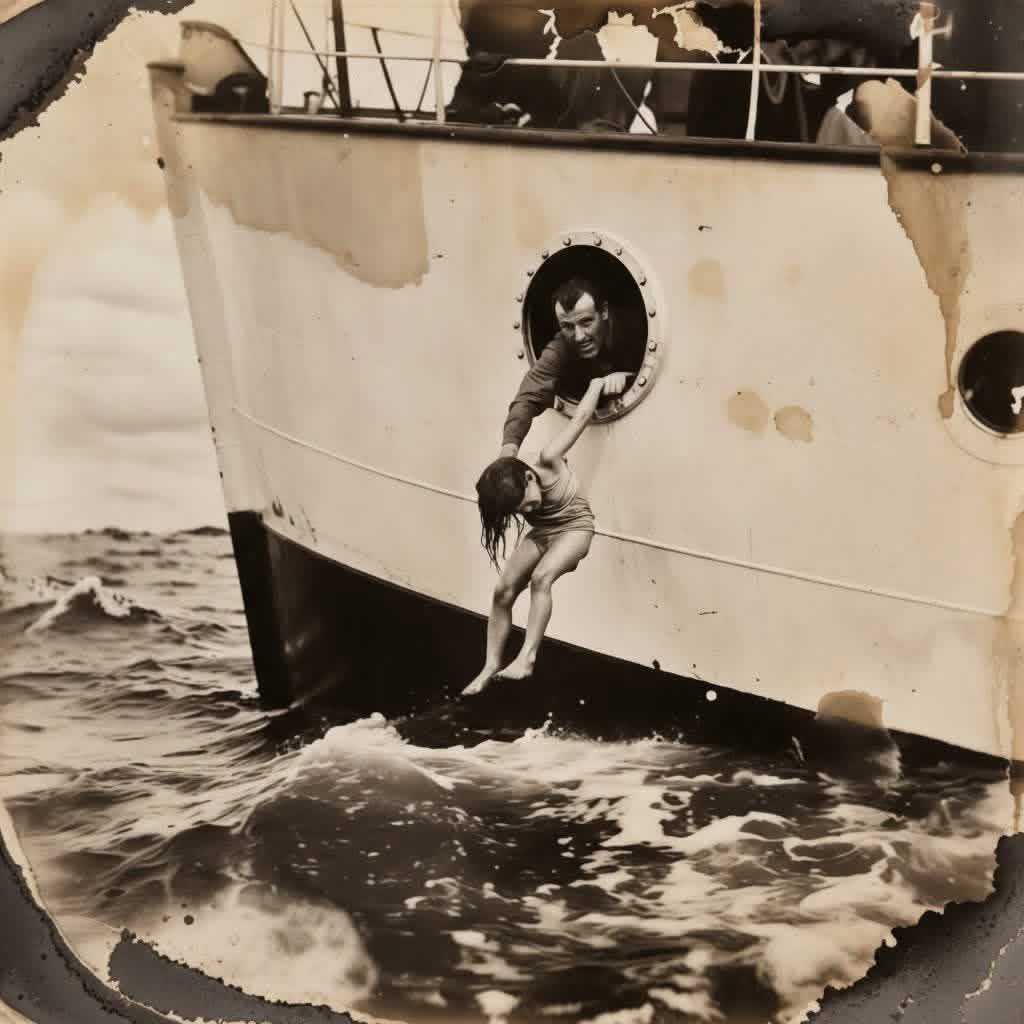
Through the chaos, he reached a broken porthole, smashed open by the storm. It was barely large enough for a child. Beyond it lay the black, freezing Atlantic. In the distance, Antonio could see searchlights sweeping the water—rescue boats were coming.
He looked at Maria—terrified, crying for her mother, clinging to him.
And then he made the choice that would define his life.
Antonio pushed his daughter through the porthole.
Maria screamed as she fell into the ocean. Antonio shouted after her, his voice cutting through the storm:
“Swim, Maria! Swim to the light! Ships are coming! Swim!”
He knew she had a chance.
He knew he did not.
The ship sank seven minutes later. Antonio Russo drowned with 117 other third-class passengers trapped below decks. His body was never recovered.
Maria Russo was pulled from the water forty-five minutes later, suffering from severe hypothermia and near drowning—but alive. She was wrapped in blankets and taken to a hospital ship. She was five years old, orphaned, traumatized, in a foreign country, unable to speak English.
She remembered only her father’s last words:
“Swim to the light.”
Maria was placed in a New York orphanage. For years, she believed her father might still be alive. No one could tell her what had happened to Antonio Russo. As time passed, hope turned into confusion… then pain. She began to believe the unthinkable—that her father had abandoned her, that throwing her into the ocean meant he did not want her.
She lived with that belief for twenty-five years.
The truth did not reach her until she was thirty. A researcher, reviewing passenger records from the 1917 shipwreck, found Antonio Russo’s name among the dead. Only then did Maria learn what her father had done—that he had sacrificed himself so she could live.
Maria Russo lived until 2004, dying at the age of ninety-two.
In 1995, at eighty-three years old, she told her story during an interview about the shipwreck:
“I thought my father was killing me. I didn’t understand he was saving me. I thought for years that he threw me away. The truth was he threw me toward life.”
Maria went on to marry. She had four children, nine grandchildren, and six great-grandchildren—thirty-one descendants who existed because one man made an impossible choice in the dark Atlantic.
“Every birthday, every good moment in my life exists because my father chose me over himself. I see his face in that porthole every night. I hear him screaming ‘swim to the light.’ I’ve been swimming to the light for seventy-eight years. I hope I made him proud.”
Her final words about Antonio Russo were simple:
“Thank you, Papa. Thank you for throwing me toward life. Ti amo.”
Some acts of love last longer than lifetimes.
You only need to know these 7 laws in life :
1) Murphy Law: The more you fear something happening, the more likely it is to occur.
2) Kidlin Law: If you write a problem down clearly and specifically, you have solved half of it.
3) Gilbert Law: When you take on a task, finding the best ways to achieve the desired result is always your responsibility.
4) Wilson Law: If you prioritize knowledge and intelligence, the money will continue to come.
5) Falkland Law: If you don't have to make a decision about something, then don't decide.
6) Parkinson's Law: It implies that if more time is given to complete a task, it will likely consume that entire time, often resulting in less efficiency.
7) Pareto Principle (80/20 Rule): This principle suggests that in many situations, 80% of the effects come from 20% of the causes.
Cut all losses at 7–8% – Never hold and hope. Protect capital first.
Take profits at 20–25% – When you’re right, lock in gains before they evaporate.
Sell if the stock breaks key support – Don’t fight the chart; the market always wins.
Avoid averaging down – Adding to losers magnifies mistakes.
Raise stops as stocks advance – Protect profits by trailing your position.
We tell girls they are already enough, and we build schools, workplaces, and social narratives around helping them express that.
We tell boys they must earn their worth, but we’re vague about what earns it and suspicious when they pursue it for themselves.
When one group is validated by default and the other only conditionally, the result is quiet resentment and slow disengagement.