A buoy in the Mediterranean measured a sea surface temperature of 33°C today.
It confirmed, this would be the highest temperature ever recorded in the Mediterranean 📈
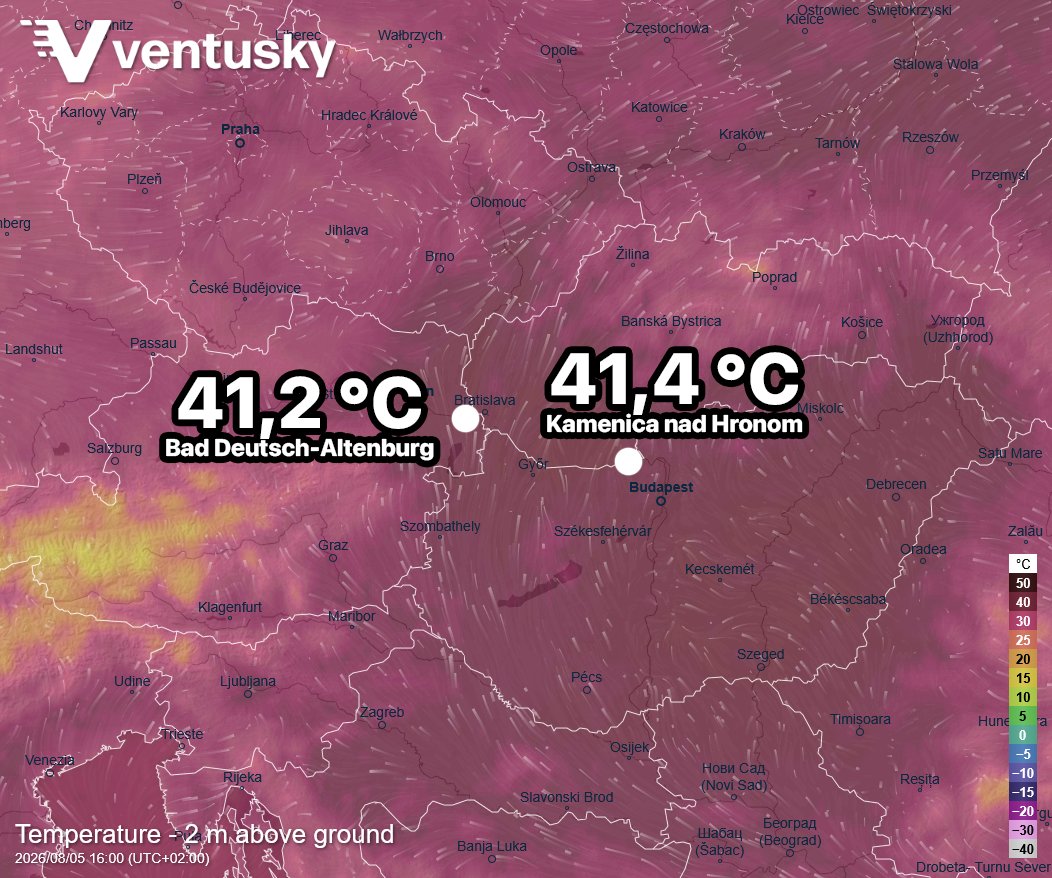
Two European countries have reported new all-time temperature records today. 🥵🥵 In Austria, a temperature of 41.2°C was measured east of Vienna. In Slovakia, the new national record stands at 41.4°C. Temperatures above 40°C are exceptionally rare and represent truly extreme heat in both countries. 🧐
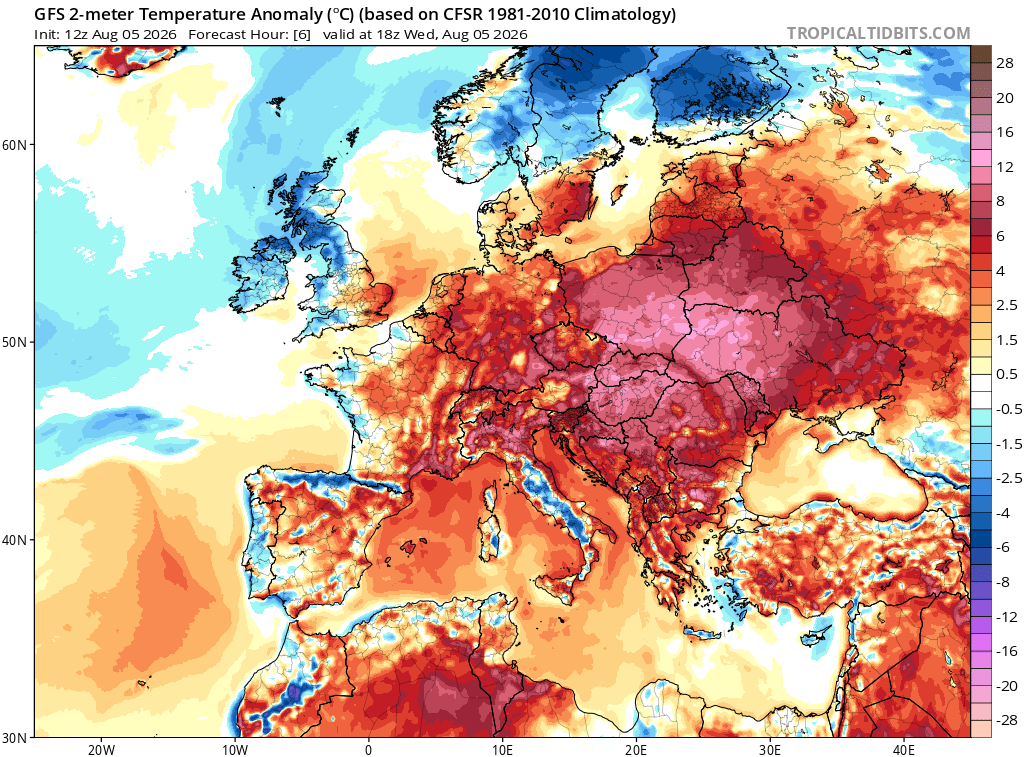
MOST EXTREME DAY IN EUROPEAN HISTORY
Thousands of records have been shattered with the hugest margins ever seen in European history from West to East.
There has never been anything like this, not even last June.
Wait for many updates later.
A new report puts a hard number on what rising heat is expected to cost in human lives.
By 2050, extreme heat driven by climate change could kill an extra 430,000 people every year. The heaviest toll falls on the poorest countries, where many people have no electricity and no way to cool their homes. Hundreds of millions are expected to be exposed to heat that the human body simply cannot handle for long.
Breaking News!
Code: Bonkers!
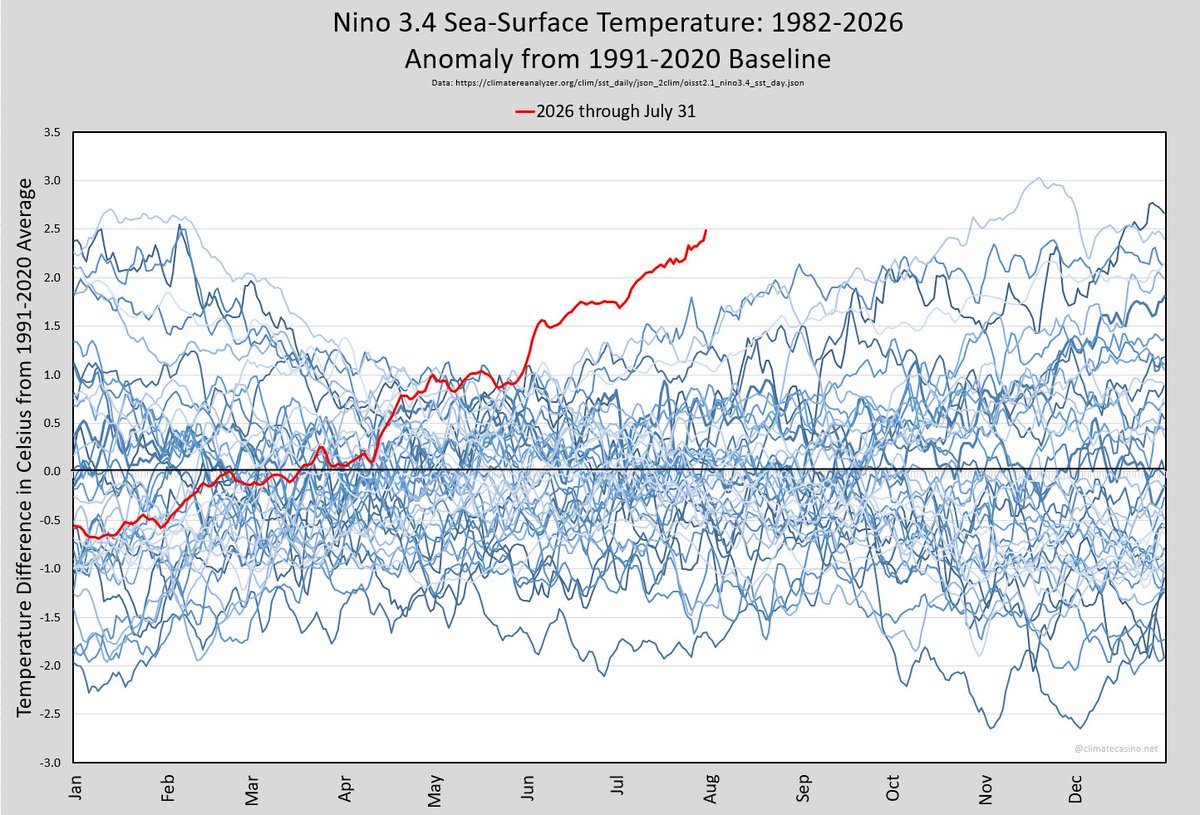
As of July 31st, Nino 3.4 sea-surface temperatures are now 2.48°C above the 1991-2020 baseline and more than 1.15°C above the previous daily high.
The Climate Casino took the "Over" on 2.5°C by August 1st. Stay tuned!
I'm not sure folks have realized just how crazy the second half of 2026 and 2027 will be for global temperatures – on the back of a record-smashing El Niño event. Here is my latest estimate of where both years will end up compared to global temperatures since 1850.
World is on fire My heart breaks seeing the devastating wildfires sweeping across Italy, especially Sicily.
My thoughts and prayers are with everyone affected. May the brave firefighters stay safe, and may the flames be brought under control soon. Stay strong, Italy 🇮🇹
Massive wildfires are tearing through Bivona, on the Italian island of Sicily. As other fires rage across Europe.
Repeat after me:
We must #ActOnClimate.
We must #ActOnClimate.
We must #ActOnClimate.
We must #ActOnClimate.
We must #ActOnClimate.
We must #ActOnClimate.
We must #ActOnClimate.
We must #ActOnClimate.
We must #ActOnClimate.
#Climate #energy
Holiday in the climate emergency.
No that’s not AI or edited, it is a photo I just took with my phone on Lacanau beach in France.
Ash is raining from the sky.
What future will this boy grow up in?
It is in our hands, but time is running out.
Cette photo mérite absolument tous les prix. Elle a même sa place au Louvre.
Elle relate précisément l’inertie de l’individu face à l’effondrement.
Regardez la composition. Un chef-d’œuvre involontaire.
Au premier plan, le sable doré, les tongs abandonnées, la glacière. Le décor ordinaire du bonheur estival. Deux personnages assis, de dos, comme dans un tableau de Caspar David Friedrich. Sauf que Friedrich peignait des hommes contemplant le sublime. Ici, ils contemplent la catastrophe. Et ils ne bougent pas.
Au centre, le parasol. Publicitaire, criard, dérisoire. Un pastis face à l’apocalypse. C’est presque trop parfait : la France qui prend l’apéro pendant que le monde brûle. Aucun scénariste n’aurait osé.
Et puis le ciel. Les deux tiers de l’image. Cette muraille de fumée qui avale la lumière, ce dégradé d’ocre et de noir digne d’un Turner. La nature qui reprend la palette des maîtres pour peindre notre propre fin.
La femme photographie l’incendie avec son téléphone. Mise en abyme totale : nous documentons notre disparition au lieu de l’empêcher.
Cette image dit tout. Le déni, le confort, l’habitude. Nous sommes tous sur cette plage. Nous voyons tous le nuage. Et nous restons assis, parce que l’eau est bonne et qu’on a posé nos congés.
Les historiens de l’art parleront un jour de cette photo comme on parle du Radeau de la Méduse.
Sauf que cette fois, le naufrage, c’est nous qui le regardons depuis la plage.
💔🌍
A quarter of a million people have been evacuated so far as wildfires rage across Europe after record heatwaves, from as far north as #Norway down through #France, #Spain & #Italy. This isn't a drill. This is the new climate reality. Urgent mitigation & adaptation are required.
Um colega partilhou, noutra rede, este texto sobre a questão da digitalização dos exames no caso sueco. A diferença que faz não existirem nem prepotência, nem homens providenciais. Assumiram o problema e recuaram.
https://t.co/6D7rx80ZS4
Ministério Público pede suspensão imediata da construção do hotel Hilton e mais de 100 apartamentos na linha de Cascais, avança RTP https://t.co/VIAnMhAaWf
Se mexerem a fundo nas licenças e "negociatas" do Pinto Luz em Cascais, surgirão enormes surpresas.
A PGR quer ainda a suspensão das licenças e a declaração de nulidade das deliberações e despachos dos responsáveis políticos que autorizaram o empreendimento. A maioria foi assinada por Miguel Pinto Luz, então vice-presidente da Câmara de Cascais e atual ministro das Infraestruturas https://t.co/ZO2otzBpIK
Miguel Pinto Luz enterrado nisto até às orelhas
Quase 3 anos depois da queixa apresentada pela SOS Quinta dos Ingleses, o Ministério Público pede a nulidade do licenciamento do Hotel Hilton, em Carcavelos, dando assim razão àquilo que sempre defendemos:
Portugal atravessa duas pseudo-crises simultâneas.
No Ministério da Educação, uma falha de execução na correcção digital dos exames nacionais, grave para os alunos e famílias que a sofreram, mas já em resolução, com as notas publicadas e o calendário de acesso ao ensino superior intacto. Na Administração Interna, uma questão de procedimento e de ética em torno do ministro, sem indício de crime até hoje conhecido.
Dois casos reais, com falhas reais. Nenhum com dimensão de crise. E é essa a primeira distinção que se perdeu: gravidade não é dimensão. Um caso pode ser sério para quem o vive e menor à escala do Estado.
Repare-se, depois, na geometria. A pressão sobre a Educação vem da esquerda sindical e partidária, apontada ao ministro que era a vitrina reformista do Governo. A pressão sobre a Administração Interna vem sobretudo da direita radical ou populista, para quem a segurança é dossier existencial, engrossada pelos muitos inimigos que trinta anos de combate ao crime necessariamente geram.
Movimentos opostos na origem, idênticos na função: derrubar a peça mais valiosa do adversário. E estes dois ministros são sem dúvida “peças” valiosas.
E há aqui um inédito que merece registo: os dois extremos do espectro convergem objectivamente na mesma operação de desgaste, cada um pela sua porta, numa tentativa quase desesperada de forçar antes do Verão uma crise que a realidade não oferece.
A comunicação social não criou os casos. Mas escolheu a escala e o método. Num caso, o espiolhar da vida privada de um ministro, com devassa de residências e de família, sem proporção entre o que se procurava e o que se expôs. No outro, uma câmara de ressonância das críticas partidárias, amplificadas sem o filtro que distingue o jornalismo da militância.
Num ecossistema onde as queixas contra um governo de centro-direita encontram eco natural, e numa lógica crescente de espectáculo e de clickbait, o menor foi inflacionado até ao tamanho de caso de Estado, com a criticidade insistente a substituir a hierarquização criteriosa.
E o custo é maior do que parece. Cada excesso destes queima o capital mais escasso dos media tradicionais, que é a confiança. Quando o leitor deixa de encontrar rigor, isenção e hierarquia, e passa a suspeitar que se compram agendas políticas, o jornalismo perde exactamente aquilo que o distinguia do ruído das redes que diz combater.
Não se pede menos escrutínio. Pede-se mais exigência. O espírito jornalístico mede-se menos pela intensidade da crítica do que pela justeza da escala, e a contenção não é submissão ao poder: é a forma superior do rigor.
No fundo, é de provincianismo que se trata. Um sistema político-mediático que trata trapalhadas administrativas e dossiers pseudo-éticos como casos de regime é um sistema que nunca enfrentou uma crise a sério, e comporta-se como tal. Basta o teste de realidade.
A economia cresce, devagar mas cresce. O desemprego é baixo. Há paz social e estabilidade institucional.
Outras sociedades europeias atravessam transformações dolorosas; há países em guerra e países devastados. A crise que entre nós se anuncia não existe no país. Existe apenas no sistema que precisa dela.
Quem fabrica crises na abundância da estabilidade confessa que não saberia reconhecer uma verdadeira. E um país que se habitua a tratar o menor como maior chegará desarmado ao dia em que o maior chegar.
Mistral CEO Arthur Mensch walked into the French parliament this week and told lawmakers Europe has exactly two years to build independent AI infrastructure or hand over one trillion dollars in spending to American tech companies.
The math he laid out should be front-page news.
This is not a technology story. It is a macroeconomic one.
Global wages are fifty trillion dollars. AI will cost around ten percent of that. Europe's share is nine trillion. Which means over one trillion dollars in AI spending over the next five years flowing somewhere.
Europe already sends 250 billion dollars a year to the US in digital services. Every dollar that leaves funds American R&D. None of it comes back.
Mario Draghi's competitiveness report last year made the same point from a different angle. Europe needs eight hundred billion euros in annual investment just to close its existing productivity gap with the US.
AI dependency makes that gap structural. You cannot close a productivity gap when the tool driving productivity is owned by your competitor.
Mensch compared it to gas. The same way Europe discovered too late what energy dependence costs in a crisis, it is standing at the same crossroads with AI right now.
The compute is being allocated today. The chips are being spoken for today.
Europe is watching it happen and calling it a technology debate.
It is not. It is a sovereignty one.
Watch the full podcast on YouTube at @CNBCi
Another major environmental catastrophe that impacts on climate and world trade, but it is not on the radar.
The following link is a good video of the Sargassum problem, a pelagic seaweed floating on the surface of the ocean.
When we sailed across the Atlantic Ocean, we got stuck three times in giant mats of Sargassum. The video gives a good explanation of what happens in the Caribbean when it washes ashore, but it misses the major environmental and economic implications that have a profound impact on world trade and marine life in an entire ocean.
The Sargassum starts off from the coast of Brazil; it picks up nutrients from the Amazon and grows at an accelerated rate. It can double in biomass every 10 days. The weed crosses the South Atlantic to Africa and flows up the west coast, picking up more nutrients from the Congo and Gambia as well as agricultural run-off. By the time it reaches North Africa, Cape Verde, it takes a left turn and starts heading back across the Atlantic to the Caribbean.
There should only be 1 million tonnes of the weed in the Atlantic, but there are now 40 million, and it is expanding year on year. Sargassum is a plant, and like all plants, it requires nutrients such as phosphate. However, the massive amount of weed uses up all the phosphate and then biochemically defaults to absorbing arsenic, which sits below phosphate in the periodic table.
The Equatorial Atlantic is now devoid of phosphate, which means there is almost no phytoplankton, zooplankton or fish. When we conducted our citizen science project, 5000 samples were collected by 25 yachts at around 15 deg. North, and the results all confirmed that the Equatorial Atlantic was effectively dead.
The results were not ignored by the academics; instead, they attacked the Citizen Science project, this has become the subject of a reports by https://t.co/agIIEMzAfR.
Given the phytoplankton, such as coccolithophores and diatoms, have exhibited a regime shift, it also means the SML oil surfactant layer is gone, which means evaporation across the air-water interface has increased and aerosol/cloud formation has decreased.
Satellite.
Imagery confirms a 10%+ increase in humidity and a 10%+ decrease in cloud formation and rain.
This is climate change TICC, the consequences.
Impact on Central America, the survival of the tropical rainforests, mangroves, coral reefs, 25% of all marine life in the Atlantic and water supply for the Panama Canal. 6% of world trade and 40% of USA trade pass through the canal, and it has been totally missed as a major economic and environmental catastrophe.
GOES centre for marine research:
https://t.co/pu9QswXI3r
The video below was taken in the middle of the Atlantic Ocean from our sailing vessel Copepod. Via Howard Dryden