Kevin Hart says success is just standing back in line after everyone else gave up
"Scooter Braun told me, if they were giving a million dollars to anyone who could hit a fastball from the best pitcher in baseball, millions would line up. People would strike out and go, 'Damn, it's over'"
"Not many people would miss and stand back in line again. He was like, 'I'm going to keep getting in line.' The line will get smaller because of how many people drop out"
"I have goosebumps."
Jaime from the Market at Edgewood grabbed the device out of our hands, scanned a barcode, and bear-hugged my co-founder in the dairy aisle.
This is the moment when we knew we had something.
10 customers giving you bear hugs > 100 giving you handshakes.
Grocery is a $1.5T domestic market — bigger than restaurants, bigger than hotels. But it's running on technology from the Reagan administration.
We just raised a $22M Series B for @VoriHQ to make every supermarket in America autonomous.
I have changed my mind on how AI will impact jobs in America.
Previously, I believed AI would replace many entry level roles typically filled by young employees. The technology would then work its way up the organization and eventually reduce the total number of jobs in a company.
The data is saying something different, so when I get new information I am willing to change my mind.
The number of software engineers being hired has been increasing. The number of open software engineer roles is growing.
The number of new college grads who get hired has increased 5.6% over the last 12 months. The unemployment level for people aged 20-24 years old who have a college degree has fallen from nearly 9% to almost 5% as well.
The Wall Street Journal recently wrote “AI created 640,000 jobs between 2023 and 2025 in the U.S., according to an analysis by LinkedIn of job posting data, including new white-collar positions such as Head of AI and AI engineer.”
And I am starting to see companies throughout our portfolio aggressively hiring to keep up with the demand for their products and services.
If AI can make employees more productive, which is widely accepted as fact, then companies are going to want as many productive units of labor as possible. This is a key reason why I am changing my mind.
AI appears to be a magical technology that will make companies more productive and more profitable. The net result will be more corporations, more startups, and more jobs.
All three are big, positive wins for the American economy.
Funny thing about references -
When you're younger, you assume you just need 1-2 people who will vouch for you at every place you've worked.
As you mature, you realize everyone you've ever worked with may be contacted about you in a competitive hiring / fundraising process.
Like recover all business controls ... tracking royalties ... locating money ... finding reg flags ... planning ... organizing years of information ... creating family office structure... business navigation ... I've been waiting my whole life for tools like this!
Sequoia’s @JulienBek says many of their founders are now wondering if they’re “just an iteration away” from AI labs destroying their business.
He says the most defensible companies - and potentially the next trillion-dollar company - will be “a software business that masquerades as a services firm.”
“If you sell tools today, you’re really in the line of sight for the models and you’re effectively competing with the next generation that they’re going to launch.”
“Whereas if you sell the work, you’re actually benefiting from what the models are doing and all the billions of dollars that are going towards AI.”
This is a wonderful idea!! So impressed by the first milestone of developing a programming language (no easy thing) -
now let’s teach our kids to solve more problems! Amazing!!
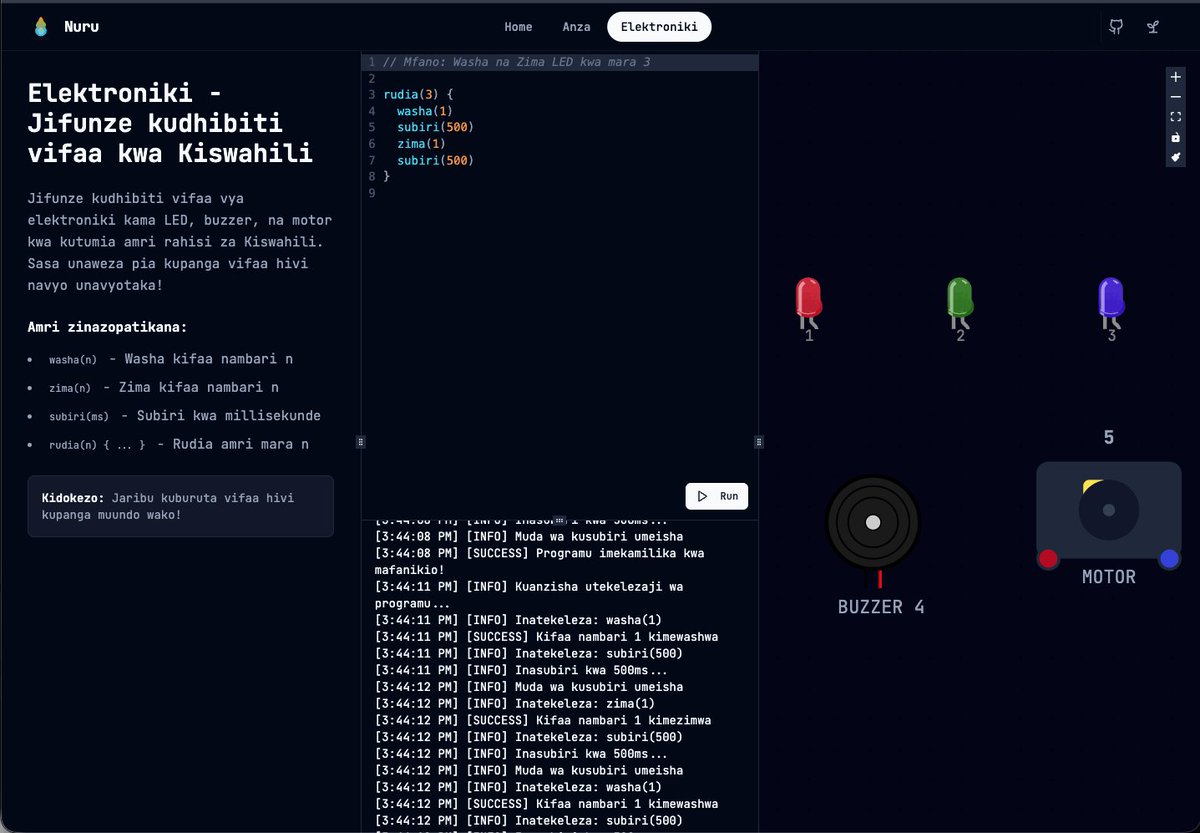
We* built the first ever Turing-complete Swahili programming language — Nuru.
And we just secured a $40,000 contract to bring it to 5,000 learners in Swahili-speaking classrooms.
And I know what you’re thinking: Why build a Swahili programming language?Aren’t there already a dozen “better” languages than Nuru could ever be?
Yes. “You’re absolutely right!” Now buckle up and hear me out!
As AI systems get stronger, the “how” is getting “cheaper” every year. Implementation details are being trivialized. The real advantage shifts to the “what”: knowing what to build, why it matters, and having systems understanding at a high level.
The winners won’t be the people who can write the most syntax from memory, they’ll be the people with strong fundamentals and the confidence to build.
That’s why we believe the programming language of the future is going to be the one you already speak.... For the millions of us from the so-called “3rd world countries”, that language is Swahili!
When we started https://t.co/t0VjIj5AG7, one thing became obvious fast: integrating into public schools in Tanzania would be hard. Most technical learning is delivered in English, but for many young Tanzanians—especially outside big cities—English is a third language.
We don’t really do excuses. And we couldn’t sit around waiting for policy to catch up to the urgency.
So we built the Nuru Playground, on top of the Nuru language that @AviTheDev had been working on, so we could finally deliver our technical programs in Swahili-speaking classrooms without the translation tax.
We have already reached hundreds of students with a couple schools on our waitlist.
Read the full article -> https://t.co/Dn1jppgca5
The future remains exciting 🫡
CC
@costechTANZANIA@Said_Hozza@Afruturist@VenturesSahara
Resharing this post - now that YC has asked for AI-Native agencies!
This is the time for African startups!
TAM expansion means that once unprofitable business models are now possible. AI-Legal, AI-Insurance broker, AI-Accounting... you name it
African customers don’t value software that much. Their low willingness to pay compresses TAM for traditional Saas. It’s why many African startups turned to fintech (willingness to pay).
But with AI you go from selling software to selling a service...
Y Combinator just released their latest Request for Startups, and there’s a fascinating focus on AI-Native Agencies.
The thesis is simple: Historically, agencies were hard to scale because growth required a 1:1 increase in headcount.
AI changes that. Instead of selling "hours" to help customers use software, the new breed of agencies uses their own proprietary AI tools to sell the finished product at 100x the efficiency.
This deeply aligns with what I’ve been seeing and building in the ecosystem. The real power move right now isn't just building another wrapper; it’s combining high-end services with proprietary IP.
A few reasons why I think this is the "Golden Era" for this model:
• Software Margins, Agency Results: You can finally achieve SaaS-like margins by automating the "boring" 80% of the work.
• The Feedback Loop: Unlike pure SaaS companies, an AI agency is "in the trenches." You see exactly where the AI fails in real-world scenarios, allowing you to iterate on your internal IP faster than any competitor.
• Vertical Integration: We’re moving from "selling a tool" to "selling the outcome." Clients don't want a seat on a platform; they want the legal doc, the ad creative, or the code delivered.
It feels like we are finally moving away from the "billable hour" trap toward a model where your value is tied to your tech stack and expertise, not your clock.