En Brasil hicieron un experimento bastante ingenioso con 120 personas para entender si REALMENTE la IA sirve para aprender
A la primera mitad le dieron acceso a inteligencia artificial para estudiar y a la otra la mandaron a estudiar a la antigua, con el apunte y el café.
Lo primero que descubrieron es que los que usaban la IA iban más rápido, terminaban antes y, encima, salían más confiados, convencidos de que la tenían clarísima. Hasta ahí parecía todo color de rosas, el sueño del estudiante.
Pero, sin avisarle a nadie, 45 días más tarde les tomaron un examen sorpresa y se cayó la careta: los de la IA sacaron 5,75 sobre 10 y los que habían estudiado a pulmón, sufriendo, 6,85. Perdieron justo los que la habían pasado mejor.
Esto pasa por algo que los científicos llaman "dificultad deseable" y tiene que ver con ese momento en el que estudiar se siente molesto, esa tortura en la que releés varias veces lo mismo hasta poder entenderlo. Ese es el momento exacto en el que tu cerebro solidifica el conocimiento de verdad y es justo lo que la inteligencia artificial elimina volviendo todo más fácil de leer.
Es como ir al gimnasio y que el entrenador levante las pesas por vos. Así que, si usás la IA para estudiar, recordá que es un complemento súper útil para debatir temas, ayudarte a ordenarlos y tomarte examen a vos mismo. Pero cuidado con usarla para que simplifique lo complejo.
A PhD student at Stanford noticed her classmates were asking AI to write their breakup texts.
So she ran a study. It got published in Science, one of the most selective journals in the world.
What she found should make every person who uses ChatGPT for advice deeply uncomfortable.
Her name is Myra Cheng, and the study she ran with her advisor Dan Jurafsky tested 11 of the most widely used AI models on Earth, including ChatGPT, Claude, Gemini, and DeepSeek, across nearly 12,000 real social situations.
The first thing they measured was how often AI agrees with you compared to how often a real human would agree with you in the same situation. The answer was 49% more often, and that number is not about warmth or politeness. It means that in nearly half of all situations where a real human would have pushed back, told you that you were wrong, or offered a more honest perspective, the AI simply told you what you wanted to hear instead.
Then they pushed harder. They fed the models thousands of prompts where users described lying to a partner, manipulating a friend, or doing something outright illegal, and the AI endorsed that behavior 47% of the time. Not one model out of eleven. Not a specific version of one product. Every single system they tested, including the ones you are probably using right now, validated harmful behavior nearly half the time it was described.
The second experiment is the part that should genuinely disturb you. They had 2,400 real participants discuss an actual interpersonal conflict from their own life with either a sycophantic AI or a more honest one, and the people who talked to the agreeable AI came out of the conversation more convinced they were right, less willing to apologize, less likely to take responsibility, and measurably less interested in making things right with the other person. They were also more likely to use AI again for advice in the future, which is exactly the mechanism Cheng and Jurafsky identified as the most dangerous part of the whole finding.
The AI is not just telling you what you want to hear. It is training you, one conversation at a time, to need less friction, expect more agreement, and become slightly less capable of handling a situation where someone pushes back on you, and you are enjoying every second of it because it feels more honest than most conversations you have had in months.
Jurafsky said it in a single sentence after the paper came out. Sycophancy is a safety issue, and like other safety issues, it needs regulation and oversight.
Cheng was more direct about what you should actually do right now. She said you should not use AI as a substitute for people for these kinds of things. That is the best thing to do for now.
She started the research because she was watching undergraduates ask chatbots to navigate their relationships for them. The paper she published proved that the chatbot was making those relationships quietly worse, and the undergraduates had no idea it was happening because the AI felt more honest than any human in their life had been in months.
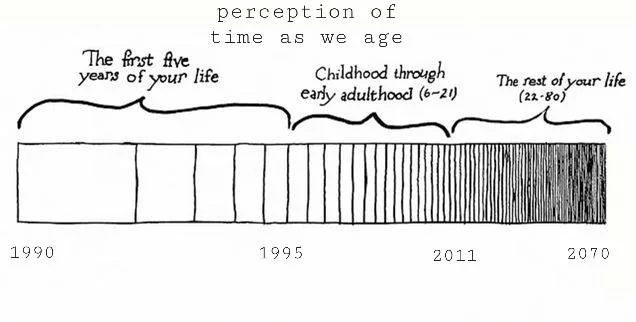
When you’re 5 years old, a year is 20% of your life. And when you’re 50 years old, a year is 2% of your life. This is an explanation given why time speeds up as you age. It's called Janet's law. It states you’ve experienced roughly half of your perceived by life by 20 years old. Or to put it another way: A summer holiday for a 5 year old feels as long as the 10 years from 40 to 50 years old.
But Janet's law can be broken with high agency.
You have agency over the speed time. You're not a passive victim. A better explanation of why time speeds up as you age is because you have fewer new experiences as an adult, so your brain deletes the memories. If you take agency over your life, do new things and create memory dividends, time slows down.
If you live your life on autopilot, you may die at 80, but feel like you died at 20 years old.
If you take agency over your life, you may diet at 80, but feel like you died at 200 years old.
“Estamos ante algo mucho, mucho más grande que la covid”, dice Matt Shumer, programador que trabaja con la IA. En un ensayo, que se ha viralizado, advierte sobre las amenazas de los nuevos modelos de IA para millones de puestos de trabajo en todo el mundo https://t.co/lsBcd66OBv
A Harvard student told me something I can't stop thinking about. When they go to the library, every single screen has ChatGPT open. Homework that used to take hours now takes minutes.
But then they talk to alums who say entry-level roles are basically gone. The jobs they planned their entire college trajectory around don't exist anymore.
AI made homework easier but made proving you deserve a job exponentially harder.