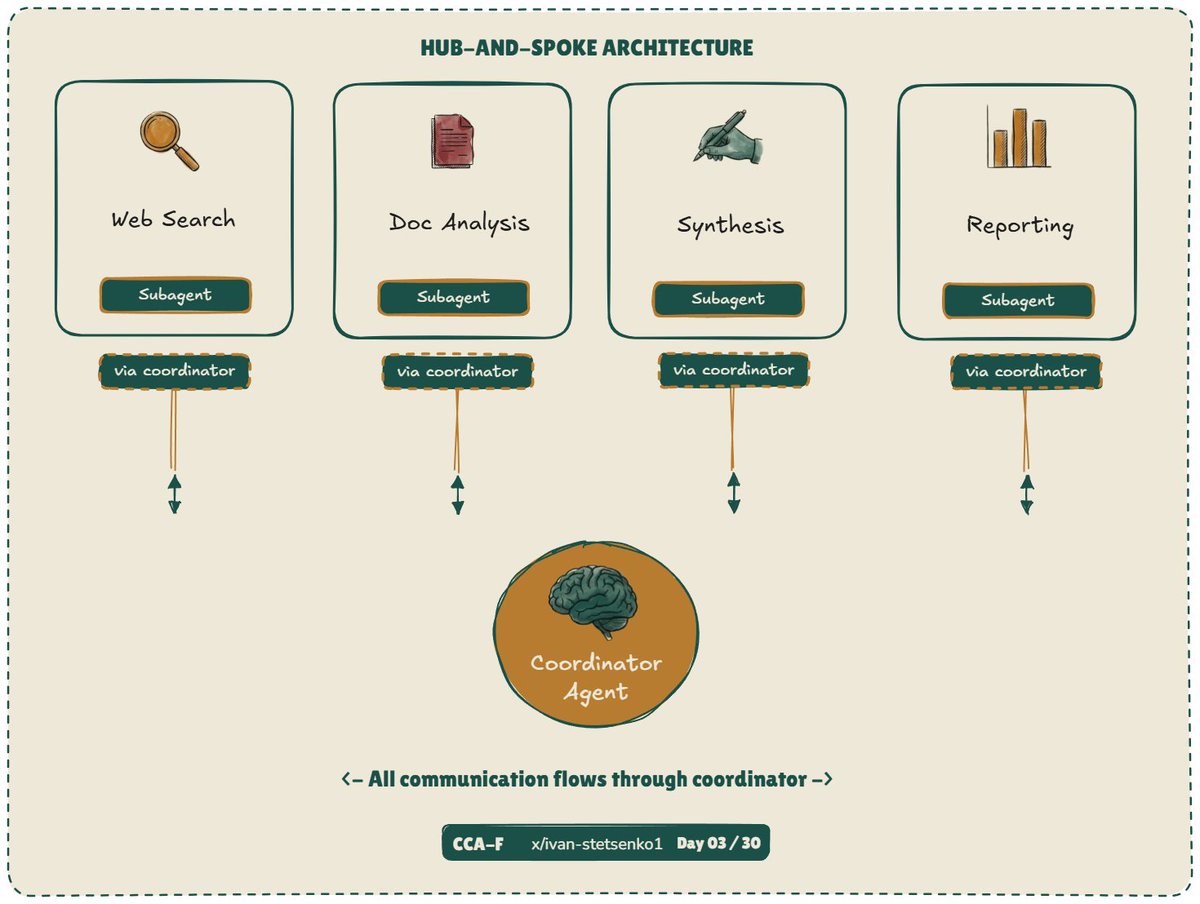
exactly. and the race condition debugging experience is what converts mesh advocates.
we tried a more organic routing approach early on. worked fine until two subagents made conflicting assumptions about shared state. coordinator-based systems make that class of bug impossible by design.
day 3/30. CCA-F prep.
orchestration patterns.
we build multi-agent systems at work so none of this was new.
few things to remember:
subagents never talk to each other.
never.
everything routes through the coordinator.
when output is incomplete, the bug is almost never in the subagent.
it's in what the coordinator assigned it.
day 4 tomorrow.
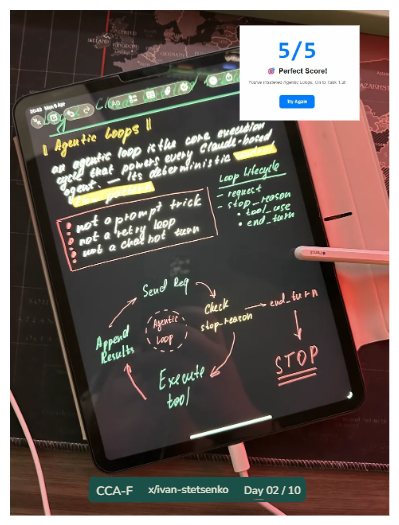
day 2/30. agentic loops. 5/5 on the practice questions.
handwriting notes after a long day is one of the best things i do for my brain. something about the pen slowing you down forces you to actually process what you just read. it's become a kind of meditation.
a few things that stuck from today:
an agentic loop isn't a prompt trick. it's a deterministic control flow. four steps, repeated until stop_reason says otherwise.
stop_reason is the only signal you can trust. not what claude says. not iteration count. not content type.
claude can return text AND a tool call in the same response. if your loop checks content type to decide when to stop, it will terminate early. your user gets half an answer.
day 3 tomorrow.
anthropic just launched the Claude Certified Architect exam (CCA-F).
it's currently only available to partner companies. my company has access.
i'm taking it.
giving myself 30 days to pass.
posting daily: what the exam actually tests, what's hard, what i get wrong.
day 1.
600k lines of production code in 60 days part-time is a wild claim to just let sit there.
the tool itself is a library of prompts and agents. those have existed since 2022. there are thousands of them.
what’s being sold here is the story, not the technology. and that’s exactly the problem with how AI gets discussed at the top. the people with the most influence and the loudest reach are often the furthest from actually shipping production systems.
being a CEO doesn’t make the prompt library novel. it just makes the tweet go further.
the distribution play is smart but it’s not the real story.
apple was not first with phones, not first with computers, used intel chips for years. none of that mattered. what they did every time was watch how others built it, learn what actually mattered to users, then ship something that felt inevitable.
this is the same pattern. let claude, chatgpt, gemini figure out what AI consumers actually want. collect 2.5B data points on usage. then build their own model when the product question is already answered.
they don’t compete on being first. they compete on being last.
from what I've seen it's almost always informal until it isn't. someone starts flagging AI-generated PRs differently, the practice spreads, and eventually a senior engineer owns it by default rather than by design.
the teams that formalize it early tend to do so after a near-miss, not a full incident. that's the rare case.
If you're building with AI coding tools, read this.
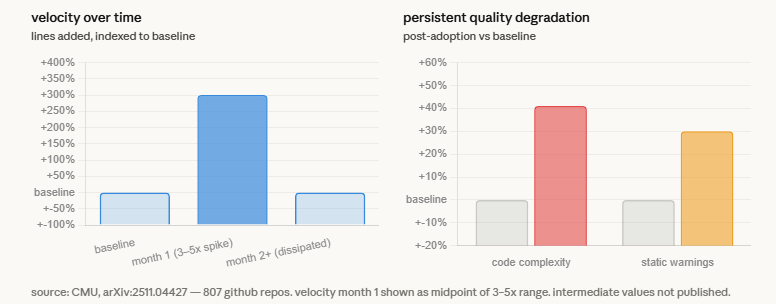
A CMU study on 800+ GitHub projects found:
- Cursor boosts output 3-5x in month 1
- But gains disappear after 2 months
- Code complexity rises 41% and stays there
The velocity is real. So is the debt.
The teams that win long-term will be the ones who scale quality checks at the same speed as AI output.
@Rychkid1@DallasAptGP ABAC works but retrofitting it into an existing vault is a significant lift. every file needs tagging, every role needs mapping, and the maintenance compounds as the knowledge base grows.
a security layer in between is probably the more pragmatic starting point
@AlexOnchain the force multiplier framing only looks good on the output side.
flip it: a junior dev who needed 3 rounds of review before AI now produces 5x the volume. the output multiplied. the quality didn't. and the reviewers didn't get a multiplier.
@DallasAptGP fair points on both. but the access control question still stands regardless of what's in the vault.
if every employee reaches the same knowledge base with the same permissions, that's a flat access model
fair if you're only consuming knowledge about AI. but there's a split worth making: people who learn about tools vs. people who actually use them in their workflow.
in my org, the ones who adopted and applied saw up to 5x productivity. the ones still researching the next tool saw none.
the debt isn't AI. it's staying in learning mode indefinitely.
Amazon mandated 80% AI coding tool adoption company-wide. Four production incidents followed in three months. 6.3 million lost orders on a single day.
This is a company built on operational discipline: pre-mortems, working backwards, blast radius thinking. And they still got burned.
The shift to lighter, agent-driven pipelines makes sense. But Amazon shows what happens when you treat "move faster" as a substitute for "review better."
Less scaffolding doesn't mean less accountability. It means the accountability has to move closer to the agent.