The most interesting thing happening with Kaspa right now is that its individual components are beginning to reveal a much larger architecture. Kaspa is not simply adding programmability to a fast PoW network. It is gradually building a system where concurrency exists from consensus all the way up into application execution.
Think about the direction. GHOSTDAG already allows blocks to exist concurrently rather than forcing the network into a single-file chain. Toccata brought stateful covenants into the UTXO model, allowing independent pieces of state to evolve without introducing one enormous global state machine. SilverScript v1 now makes those state transitions readable and practical to write. Argent takes another step by representing applications as actors that consume, observe and create other stateful UTXOs atomically. Meanwhile vProgs is actively developing scheduling, resource dependency tracking, parallel execution, rollback and verifiable computation infrastructure. DAGKnight, still under development, attacks the ordering problem from the consensus side by adapting to actual network conditions.
The common denominator is concurrency.
Most smart-contract architectures begin with a global computer and then spend years trying to parallelize it. Kaspa is approaching the problem from almost the opposite direction: start with parallel consensus, preserve independent state, explicitly describe dependencies, and only serialize the pieces of computation that actually conflict.
That distinction could become extremely important in an economy increasingly populated by autonomous software. Millions of agents do not need one giant shared computer. They need independent resources, bounded authority, atomic coordination, verifiable computation and a neutral ordering layer.
Kaspa may ultimately be building something more interesting than “smart contracts on PoW.”
It may be building a decentralized operating system for concurrent economic activity.
Quantum computers will eventually be able to break the cryptography that protects blockchains today. The fix is new "post-quantum" signatures, but they are big and slow to work with.
We just showed they can be checked on Kaspa in seconds. Here is how.
In plain terms: we take the three new quantum-safe signature standards (NIST) and prove them correct inside a zero-knowledge virtual machine, so the network can trust the result without redoing all the work.
The numbers below are the time it takes to produce that proof.
All three NIST schemes, proved on an RTX 4090 (means of 5 runs):
Falcon-512: 1.91s
ML-DSA-44: 5.35s
SLH-DSA-128s: 16.3s
SLH-DSA is the hard one (hash-based). It was taking 30+ minutes. RISC Zero's SHA-256 precompile is what brings it down to 16s.
The important part: we did not run these on our own hardware. @0xfourier (GhostProver / NTH MOMENT) benchmarked it independently and the proof artifacts are published. Don't trust the graphic, check the artifacts.
https://t.co/sEmgWuDI9H
https://t.co/BPrOK5psRs
Thanks to @0xfourier and to the crypto interns who worked on this. PQ + ZK, built in the open. #Kaspa $KAS
More detailed breakdown:
We began this as a feasibility investigation into optical mining of the current algorithm, not as a product announcement.
Exact verification is the key. Because every node re-checks the answer precisely, any analog or optical system has to be extremely accurate. That accuracy costs far more energy and capital than just running the normal ASIC.
On the real kHeavyHash: optical approaches lose by roughly 30–80× on energy and 100–1000× on capital. Even giving optics a free matrix multiplication still only gives a tiny speedup because of the rest of the algorithm.
We checked the exotic options too (plasmonics, squeezed light, single-photon detectors, superconducting logic). None deliver an easy overall advantage once real-world costs are included. Superconductors can look good on pure energy in some cases but need absurd amounts of hardware.
The deeper point: when verification must be exact, alternative hardware tends to become capital-limited rather than energy-limited.
OpticHash is a separate design exercise - “what would a proof-of-work look like if we designed it for optics from the start?” It is open research, not something ready to deploy. We are deliberately cautious about its energy numbers.
On dual mining lanes: we mapped rules that avoid the classic “weakest-link” problem. Importantly, simply adding a second type of mining does not automatically increase the total security budget.
Everything is reproducible. The code checks every number in the paper.This was an investigation that followed the data. The current algorithm is tougher for exotic hardware than many people hoped - and that turns out to be a feature.
Last year we began a proper technical study into optical mining for Kaspa.
The question: could lasers, optics, or even superconductors gain an unfair advantage mining the real kHeavyHash algorithm? The full results are now public.
What we found:
Kaspa checks every result exactly. That precision makes analog shortcuts, optical ones included, very expensive. No exotic hardware we tested gains an easy edge: not optics, and superconductors fail once you count the real capital cost.
Kaspa mining stays hard to outcompete. By design.
We also explored what an optics-native alternative could look like (OpticHash), and how new mining lanes could be added while avoiding the usual weakest-link weaknesses.
It is a design study, and every number is reproducible from the open code.
Full paper, simulations and code:
https://t.co/8CbE7nCSNJ
https://t.co/XDre7Arspi
Kii will be at the 16th @DiiDesertEnergy Leadership Summit in Istanbul, 29 Sept – 1 Oct.
This is not a crypto event. It is the annual gathering of the companies actually building EU–MENA clean energy systems and markets.
Look at their Clean Energy Pyramid. @pvson
One of the structural layers is Trusted Information: security and optimality through trusted data, AI, blockchain and cyber security.
That is the layer Kaspa was built to carry. Energy markets need an information and settlement substrate that is:
• fast enough for trade
• neutral enough for counterparties who do not trust each other
• cheap enough to attach certificates, attributes and provenance to every electron and molecule
• secured by proof of work, not a validator committee
Last year we introduced Kaspa’s BlockDAG to this network. This year the conversation is trusted trade: registries, certificates, settlement and auditability that can travel across borders without a central operator.
Kaspa as the information carrier for clean energy markets.#Kaspa #Kii
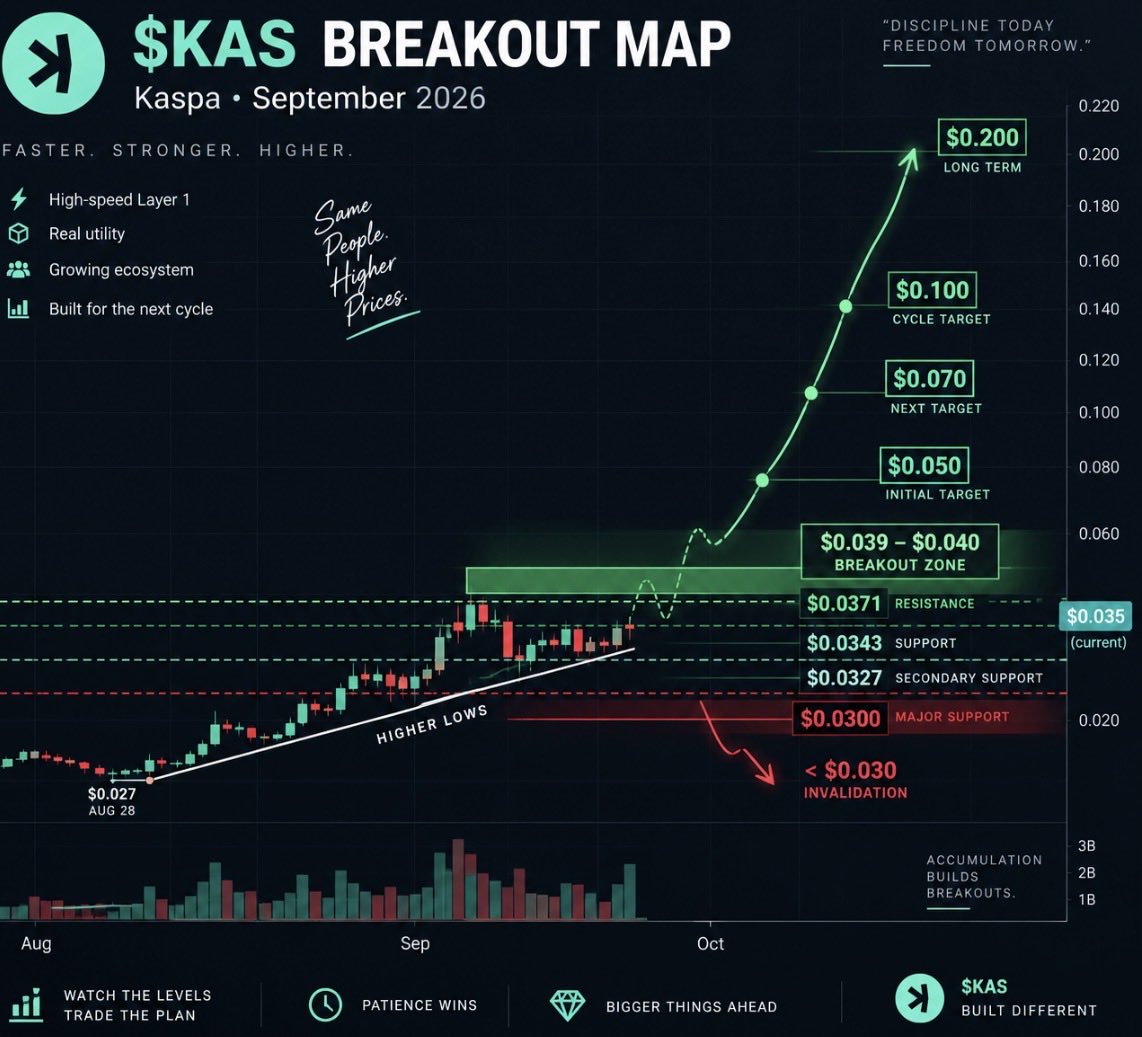
$KAS just hit my radar.
I've been watching it sit around $0.035 for days now. If it breaks $0.040 with actual volume, things could get wild fast.
My upside targets: $0.050, $0.070, then $0.10.
But here's the line that matters most: $0.030.
Hold that and we're still cooking.
As much as I love crypto, there is one thing I still cannot understand:
Why has @coinbase ignored Kaspa for years?
The Kaspa community has repeatedly tried to reach out. We have asked why kaspa:native is still not listed, whether there is any technical, regulatory, liquidity or integration issue holding a listing back, and whether there is anything the community or ecosystem can do to assist.
We have received no meaningful answer.
Coinbase has said that asset listings are free. That is completely fair.
But if listings are based on merit and projects cannot pay for access, then how is a legitimate community supposed to get your attention when repeated requests receive no response at all?
At this point, it is becoming increasingly difficult not to wonder whether Kaspa is being consciously overlooked.
And that is the part I would genuinely like clarity on.
Crypto is full of communities, narratives and memes — and memes are fun. But Kaspa is a serious, technically innovative Proof-of-Work network with a large global community that has supported this ecosystem for years.
We are not asking for special treatment.
We are asking for transparency.
If there is a reason Kaspa has not been listed, tell us.
If there is a requirement that has not been met, tell us.
If there is something the Kaspa ecosystem can improve or assist with, tell us.
But silence for years leaves the community with only one question:
Why?
@coinbase & @brian_armstrong ,
we would genuinely appreciate an answer.
Sincerely,
The Kaspa Community 💙
In a nutshell:
Kaspa’s edge over legacy networks:
🔹Vs BTC: Programmable L1 UTXOs enable native apps, bypassing rigid scripts.
🔹Vs ETH: Decomposed state prevents global contract bloat.
🔹Vs SOL/ETH: ZK-proofs offload heavy compute. L1 just verifies, never re-runs!
#Kaspa $KAS
🚨 KASPA JUST HIT 2.35 BILLION TRANSACTIONS — AND IT’S ONLY GETTING STARTED 🔥
While legacy chains struggle with congestion and high fees, Kaspa is quietly becoming the fastest, most battle-tested Layer-1 on Earth.
• 2.35 BILLION transactions processed.
• BlockDAG technology delivering insane throughput.
• Sub-cent fees.
• True decentralization.
• No downtime. No drama.
This isn’t hype — it’s real adoption and utility in action.
Toccata Hard Fork is dropping now! Bringing covenants, native tokens, SilverScript programmability, and ZK firepower on top of this blazing speed.
Kaspa isn’t competing with the old guard.
It’s building the infrastructure for the AI agent economy, micropayments, and the future of programmable hard money.
If you haven’t taken a hard look yet… now is the time.
The network is proven. The tech is superior. The community is relentless.
$KAS loading.
#Kaspa #KAS #Toccata #Crypto #BlockDAG 🚀
Kaspa's Toccata hard fork is live on mainnet
kaspa:native just hard forked. Toccata activated on mainnet today, the biggest upgrade in Kaspa's history.
It turns a high-speed payments chain into a programmable Layer 1: native tokens, covenants, and zero-knowledge proof verification at the base layer.
Toccata lays the groundwork, it doesn't ship the apps. The race now is what gets built on top.
📢1 Day to Toccata 🎹
Toccata activates at DAA 474,165,565.
Current estimate: June 30
Approximately 16:15 UTC / 12:15 p.m. EDT
The DAA score is the actual trigger, so the precise time may shift slightly as the network progresses.
Kaspa is a digital, open-source network where money, information, and programmable agreements are confirmed at internet speed, recorded in a way that can’t realistically be changed, not controlled by any company or authority, and open for anyone to use, help run, or build on.
Real-Time | Decentralized | Programmable Money
Technical guides and resources in the thread below.