Something big is coming. I'm going to init (AUGUST 31 - SEPTEMBER 4). Five days of Appwrite launches, live sessions, and surprises. One ticket holder wins exclusive swag on the last day. Claim your pass: https://t.co/iIgdbfLspn
In our new Persona Cartography paper we show that you can scale and combine LoRA adapters at inference time for fine-grained weight-space LLM persona control.
We train and apply LoRAs to control the big-5 OCEAN character traits, and treat some common LLM pathologies.
🧵
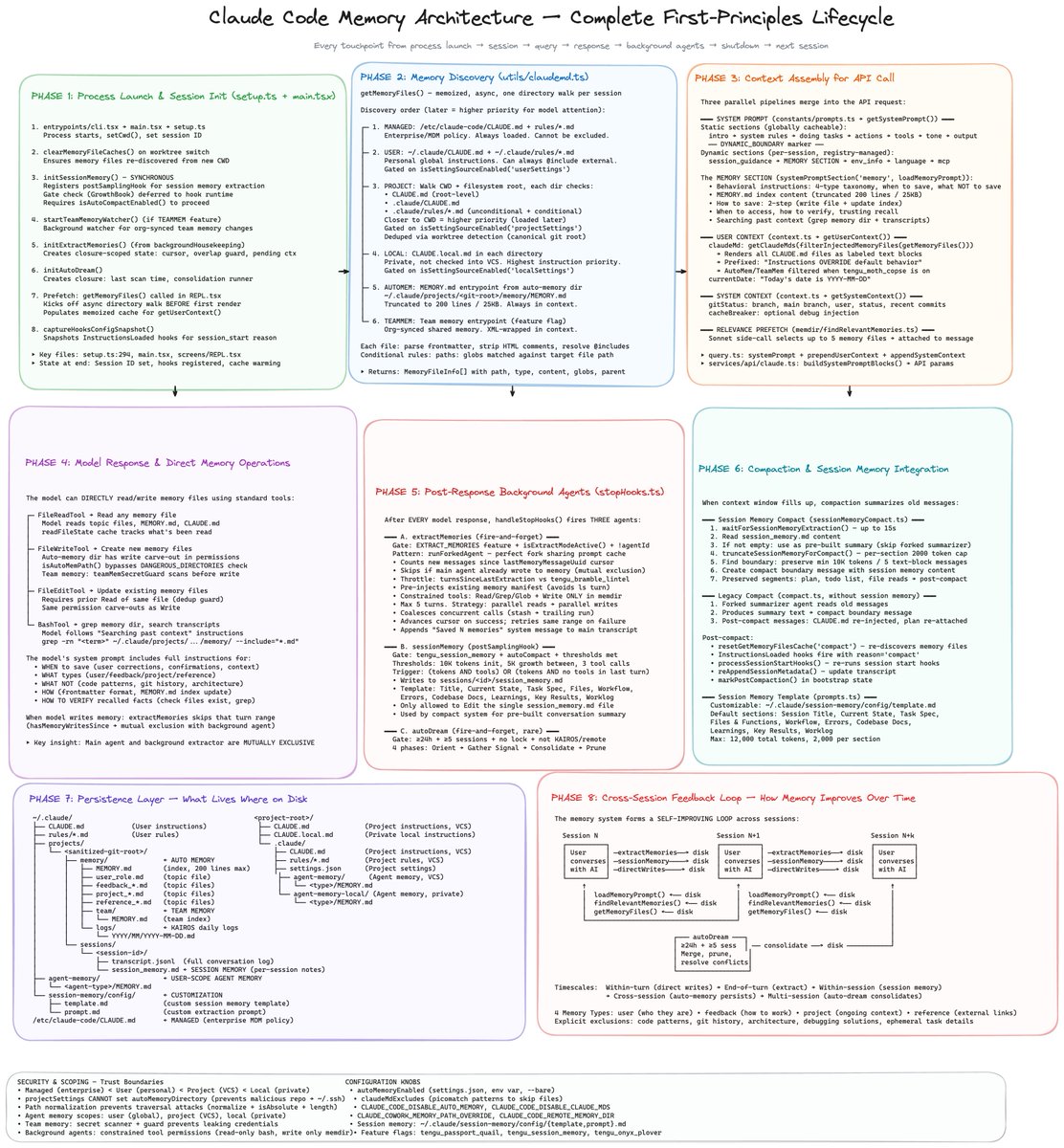
here's how Claude Code actually handles memory : all 8 phases 🧵
Our team at @mem0ai use @claudeai a lot, we deeply care about memory. here is a summary of how it works 👇
User Input -> Context Assembly -> History System -> API / Query -> Response -> Summary
Phase 1: session init registers hooks, warms the memory cache, and kicks off async directory walks before the first render
Phase 2: memory is discovered in priority order — managed enterprise policy → user global → project VCS → local per-directory → auto-generated → team shared
Phase 3: three parallel pipelines merge into every API call: system prompt + memory section + user context. relevance prefetch selects up to 5 memory files via sonnet side-call
Phase 4: the model can directly read/write memory files using FileReadTool, FileWriteTool, FileEditTool. background extractor and model writes are mutually exclusive
Phase 5: after EVERY response, three background agents fire — extractMemories, sessionMemory, and autoDream. extractMemories is a forked agent that runs in parallel, capped at 200 lines / 25kb
Phase 6: when context fills up, compaction summarizes old messages using a skipped summarizer, preserving min 10k tokens / 5 text-block messages
Phase 7: memory lives across ~/.claude/, project root, sessions/, and agent-memory/ — auto memory is git-ignored, team memory is VCS-tracked
Phase 8: self-improving loop across sessions — within-turn writes + end-of-turn extracts + session memory + auto-dream consolidations every 24h+
every touchpoint: launch → query → response → background agents → shutdown → next session
shoutout to @ChaithanyaK42 for the beautiful excalidraw!
My Macbook Keyboard is Broken and it's Insanely Expensive to Fix – "Sometimes you have to feel the hurt on your own body to fully understand the absurdity of the world, and I felt the hurt on hardware repairability this week"
https://t.co/TkdPIw8GA0
https://t.co/Ln8JE7Qj8e
Very interesting paper showcasing failure modes in the deployment of agents (OpenClaw) in a controlled lab env where a group of researchers interact with them for 2 weeks in a mix of red teaming & benign interactions
Do LLMs know whether they’ll be right before they speak? By reading only question-time activations, a tiny linear probe predicts if the next answer will be correct. No answer needed!
As part of the MARS 2.0 program, we studied such probes and what questions they work on.
Test-based certification is the only way forward in food, eager to see more over time.
Food is not simple anymore - it is a complex, industrial product with global supply and processing chains. Contamination can be introduced in many stages along the way from farming to harvest, processing, packaging, transport and preparation. Examples include pesticides, nitrates, heavy metals, plastics, bacteria, etc etc. So it's not just about what food to eat, it's about which specific food item SKU, from which specific supplier, and the only way to know is to test. E.g. these two cat foods look the same, the ingredients might look the same, but the one on the left is 1000X higher in glyphosate and 100X in lead. Or e.g. this baby food formula or turmeric is loaded with heavy metals, this canned seafood, your local boba or this milk brand is seeped in plastics, or this breakfast cereal way way too high in glyphosate (real examples).
I used to think that the FDA exercises oversight but the reality is that it doesn't have anywhere near enough resources to do it thoroughly and their focus is a lot more on e.g. acute microbial threats (like Salmonella, E. coli, Listeria, ...) that immediately hospitalize people, less on the rapidly growing diversity of compounds that may or may not deteriorate health over decades and that are basically treated as innocent until proven guilty under GRAS and so on. Meanwhile, the public health macro picture looks not so great - obesity up, type-2 diabetes up, fertility down (sperm count/motility), weird endocrine trends (e.g. testosterone down in men), depression and anxiety up... It wouldn't shock me if modern industrial food turns out to be a major contributor.
Mozilla just released AIssert, a CI/CD ready framework based around Giskard for automating E2E tests of LLM integrations.
This is a step further than running evals against your model outputs in isolation, allowing you to test the full inference pipeline.
https://t.co/2LQ6zduSAp
telekinesis-inc/aiopandas: Lightweight Pandas monkey-patch that adds async support to map, apply, applymap, aggregate, and transform, enabling seamless handling of async functions with controlled max_parallel execution.
https://t.co/uvrBCCgQt6
Driving around SF. Omg this is crazy I can't believe there's billboards advertising cloud GPUs on the streets of SF, the hype is totally out of control. That said, actually I would like some more GPU and I haven't heard of this company yet this looks interesting.
The fact that most individual neurons are uninterpretable presents a serious roadblock to a mechanistic understanding of language models. We demonstrate a method for decomposing groups of neurons into interpretable features with the potential to move past that roadblock.