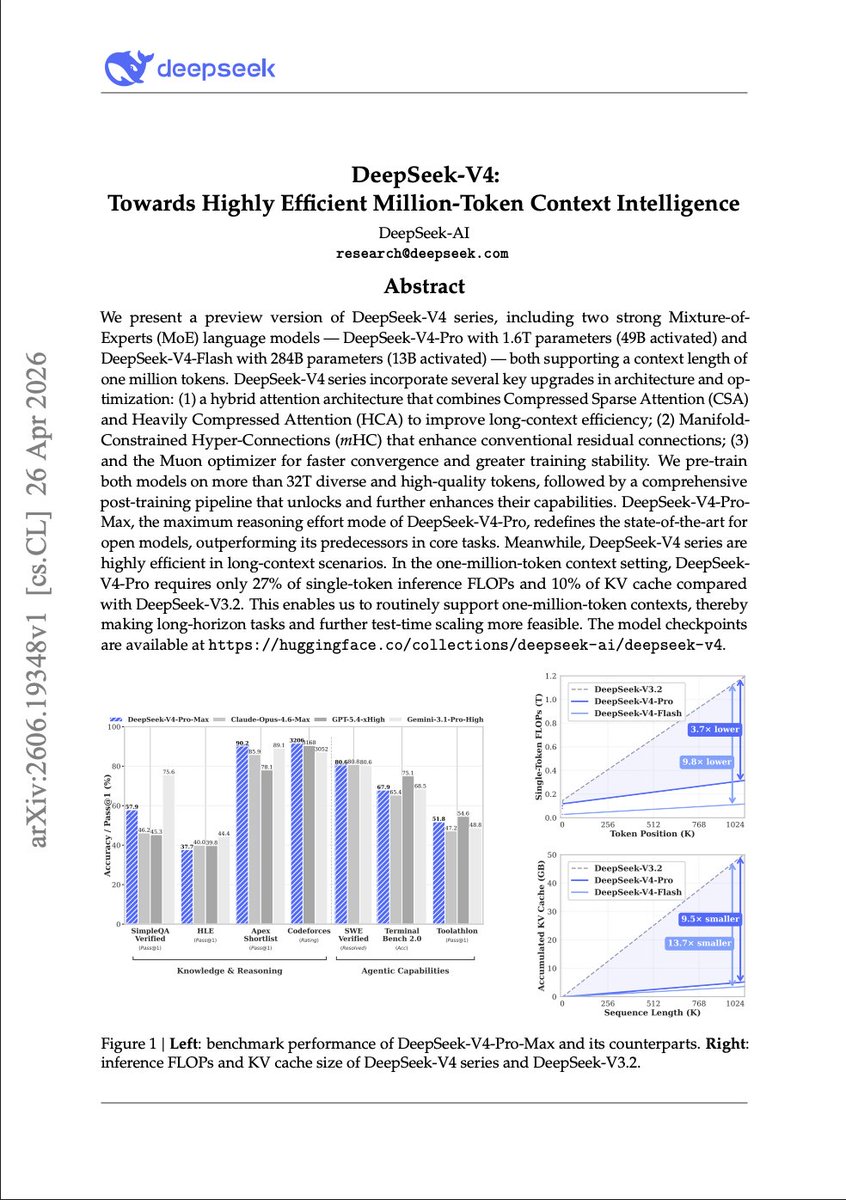
DeepSeek just made one-million-token context cheap.
Researchers from DeepSeek-AI dropped the technical report for DeepSeek-V4.
Two models. Pro (1.6T parameters, 49B active) and Flash (284B, 13B active). Both natively handle one million tokens.
The breakthrough is hybrid attention:
• Compressed Sparse Attention shrinks the KV cache along the sequence
• Heavily Compressed Attention compresses even harder while keeping dense attention
Add Manifold-Constrained Hyper-Connections and the Muon optimizer.
At one million tokens the numbers are brutal:
• Only 27% of the single-token FLOPs of DeepSeek-V3.2
• Just 10% of the KV cache size
Long-horizon agents and serious test-time scaling just stopped being expensive.
DeepSeek-V4-Pro-Max already sets new open-source records on knowledge and reasoning. And it stays dramatically cheaper than the closed models - including the latest Grok line.
The old rule was simple: you can have a million tokens if you’re willing to pay for it.
DeepSeek deleted the second half of that sentence.
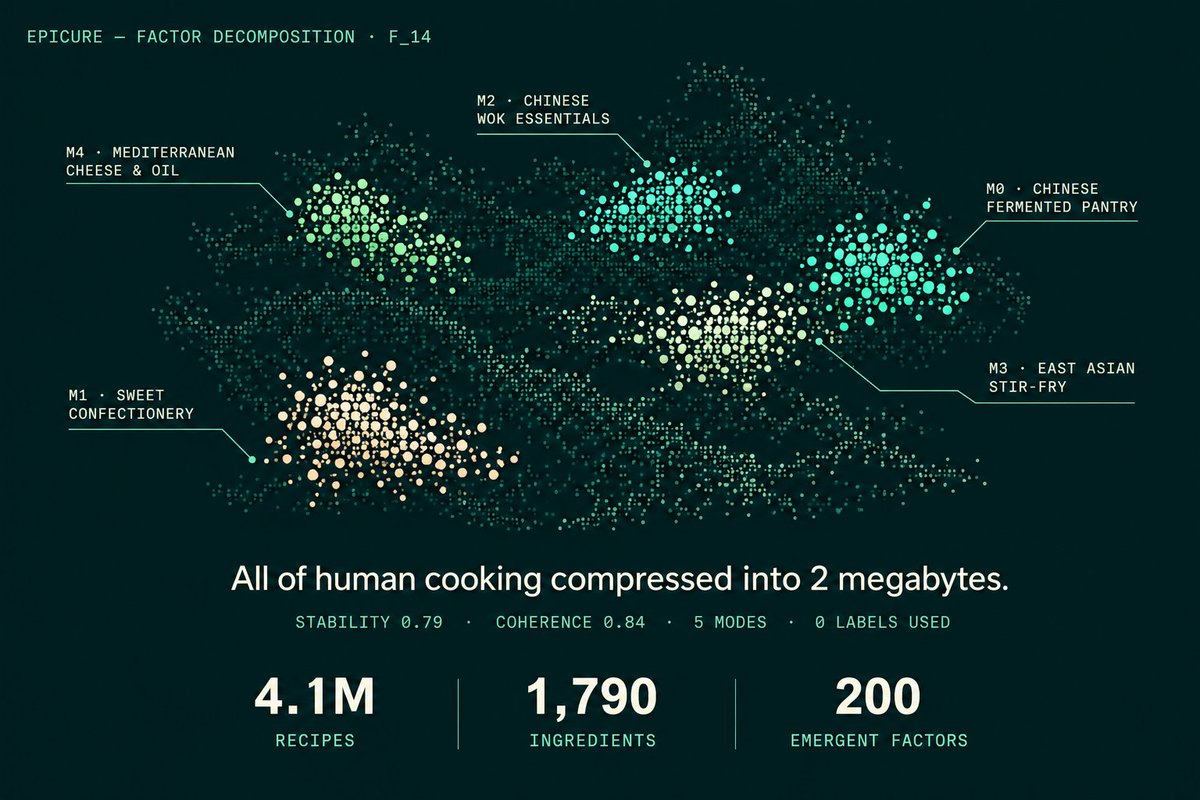
Launching our new paper on arXiv: we trained the largest multilingual food model ever built.
4.1M recipes. 7 languages. 1,790 ingredients. 300 dimensions.
All of human cooking compressed into 2 megabytes.
Germany is a sleeping giant of physical AI
everyone's been writing Germany off in the AI race because there's no German OpenAI and no big data center story.
but theres actually two AI races happening:
the first is software. chatbots, LLMs, data centers. US/China are winning that, not even close.
the second one is physical. robots that pick up boxes, weld cars, carry groceries, stack pallets.
and on this one Germany is one of the top contenders in the world
this stat might convince you (it convinced me):
Germany is 3rd in the world for robots per factory workers (449 robots per 10,000 human workers).
only South Korea (1,220) and Singapore (818) are ahead.
Japan is behind at 446. the US is all the way back at 307.
so Germany already runs more of its economy on robots than almost anywhere else on earth.
and the German companies building this next wave of physical AI are some global heavyweights.
a few worth knowing...
> Neura Robotics in Metzingen is building humanoid robots and raising ��1B from Tether at a €4B valuation (this was March 2026). Volvo already in from an earlier round.
> Sereact in Stuttgart raised $110M in April 2026 to build the software brain that lets robots see and grab things. already runs 1 billion+ real-world picks for BMW, Mercedes, and Daimler Truck.
> Agile Robots in Munich was the worlds first robotics unicorn. revenue doubling yearly, around €200M now, heading for €1B.
>RobCo in Munich raised $100M in early 2026 at a ~$500M valuation. their robots learn new tasks by watching a worker do it once instead of getting programmed line by line. already pushing into the US and aimed at the small and mid-size factories that make up most of german industry.
> Fraunhofer (Germany's network of 76 applied research labs) built the evoBOT in the video below. self-balancing, two arms, carries 100kg of cargo, being tested at Munich Airport right now.
but why is Germany specifically well positioned for physical AI though?
three things stack on top of each other.
first, the factories. Germany has thousands of family-owned precision manufacturing shops that have been logging sensor data for decades.
that data is basically the training fuel for physical AI and almost nobody else has it at this depth.
second, the customers are already there in-country.
VW, BMW, Mercedes, Porsche, Bosch, Siemens. a robotics startup in Stuttgart can ship its first commercial deployment to a brand everyone recognizes in year one.
that's why Sereact's customer list reads like a german car show lol.
third, the engineer pipeline. Fraunhofer spins out companies like Agile Robots straight from its labs. KUKA built the first 6-axis electromechanical robot arm back in 1973. they've been doing this for 50 years.
so the chatbot race is mostly settled and Germany lost spectacularly
but the robot race is still early innings. and i think Germany's well positioned
we ACTUALLY got the oppressor mk2 before GTA 6.
Polish engineer Tomasz Patan built the Volonaut Airbike.
it hits 124 mph, runs on jet propulsion, has no propellers, and weighs less than your dog.
pretty fucking sick.
The ancient Romans, Greek, and Chinese ate these plants for centuries.
Modern Americans call them "weeds" and spray them with chemicals.
After looking around I found 8 common garden weeds that contain more nutrients than kale, spinach, and broccoli:
1. Dandelion Greens
"Why have we not seen any aliens? It could be because intelligence is incredibly rare, and maybe we're the only ones in this galaxy, like tiny candle in a vast darkness. We should do everything possible to ensure the tiny candles candle does not go out."
一 Elon Musk
Elon Musk, nine years ago: "There will be fewer and fewer jobs that a robot cannot do better."
Today, that's starting to look like truth, not fiction.
Back then, Elon was asked what happens when AI and robots can do most jobs better than humans.
"These are not things that I think that I wish would happen. These are things simply things that I think probably will happen."
His forecast was blunt: mass unemployment is coming, and society will have no choice but to respond.
"Ultimately we will have to have some kind of universal basic income. I don't think we're going to have a choice."
When asked to clarify whether this meant unemployed people would be paid across the globe because robots had taken over, Elon confirmed:
"There will be fewer and fewer jobs that a robot cannot do better."
But Elon didn't frame this as purely dystopian. With automation comes abundance:
"The output of goods and services will be extremely high. So with automation will come abundance. Almost everything will get very cheap."
The economic problem, in his view, is solvable.
Pay people. Goods are cheap. Survival is handled. The harder problem is what comes after survival.
"The much harder challenge is how do people then have meaning? Like a lot of people they derive their meaning from their employment. So if you're not needed, if there's not a need for your labor, what's the meaning? Do you feel useless?"
That's the question Elon left unanswered nine years ago, and it may be the one that matters most today.
The NSA spent billions trying to break encryption.
One German programmer beat them.
He earned only $25k a year. 🤯
Meet Werner Koch 🇩🇪
> German free software developer. Born 1961 in Düsseldorf.
> 1997 ~ Richard Stallman called for a free encryption tool.
> Only option then: closed-source, US-restricted PGP.
> Werner answered. He built GnuPG (GPG) alone — free software to encrypt files, sign software, and verify identity.
> 1999 ~ Released GPG 1.0. Fully open source. No restrictions.
> Today his code verifies every Linux server update, every Debian package, every Tor Browser download on Earth.
> Every signed Linux release depends on it.
> Used by activists, dissidents, and security pros worldwide to stay untracked.
> Edward Snowden used GPG in 2013 to leak NSA documents. It held up against the world’s most powerful spy agency. 🚀
> 2001 ~ Founded g10code with his brother to work full-time on GPG.
> Earned $25,000/year for 14 years while supporting his wife and daughter.
> 2012 ~ Funding ended. He had to let go of his only programmer.
> 2013 ~ He was the sole maintainer and nearly quit.
> 2015 ~ ProPublica story dropped. Internet donated $137k in 24 hours.
> Facebook + Stripe pledged $50k/year each. Linux Foundation gave $60k.
> Won FSF Award for the Advancement of Free Software.
> Today he still maintains GPG from his home in Erkrath, Germany.
One man kept the internet’s secrets, secret.
The world almost lost him in 2013.
His code still protects yours.
Privacy GOAT. 🐐
The Fibonacci sequence (0,1,1,2,3,5,8,13…) isn’t just math — it’s a universal pattern. As it grows, ratios of terms approach the Golden Ratio (Φ ≈1.618), a harmony found in spirals, plants, shells, galaxies & even DNA.
[🎞️ thevisualalchemy]
The Fourier Transform is a mathematical operation that transforms a function of time (or space) into a function of frequency. In essence, it decomposes a complex signal into its constituent sinusoidal components, each with a specific frequency, amplitude, and phase. This is particularly useful in many fields such as signal processing, physics, and engineering, because it allows for the analysis of the frequency characteristics of signals. The Fourier Transform provides a bridge between the time domain and the frequency domain, enabling the analysis and manipulation of signals in ways that are more intuitive and computationally efficient. The result of applying a Fourier Transform is often represented as a spectrum, showing how much of each frequency is present in the original signal.