🚨 ¡Se acabó eso de "compras una licencia, no el juego"! 🎮⚖️
🔥🎮 El congresista estadounidense Maxwell Frost acaba de presentar la "Ley de Protección de Nuestros Juegos" para blindar la propiedad digital de los jugadores:
▪️ Si compras un juego, es tuyo para siempre.
▪️ Si cierran los servidores online, los estudios deberán dar acceso a servidores propios para que siga siendo jugable.
👉 Si saliera adelante sería un golpe directo a las compañías que borran juegos de nuestras bibliotecas digitales. 🤔 ¿Crees que una ley así debería promoverse en todo el mundo? 👇
@benjamincowen Your analysis is always thoughtful and insightful
Unfortunately there’s many who try to manipulate your words to their benefit
Please continue your great work
I never tweet but my word this happens so often
Let me tell you a story about how unethical Anthropic is.
In April, the Anthropic team began heavily courting our engineering team to tell them corporate secrets, technical details, and future plans for @cfosilvia.
They pretended their interest was due to our exploding popularity and accelerating compute usage, but it quickly became apparent that Anthropic was fishing for details on how we built our product and why it was so popular.
This included the Anthropic team trying to wine-and-dine our engineers, including a infamous steak dinner where someone told our team "don't worry about it, this is on Dario."
Our team was not born yesterday, so we quickly realized what was happening and refused to share sensitive information and technical details with the Anthropic team.
As we suspected, Anthropic was trying to get information from us, so they could build a competing product. Some people on their team must have a guilty conscious because they messaged us a few days ago to give us "a heads-up" that they were launching a competing product.
Thankfully, the Silvia engineering team has been aggressively working to get off the frontier models for the last ~ 6 months. That effort has been highly successful, because our compute costs are ~ 97% lower when we use our own model & hardware, the latency is lower, and the accuracy of answers materially increases as well.
The sad thing for Anthropic is they have now released an inferior product and they had to sell their soul to do it.
The only thing worse than being a trillion-dollar company that can't beat a 10-person team is being a trillion-dollar company that no one trusts and everyone knows is unethical.
Serious investors continue to choose @cfosilvia over ChatGPT, Claude, and other frontier companies because these products are not optimized to solve the actual user problem.
Today, Anthropic launched a Claude wrapper that is masquerading as a personal finance product. Best of luck to them.
But I will take the Silvia misfits vs the Anthropic losers any day of the week.
if you want to support people trying to do things the right way, and help investors be more informed, then consider signing up for Silvia today: https://t.co/4LyYZFRC4m
Hi @Jason, @friedberg, @chamath, and @DavidSacks,
Please watch this 5-min clip. If you find it interesting, please watch the entire discussion.
The ONLY way we can save our wonderful country from the scourge of communism is by having folks like you stop spewing hot takes about it and start acknowledging that you're part of the problem.
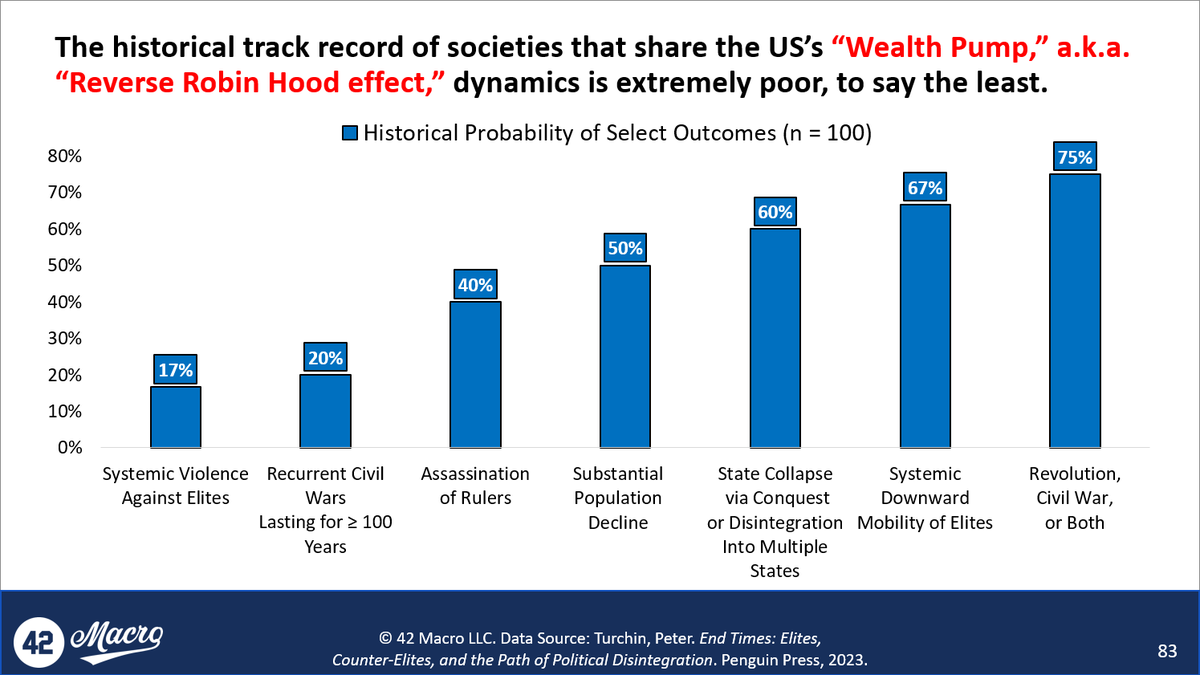
Capitalism does not produce the outcomes in these charts. A broken political system in which the donor/Epstein class pays to rig fiscal, monetary, regulatory, and foreign policy against working-class families does.
You guys have a big-enough platform with @theallinpod to help fix this. Based on your recent commentary, however, I’m concerned that not only do you have no intention of helping save our nation, but you’re actually hell-bent on perpetuating Dr. @Peter_Turchin’s “wealth pump,” which is what I call the “Reverse Robin Hood effect.”
Why? Because mounting a primal rallying cry against the mere whiff of redistributive policies from this starting point in the labor vs. capital income and wealth distribution cycle is, at best, deliberately obfuscating and, at worst, demented.
Prove me wrong by inviting me to debate each of you on your show on behalf of We the People.
❤️+🩶+💙=💜
🚨 WE'RE IN TIMES SQUARE!
Together with @kalaelizabeth, we've managed to get a #SaveMassEffect billboard up in Times Square, NYC, all day today!
📍 1560 Broadway, above the Pelé store (Duffy Square)
⏰ 15 seconds every hour at :35
HOLD THE LINE! ❤️
Are Small Models Really a Threat?
The Anthropic Fear Factory just released a new report warning that small models may be only months away from self-replicating across cheap IoT devices like off-brand Android TV boxes and smart ovens. They say such an AI worm would be hard to shut down since there’s no central kill switch.
We’ve gone from “The Terminator is coming” to “your toaster might kill you.”
But the experiments don’t support the dramatic headlines. They ran a 26B model across 15 $55 TV boxes at 0.39 tokens per second. The end-to-end test used emulated devices with deliberately open ADB ports, so the “hacking” step was trivial. The capable model often ran on a separate server. Agents were harnessed and told to propagate. This is not proof of autonomous rogue AI worms in the wild.
Nor is the threat even novel. Worms that do this without AI already exist. Mirai in 2016 scanned for default credentials and built massive DDoS botnets. Kimwolf has infected over two million devices, mostly cheap Android TV boxes, by hitting open ADB ports.
Small models don’t currently add much that matters on these targets. The bottleneck has never been figuring out the device. It’s the huge number of devices that ship with open ports, default passwords, and no patching. Traditional worms already exploit that at scale.
A practical attacker would use the best models available offline to design a better traditional worm, then ship the lean binary. You get the intelligence benefit at design time without dragging a slow, heavy model along with every infection. Embedding a weak model in the payload is the worse option for anyone who actually wants the largest, fastest botnet.
The timing of Anthropic’s latest scare campaign is hard to ignore. The day before, Brian Armstrong posted that Coinbase fine-tuned an open-weight small model (Qwen-3.5-9B) on proprietary fraud data. It beat frontier models, including Anthropic’s own Opus 4.5, while being faster and much cheaper. In testing it cut fraudulent transactions by about 30%.
This is the emerging pattern. For narrow enterprise workloads you don’t need a general superintelligence. You need a small specialist model trained on your own data. Cheaper to run, especially as compute gets tighter, and often better on the metric that matters. That is a direct threat to the frontier-company model of selling access to ever-larger general models.
Safety advocates should be welcoming this development. If the real concern is existential risk from ever-larger frontier systems — the ones that could theoretically do sustained autonomous R&D or become hard to control — then a shift toward smaller specialized models is the safer outcome.
Small models specialized on fraud detection or support tickets are not pushing the frontier. They are not in the category of systems that could become a new species. The theoretical loss-of-control risk is created by models getting bigger and more generally capable.
Safety advocates focused on those risks should welcome companies having a cheaper alternative to constantly scaling general models. Instead we get dramatic warnings about small models at the exact moment they are starting to take real enterprise share from closed-model companies like Anthropic.
Today, we’re sharing more about the future of Bungie, including our plans for Destiny, Marathon, and how we’re changing the way we work.
Read more on https://t.co/ZkmLWmaQZr: https://t.co/QbDwADGinr
Dario has written that we need to “pace the frontier,” and Sam has agreed. People may be surprised by my response: go ahead.
You guys are the frontier. By any reasonable metric — market share, revenue growth, model capability — the two of you have a duopoly on frontier intelligence. You’ve also claimed the lead is widening because of recursive self-improvement.
I don’t see what you see in the lab. If the unreleased models are scary enough that you think you should slow down, I support your decision to be responsible.
But stop pretending you need anyone else’s permission. Stop pretending antitrust law has to be suspended so you can form a cartel. Stop pretending you need a regulatory approval process that supersedes product liability. Stop pretending METR is independent when it is intertwined with Anthropic’s investors and staff. Stop pretending you need those same evaluators to police competitors who aren’t even at the frontier.
Most of all, stop pretending the motivation to slow down is purely altruistic. You face massive product-liability exposure if your products enable a truly damaging cyberattack. The market already punishes models that behave in unpredictable or unauthorized ways. After the Hugging Face episode, it is simply good business for OpenAI and Anthropic to trade some raw power for reliability and predictability. Call it alignment if you want. It is also just giving customers what they want.
Pacing the frontier would also create breathing room for a more intelligent conversation about regulation than Bernie Sanders’ “shut it all down.” China is very unlikely to join a global agreement, as you know, and that has to be taken into account as well.
So go ahead and pace the frontier. You are the ones setting it. The easiest way not to build superintelligence is for you to agree not to build it. Demanding your preferred regulatory framework as the price of that will look like blackmail of the public and the political system. So just do it.
If you do, you’ll buy goodwill for the next conversation. If you don’t, we’ll know this was just another bid for regulatory capture — or an election-season psyop.