Instead of watching an hour of Netflix, watch this 2 hour hour Stanford lecture will teach you more about how LLMs like ChatGPT and Claude are built than most people working at top AI companies learn in their entire careers.
🚨 Stop using Claude like it’s ChatGPT — they’re completely different tools.
Here’s how to set it up the right way in just 10 minutes 📸
(Save this for later 🔖)
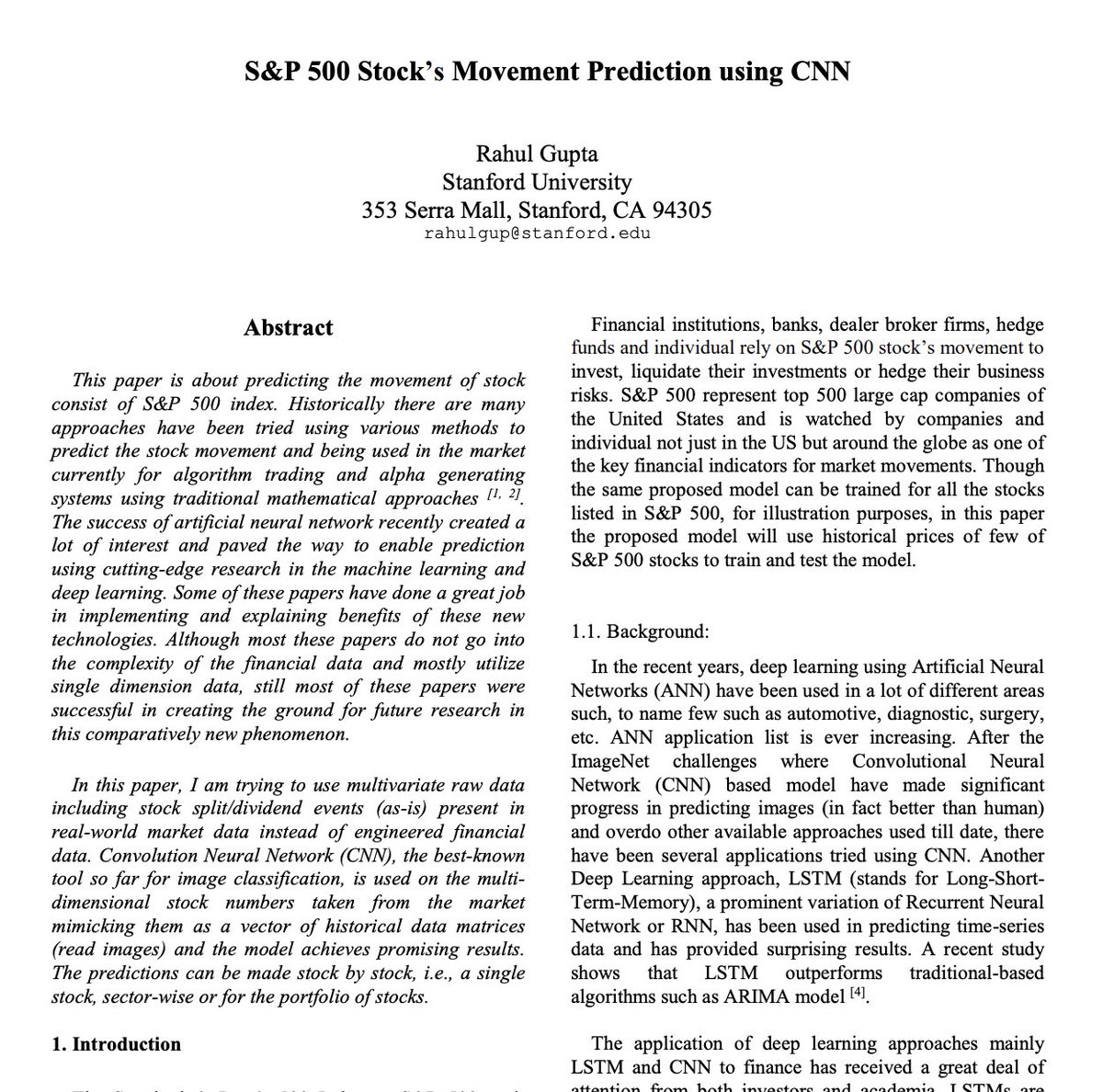
This paper from Stanford University tackles a question that’s been debated for decades in quantitative finance: can raw market data alone meaningfully predict stock price direction, without handcrafted indicators or heavy financial feature engineering?
The author proposes a Convolutional Neural Network–based approach to predict the directional movement (bullish vs bearish) of individual S&P 500 stocks using pure multivariate price data.
Instead of technical indicators, the model consumes raw daily OHLCV data plus adjusted prices that explicitly encode dividends and stock splits, which are usually smoothed away or ignored in most academic work.
The core idea is subtle but important. Multivariate time series are treated as spatial objects, not just sequences. Each rolling window of historical prices is reshaped into a matrix that behaves like a 1D “image,” allowing CNN filters to detect local patterns such as short-term momentum, volatility shifts, and structural breaks caused by corporate actions.
This reframing borrows intuition from computer vision rather than traditional econometrics.
The dataset spans up to two decades of daily data per stock, sourced from an institutional-grade provider. Ten channels are used: open, high, low, close, volume, and their adjusted counterparts.
Sliding windows generate thousands of training samples per stock, dramatically increasing data density without synthetic augmentation. A normalization step ensures scale invariance across features.
Architecturally, the model uses a deep 1D CNN with eight convolutional layers, followed by fully connected layers and a Softmax classifier optimized with cross-entropy loss. Early layers focus on short-term price structure, while deeper layers capture longer-term trends.
Unlike LSTMs, which struggle with noisy gradients and statefulness in finance, the CNN’s localized receptive fields make it naturally robust to volatility spikes and event-driven price jumps.
The training objective is framed as a probabilistic classification task: predicting bullish or bearish movement over future horizons ranging from 2 to 30 days.
Extensive hyperparameter tuning reveals that performance depends heavily on window size, batch size, and learning rate, with Adam optimization and larger batch sizes producing the most stable convergence.
Results are where the paper becomes provocative. On several large-cap stocks, reported validation accuracies reach high-80s to low-90s percent, significantly outperforming earlier deep learning baselines trained on raw data.
JP Morgan stock, in particular, shows accuracy touching ~91% for longer forecast horizons. Loss curves and accuracy plots suggest genuine learning rather than overfitting, aided by careful train–validation splits and shuffling.
The author is careful not to overclaim. The model predicts direction, not returns, and does not directly incorporate transaction costs, slippage, or execution constraints. Still, the findings suggest that CNNs can internalize complex market mechanics directly from raw price tensors, including the non-linear distortions introduced by dividends and splits.
The broader implication is that feature engineering may be less critical than representation choice. By letting the model learn spatial relationships inside time-series windows, the approach sidesteps many subjective assumptions baked into technical indicators. The paper also hints at natural extensions: hybrid CNN–LSTM architectures, portfolio-level predictions, and integration of textual sentiment for fundamentals-aware forecasting.
In short, this work argues that treating financial time series as structured, image-like data is not a gimmick. It is a viable inductive bias that unlocks predictive signal from raw market data, challenging the long-held belief that markets are too noisy for deep learning without heavy human intervention.
Paper: S&P 500 Stock’s Movement Prediction using CNN