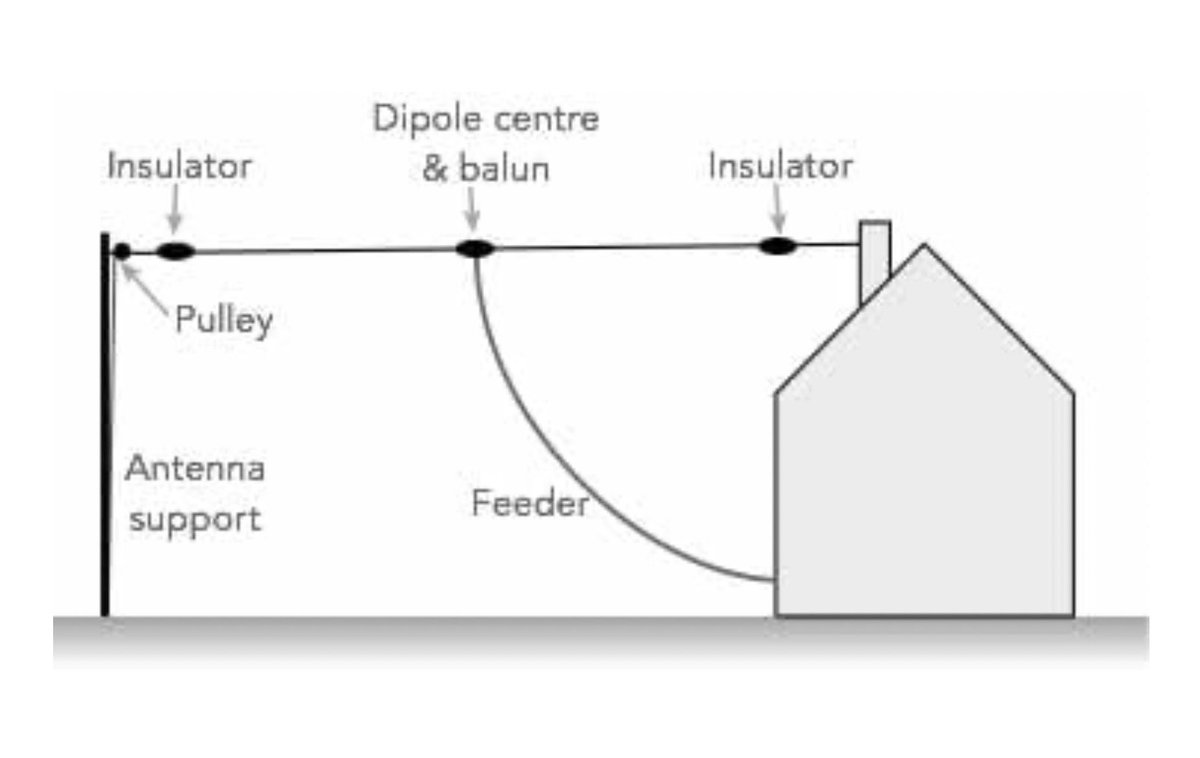
Crafting your own sky wire is one of the most rewarding milestones in amateur radio.
Building an HF dipole is budget-friendly and gives you hands-on insight into how your signal actually propagates.
Based on the fundamental guide from Electronics Notes, here is how to assemble a high-performing half-wave dipole for 80m down to 10m. 🧵
👇
#HamRadio #AmateurRadio #AntennaDIY #hamr #antennas #electronicsnotes
When talking about reflected power in a feed line which is correct SWR or VSWR?
As both a professional engineer and a radio amateur, I hear them used interchangeably all the time on the air and in the lab.
But is one actually more correct than the other?
To answer that, we first have to look at what’s really happening inside your coax when power gets reflected. Why does a mismatched load cause energy to bounce back in the first place? 🧵👇
#SWR #VSWR #RFdesign #antennas #RFdesign #amateurradio #hamradio #hamr
📷 The X-026 has a name: IC-7110
Revealed minutes ago at Tokyo Ham Fair 2026.
First photos + everything we know 📷
https://t.co/JK5dEBGLjV
Worth the four-month wait? 📷
#IC7110 #7110 #HamRadio#Icom#X026#TokyoHamFair2026#DXZone
A crystal oscillator uses a piezoelectric crystal to generate a highly stable frequency signal. When an electrical signal is applied, the crystal vibrates at its natural resonant frequency and produces a precise oscillation.
In a microcontroller circuit, the crystal resonator (XT) works with two load capacitors, C₁ and C₂, to support stable oscillation. The MCU uses this clock signal to control the timing of its operations. The load capacitance depends on C₁, C₂, and stray capacitance.
Crystal oscillators are widely used in microcontrollers, digital clocks, communication systems, computers, watches, and other electronic devices where accurate timing is important.
VCXOs: What are they & where can these oscillators be used in circuit designs.
A Voltage Controlled Crystal Oscillator (VCXO) combines the high stability of a quartz crystal with the flexibility of a voltage-controlled adjustment. It allows you to "pull" or trim the frequency by a small amount using an external control voltage.
#Electronics #engineering #electroniccomponents #crystaloscillators #vcxo #voltagecontrolledcrystaloscillator #electronicsnotes #RFDesign #Oscillators
What makes the Superheterodyne (or "Superhet") receiver the gold standard?
Developed by Edwin Armstrong in 1918, this architecture solved the massive stability and selectivity problems of early radio.
By converting incoming RF signals into a fixed "Intermediate Frequency" (IF), it created a stable, reliable way to tune stations.
It’s the foundational technology that has underpinned almost every radio receiver—from broadcast AM/FM to modern high-end microwave communication systems—for over a century. 🧵
(1/5)
#superhet #superheterodyne #radio #amateurradio #hamradio #hamr