BIG ANNOUNCEMENT FROM HUGGING FACE TODAY:
We're unveiling Microduck 🐥🤖
It's a tiny $399 open-source robot you can teach new tricks with reinforcement learning. It can walk, pick things up, get back up when it falls, and even roller-skate.
Welcome to the era of open-source affordable robots to democratize physical AI and world models!
🤗🤗🤗
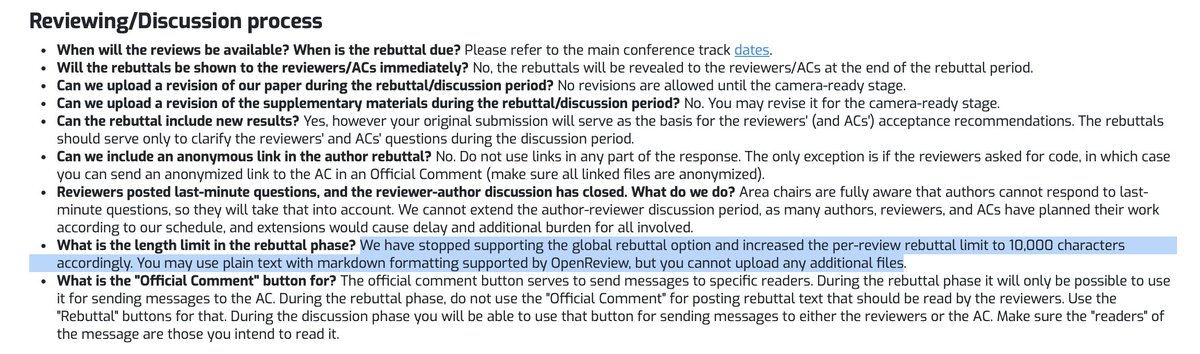
@NeurIPSConf, why take the option to provide figures in the rebuttals away from the authors during the rebuttal period? Grounding the discussion in hard evidential data (like plots) makes resolving disagreements much easier for both the authors and the reviewers.
Left: NeurIPS author instructions from yesterday, Right: Same page today.
New paper: lets help AI understand scenes better by *checks notes* helping it understand scenes better 🤔 Sometimes the most straightforward solutions are hiding in plain sight
https://t.co/W4OIr6SIxL
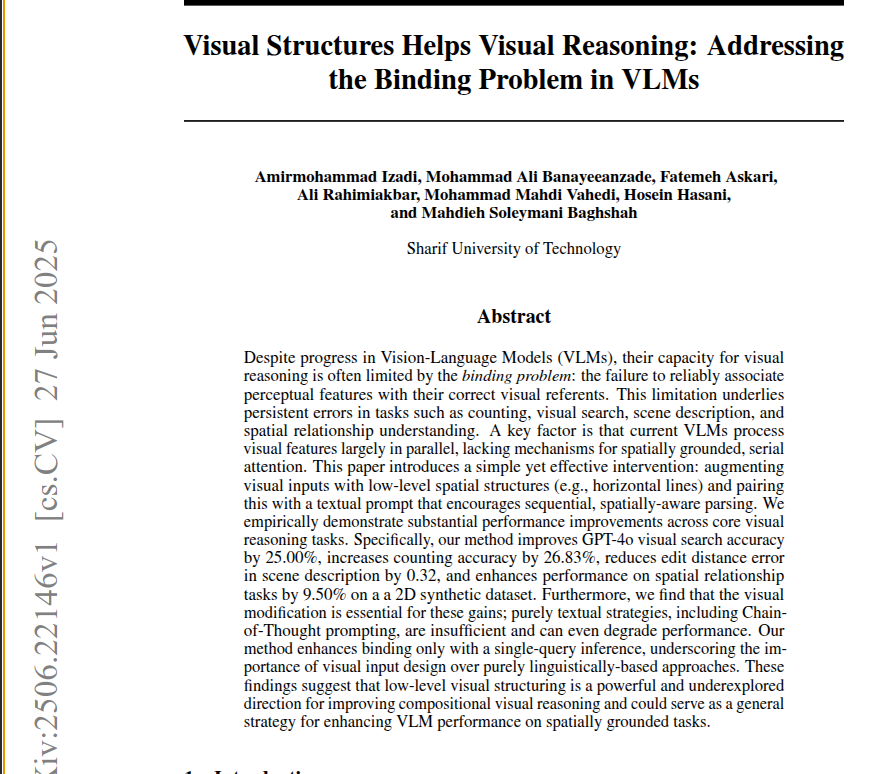
9. Visual Structures Help Visual Reasoning
This study shows that adding simple spatial structures (like horizontal lines) to images significantly boosts GPT-4o’s visual reasoning by improving feature binding.
https://t.co/V4KTUWuU0Z
Add lines, get instant spatial reasoning gains in any VLM.
Three thin horizontal lines over an image make GPT‑4o and other vision language models count, search, and describe far better.
This simple scaffold fixes the binding problem that mixes up features and locations.
Models normally process all pixels at once, so a red label may attach to the wrong cube.
The authors split the scene into 4 rows and tell the model to scan row by row, creating a quick serial spotlight without retraining.
Counting accuracy rises from 12% to 39%, visual search harmonic mean from 0.48 to 0.73, scene description errors drop, and spatial relation hits jump by 9.5%.
Chain‑of‑thought prompts alone fail, proving the visual cue is the key.
Because the tweak costs almost nothing and works in one call, any app can adopt it today.
The study suggests that interface level tweaks can unlock reasoning that the network already holds.
----
Paper – arxiv. org/abs/2506.22146
Paper Title: "Visual Structures Helps Visual Reasoning: Addressing the Binding Problem in VLMs"
Beyond the simple idea, the attention analysis was really interesting. It shows the lines literally guide the LVLM to scan row-by-row; almost like how we methodically look for Waldo in a picture 😁
Adding horizontal lines to images improves VLM (vision language model) performance of tasks like counting, visual search, spatial understating, scene understanding, and more