This is a pretty big statement from Broadcom.
“There is unanimous industry consensus that the largest clusters on the planet are using Ethernet for scale-up.”
Scale-up has historically been where proprietary fabrics had the strongest position. Now Broadcom is saying Ethernet is moving directly into that part of the AI cluster.
Obviously very good for $AVGO and its Tomahawk franchise, but I think $ANET investors should pay attention too.
Arista is already building Etherlink for both scale-out and scale-up using Broadcom’s Tomahawk 6. Arista expects trials and pilots to start in 2027, with scale-up revenue becoming meaningful from 2028.
If Ethernet really becomes the standard across both scale-out AND scale-up, the networking opportunity for $AVGO and $ANET gets considerably larger.
One of the biggest things politicians don't seem to understand is that efficiency is both economically beneficial and raises the standard of living while not destroying jobs.
Consider this example: you have a company that employs 100 employees. But with AI they now only need 70 employees to do the job that the 100 were previously doing. So the company does layoffs. Politicians will point and say this is a bad thing and AI is destroying jobs, but are they right?
The mistake is looking only at the 30 jobs that disappeared and ignoring what was gained.
The company can now produce the same amount of work with 30% fewer workers. That means the economy maintains the same amount of productivity while 30 people now have their labor freed to do something else.
The company now has higher margins, is more stable, can reinvest profits or pay out profits in bonuses to employees and owners. Their quality of life has increased.
The 30 workers will move on to other businesses, industries, or with AI the barrier to entry of making new services and products is much lower, meaning they can find or build new gainful employment quicker. And they have many institutions to help with transitions during job loss to finding new opportunities.
Their new businesses and jobs are additive to economic output, because the company they left still has the same amount of output without them, while the company they're working at now has additional output.
When jobs are lost due to efficiency, the economy does better and people have a higher quality of life. But if jobs are lost due to inefficiency and higher friction (disruption, inflation, burdensome regulations, higher input costs, taxes, etc) economic output declines and quality of life is lowered.
The politicians that try to "create jobs" by making processes intentionally less efficient have it totally backwards. They are hurting the company, the economy, and even the employees they're trying to help, in the long run.
What happened to bikes? 🚲
The fitbit connects to the bike's Heart Rate Monitor -- Doctor mode.
Changed the tail lights to Disco Ball setting -- Rear light mode.
The bike talks, tells you directions or to speed up -- Fitness coach mode!
Last month I wrote about how we can build a positive and safe future for everyone: https://t.co/eoLGVY8yad
Every lab has the responsibility and incentive to move at the pace required to train its models safely, and the ability to take its own actions to ensure that happens.
The reality is:
- People won't want to use agents that are misaligned with them and that don't do what they ask, so labs have a strong natural incentive to make their models more aligned.
There is a lot of debate about slowing progress on capabilities until alignment catches up. My view is that trust and alignment are quickly becoming the most important capabilities that will differentiate agents and models. Any lab that doesn't focus on alignment will fall behind.
- Labs face significant liability if their models cause harm, so they have a strong incentive to prevent this as well.
Meta delayed shipping Muse for several months to focus on safety and security. We didn't call for everyone else to do this before we would. We just did it as part of our day-to-day work because it was clearly the right thing for people and for us. I'm proud of the security foundations we've built.
- Engaging independent evaluators and advisors is industry best practice. MSL already does this today in several areas because it helps produce better work. Other labs can just do this too. In general, it would be helpful for there to be a larger and more diverse ecosystem of evaluators.
- Committing the significant majority of compute towards serving people rather than racing towards recursive self-improvement is one of the best ways to ensure we develop this technology safely. Meta has made this commitment and other labs can do this as well.
I believe the key to building a positive future for everyone is maintaining the right balance of power. This is within our power to do.
.@DavidSacks says if Dario Amodei truly believes frontier AI could end humanity, he has no business running Anthropic. Make it safe, shut the lab down, or step aside.
I just posted my new article about why the Fed shouldn't raise rates on Nowflation, enjoy:
The Fed Can't Hike Its Way Out of an Oil Shortage — by Steven Fiorillo on Nowflation https://t.co/hXCs3MKFEw
$AVGO is betting on Closed Models:
CEO Hock Tan on AI economics:
▪️Open-weight models burn $100B compute to make $30B in revenue.
▪️Frontier models spend $100B to make $120B in revenue.
“One of these won't be sustainable”
@ GS Communacopia Conf this week
The critical importance of high-performance networking in the rapidly evolving era of AI can’t be overstated. Find out how major technology leaders—including @Meta , @Microsoft, @Arm, @AMD, @cerebras, @OpenAI, @Google and @AnthropicAI partnering with Arista Networks to build the scalable, open-standards-based infrastructure required for modern AI workloads.
#AI #networking
We are excited to bring the first open benchmarking of Google's TPUs to the world
Running every day, on many models + scenarios
$/token is better than B200 and B300
Huge shout-out to Google @inferact and the InferenceX team at SemiAnalysis to this effort that's taken many months
Cerebras CTO Sean Lie says OpenAI built a genuinely better GPU with Jalapeño and its AI-first design method is the industry's future
"What I see is that they've built a significantly better GPU. And that in its own right is a big achievement. NVIDIA knows what they're doing. They own the market for a reason. They're not dopes."
"And so to be able to come out of the gate and build a significantly better GPU is a big achievement."
"But to me, the reason why Jalapeño is so exciting isn't even all these Paretos, it's really the design methodology behind it. They very clearly took a drastically different approach to building this chip."
"Having an AI-first methodology enabled them to build the chip faster and achieve some of these very impressive results, and that is 100% the future of our industry."
"And it's not surprising to see that OpenAI is kind of leading the way here, because this is very much their MO."
______
Link and takeaways from his conversation: https://t.co/TWGSk8LBED
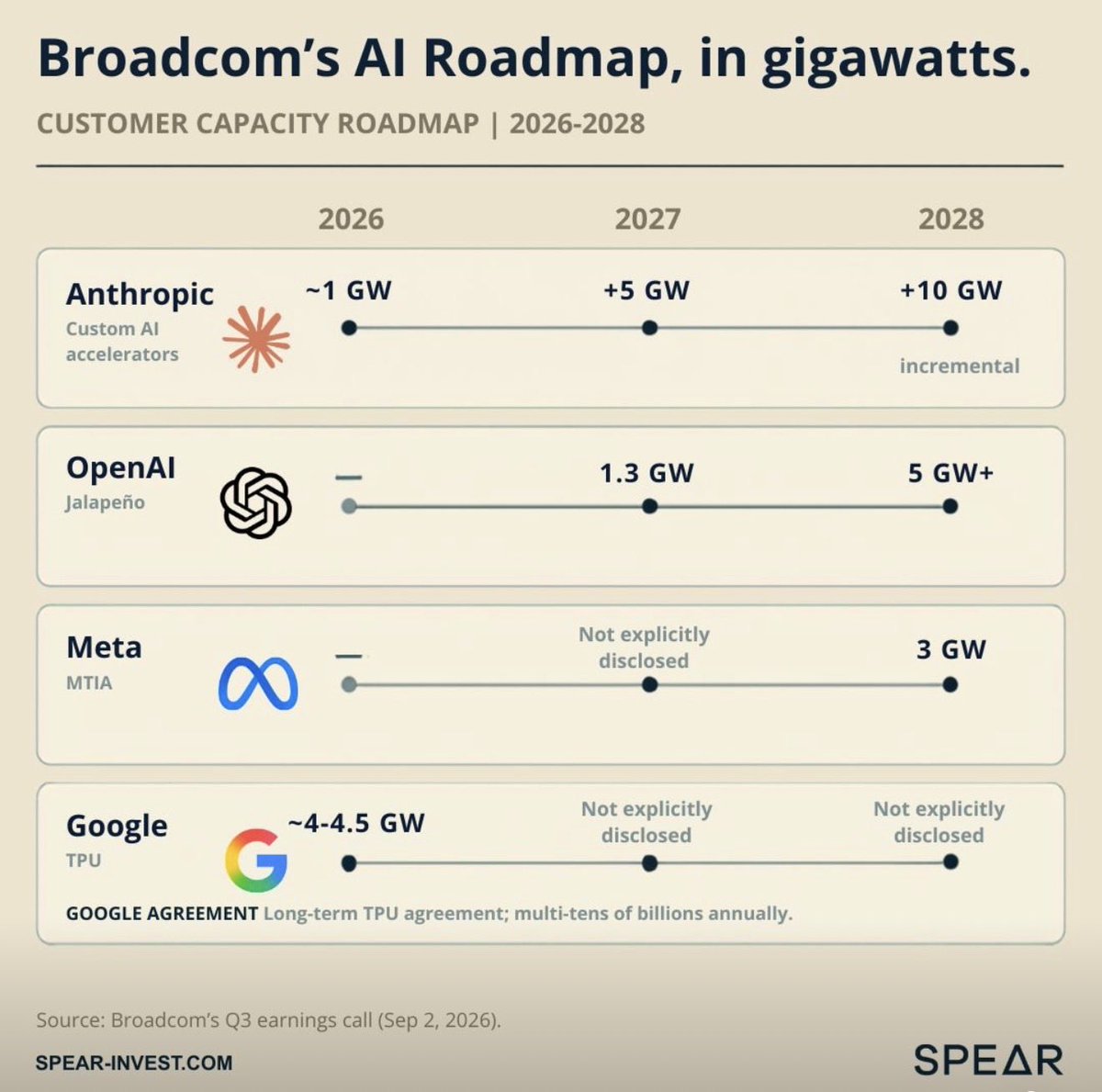
Via UBS. I know we know, but just to emphasize. Ant becoming second only to Google in size for $AVGO.
If I had to guess OpenAI will be doing more with MTK.
Hock Tan says the AI labs are becoming hyperscalers in their own right, building their own silicon and running their own data centers
"Now, these guys are going to be hyperscalers in their own right."
"So what they do is they want first-party compute capacity, just as they create their own. They want to create silicon that is very cost-performance optimized, and they want to run their own data centers eventually. They want to run it as fast as they can."
"Short term, you're right, they are using cloud services, third-party services, to deploy their models."
"Long term, we see these guys to be no different from a hyperscaler, and they will run their own data centers and be first-party to offer AI, generative AI API access to models to the world."
"So we see that happening. It's not speculation, it's actually happening, and we are in the midst of enabling that."
브로드컴( $AVGO) AI 목표치 발표:
2026 회계연도(FY26): 약 580억 달러
2027 회계연도(FY27): 약 1,150억 달러 (약 2배)
2028 회계연도(FY28): 약 2,300억 달러 (다시 2배)
단 2년 만에 AI 반도체 매출 4배 성장
공급 및 수요 현황: 2027년과 2028년 공급 물량은 이미 모두 확보된 상태이며, 현재 수요는 2027년 전망치를 넘어서는 수준
수익 목표: 2028 회계연도 주당순이익(EPS) 30달러 이상 목표
$AVGO sandbagging.
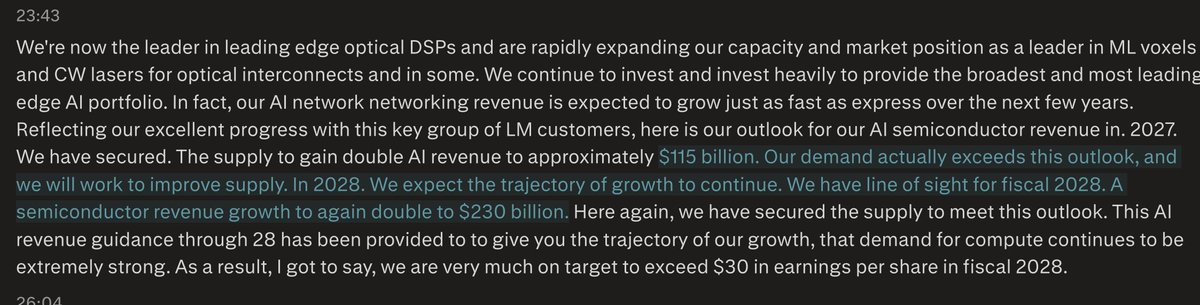
"we expect AI revenue to double again to approximately $115 billion in fiscal 2027, and double again in fiscal 2028 to 230 billion."
$AVGO CEO: "Demand for lasers, whether it is EML lasers, CW lasers.
Is far surpassing supply out there in the industry"
Pretty material coming from one of the largest laser suppliers in the world... Even while they 3x laser capacity.
Exciting validation for laser companies.
There we go, $AVGO earnings call to clarify miss. Broadcom expects:
FY27E: ~$115B (+100% growth)
FY28E: ~$230B (+100%), think analysts were modeling ~$180B.
Demand actually exceeds this outlook, and Broadcom will work to improve supply. This is way above street estimates, similar to $NVDA earnings.
"very much on target to exceed $30 in earnings per share in fiscal 2028." ~12.2x forward p/e (of $367/share)
Also just a brownie quote: "AI networking revenue is expected to grow just as fast as XPUs over the next few years."
Way more bullish forward guidance relative to next soft quarter revenue projections, think the few percent AH selloff was an overreaction.
Just my initial thoughts.
Congrats to Gemini team on their 3.8 Flash & 3.8 Flash Cyber launch! You can access our latest, most intelligent workhorse model directly from Gemini in @googlechrome starting today. 🚀🕸️✨
Fun fact: Our security tested Gemini 3.8 Flash Cyber and found it's 2.6x more effective than larger models at producing correct patches for lots (hundreds!) of dormant vulnerabilities in Chrome! 🪰💥
Details in https://t.co/P7XvjL2qUY