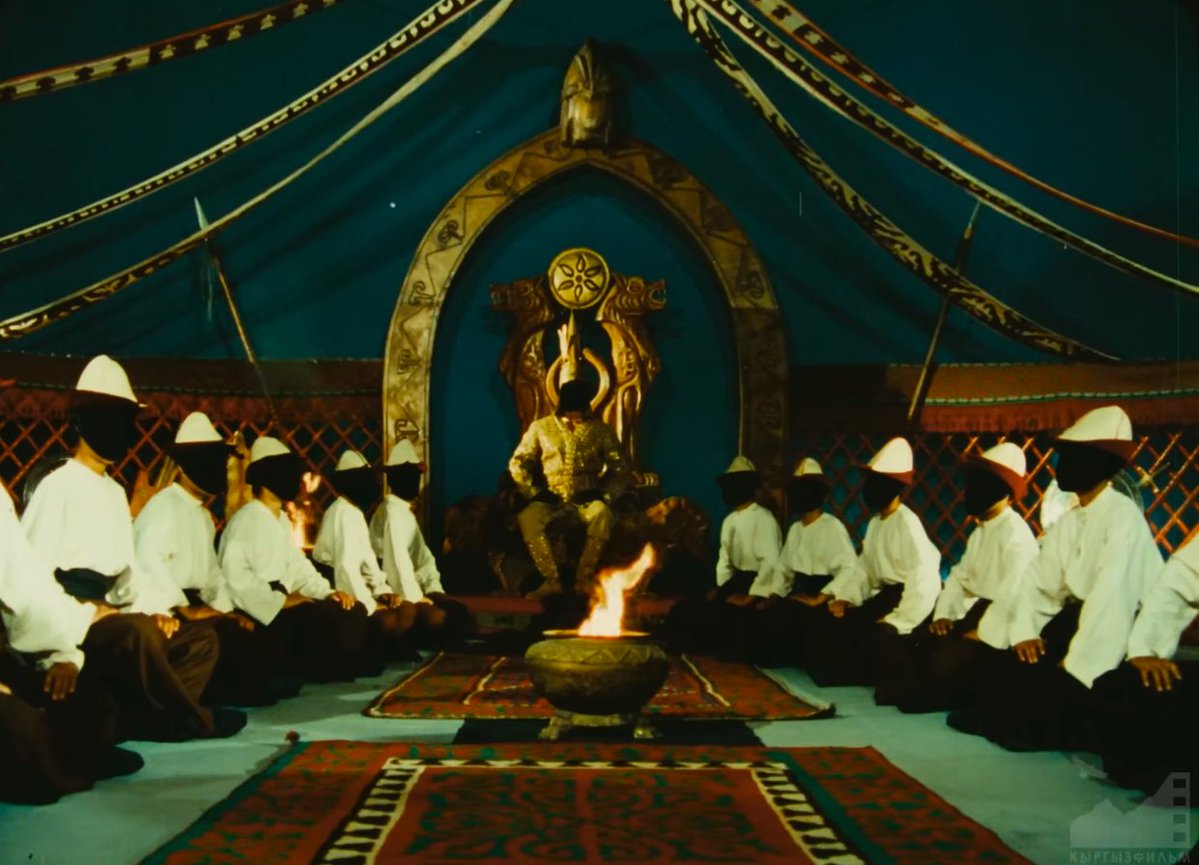
No one informed me that the coolest looking movie ever made is a dramatization of a 1,000 year old epic poem from Kyrgyzstan.
The Universe of Manas (1995), Melis Ubekyev
The nation-state is not the natural political unit of Muslim civilization.
And Muslims unconsciously know it, which is why every Muslim-majority country in the Arab-Persian-Turkic core has an identity crisis baked into its constitution.
The nation-state requires you to locate sovereignty in a people, a territory, an ethnicity. Islamic political theology locates sovereignty in Allah, with the umma as the collective body cutting across blood, land, and language by design. These are not compatible operating systems.
So what happened post-colonialism is that Muslim societies inherited the French or British state model, tried to run Islamic social expectations through it, and got permanent institutional schizophrenia.
Turkey tried to resolve it by amputating Islam. Egypt tried to suppress it. Iran tried to fuse them and got theocratic bureaucracy. The Gulf states paper over it with oil money.
None of them solved it because the form itself is the problem.
The caliphate gets dismissed as medieval fantasy, but the people dismissing it never explain what legitimate political theology actually looks like for a civilization that never agreed Caesar and God occupy separate domains.
The West didn’t arrive at Westphalia cleanly. It took the Thirty Years’ War, then two more centuries of political philosophy, to even pretend the question of religious versus political authority was settled. That settlement was theirs to make, earned through generations of exhausting, bloody, internal argument.
Muslims didn’t get that long, ugly, necessary process. They got the compressed version, stapled on by colonial administrators, with no civilizational reckoning of their own behind it.
That’s the actual crisis. Not that the caliphate ended. That nothing home-grown ever replaced the theological work it used to do.
orang2 kaya ga pernah punya konsep minta maaf ke orang2 yg lebih miskin, mereka lbh percaya meminta maaf ke Tuhan dgn berbagai macam ritual keagamaan yg hanya bisa dilakukan org2 kaya
entah memperbanyak perpuluhan, melakukan pengakuan dosa tiap minggu, berangkat haji, wakaf, dsb
Insightful passages from al-Birūni on semantics of different languages, which teaches us that we must interpret a text as per the rules of its original language, to understand its proper meaning.
As per him, due to semantic differences, in Arabic, we can call contingent
🧵
Modern science and technology is the long lost wisdom of the Muslims, this time we should wield them with better ethics and attitude towards earth and humanity
Christian’s from Europe flocked to Muslim lands to learn under Muslims, the author adds that Muslims were everything the world denies Muslims to be today!
@kaiashere Sumpah Islam dlu ga sebego skrng deh, apalagi jama Golden Age, bener bener mempelajari sains, ga takut belajar hal baru, banyak ilmuan Islam yg mengubah peradaban dgn sains. Skrng kaya orang dongo, kuno & di doktrin agama buat alergi sains & ilmu pengetahuan anjir
Kenapa sih jika guru dan dosen meminta hak kesejahteraannya sepertinya berat sekali dipenuhi?
Ada saja alasan pembenaran dan penolakannya. Mulai dari alasan ‘moral’ hingga anggaran.
Saya tidak berbicara pada level guru atau dosen yg berstatus ASN saja. Swasta pun demikian.
Saya pernah mengantarkan seorang Guru Besar Fakultas Hukum senior di salah satu universitas swasta besar mahasiswanya ribuan (bahkan puluhan ribu), ketika terbaring sakit, bahkan institusi kampusnya tidak memfasilitasinya dengan BPJS Kesehatan dan Ketenagakerjaan.
Syria is paving the way for a return to the status quo pre the rise of the Najdi Salafi movement in the Hijaz
For the first time, Salafis in a major country like Syria have collectively let go of one of the biggest tenets of Najdi Salafi dogma: declaring Ash'aris deviants
Sh. Abd al-Rahim Attun
Dr. Ibrahim Shasho
Dr. Yasin Allush
Dr. Madhar al-Ways
Dr. Anas Ayrut
Dr. Abdullah al-Muhaysini
Sh. Hasan Sufan
Also stated by President Ahmad al-Sharaa (who is the mastermind behind it, which was easy to foresee from his first week in Damascus)
These are the biggest Salafi names in Syria, not outliers, and many others are in agreement with them. All of them explicitly stated that Ahl al-Sunnah are 3 groups: Ash'aris, Maturidis, Ahl al-Hadith
What does this mean in practice? It means 99% of reasons for a Salafi-Ash'ari divide are gone. No more disputes over Fiqh issues like Mawlid and Tawassul (and definitely no Takfir). No more (major) disputes over creedal differences. The differences in opinion may remain, but by conceding that Ash'ari views are not deviance, they would fall under valid Khilaf, and thus no dispute is necessary - which has always been our goal
Pre the revivalist reformist Najdi Salafi movement, this was the case for generations
All major Hanbalis after the 6th century lived between Syria, Palestine, and Egypt, which were Ash'ari strongholds. They lived under the Ash'ari Ayyubids, Mamluks, and Ottomans, singing praises for their Sultans. They diligently studied under the Ash'ari scholars of their age, seeking knowledge and Ijazahs from them. And they used to gladly marry their daughters off to Ash'ari scholars
Anyone who reads the history of those centuries will come to realize that the early harsh Ash'ari-Hanbali differences turned out to be exaggerations and misunderstandings. And when they were calmly discussed, both parties realized that they had misunderstood the other, leading to the harmony we saw for centuries
Syria is not only a breakthrough politically, but also religiously, mending a tear in the Ummah that has lingered for far too long. Our hope now is that Salafi groups in other countries follow Syria's example and rethink their view on this issue
It is inconceivable for a large chunk of the Ummah of the Prophet ﷺ, reaching 80% in the most modest estimate, be deviants. Just think about it
Why did Java gone backwards? Once they started distancing themselves from Islam, killing each other over throne, and selling resources to stay enthroned
Jawa tahun 1535 sudah punya persenjataan hebat!
Mereka bikin sendiri artileri perunggu berkualitas tinggi, senapan, busur, sumpit dengan anak panah, dan tentu saja keris di punggung. Bahkan tombak mereka dinilai lebih bagus daripada buatan Spanyol kala itu🇮🇩⚔️
✍️A.Urdaneta 1535
son😭😭😭😭 you know nothing about sharia if you think islamic rulings ignore systemic issues. padahal syariah itu sebuah sistem. di dalamnya ada aturan tentang hukum pidana, ekonomi, hak dan kewajiban negara, pendidikan, keluarga, sampai adab pergaulan dan edukasi seksual.
semua direduksi jadi hijab. padahal pendidikan seksual bukan cuman hijab aja. ada perintah menjaga pandangan, menjaga kemaluan, larangan zina, larangan pelecehan, larangan khalwat, dan lain-lain yang gak sependek akal prasangkamu yang jelas gak akan menyelesaikan apa-apa
The wish of the uneducated to see history and arguments as black and white is truly mind-boggling.
Imam Jafar al-Sadiq was arguably one of the most influential teachers of his generation in Medina, with a large circle of students transmitting from him. As a result, many of his narrations became widely known through numerous transmission routes. Al-Bukhari's objective in compiling Sahih al-Bukhari was not to include every reliable narrator, but to select only those reports that met his exceptionally strict criteria. His methodology often favoured the strongest and most meticulously scrutinised chains of transmission over more widespread networks.
Another factor frequently mentioned by hadith critics is the proliferation of fabricated reports attributed to Jafar al-Sadiq during the political and sectarian conflicts of the late Umayyad and early Abbasid periods. Because of his immense prestige among competing religious movements, many statements were falsely ascribed to him. He is praised as a truthful and eminent Imam, but also, distinguishing his authentic narrations from later fabrications has become increasingly difficult. This context helps explain why al-Bukhari preferred transmission chains that he considered free from such complications.
Importantly, al-Bukhari did not reject Jafar al-Sadiq as a person or scholar. He included him in his biographical work, Al-Tarikh al-Kabir, and treated him as a respected historical authority. This suggests that Jafar al-Sadiq's absence from Sahih al-Bukhari should not be interpreted as evidence of personal bias or a judgment against his character. Rather, it reflects al-Bukhari's exceptionally stringent hadith methodology and his preference for transmission chains that met his specific criteria for inclusion.