New article up now: The Molecules India Doesn't Make - on the science & tech of coal gasification. Pros and cons & as honest as it can be. Economics of coal gasification next in a week or two, time permitting.
https://t.co/GuCmxgrCjw
MEA needs a less clichéd and more serious script for the PM's visits abroad, one where he engages with his hosts on substantive issues, rather than his own accompanying troupe and Indians settled abroad.
While millions knew Carl Sagan from television, his students at Cornell University experienced his philosophy firsthand.
He famously taught an undergraduate introductory seminar where the entire grade depended on challenging assumptions.
The unwritten rule was simple: students could earn an “A” for completely disagreeing with Sagan on a scientific or philosophical point, provided they used strict empirical logic to support their claim.
The lesson was intellectual humility.
Sagan would deliberately present a convincing but flawed scientific argument, wait to see who blindly accepted it because of his authority, and then dismantle it to show how easily the human mind can be swayed by a famous title or confident delivery.
@TheAusToday@ProfVemsani It is really sad and embarrassing for India to fall into this swamp of pseudo-science, ethnocentrism, populism and propaganda. All this nonsense, including Vemsani, is just contributing to a deteriorating picture of India.
There were multiple migration waves INTO India.
Rubbish, Indian IT companies could not even develop an OS or Office suites or email or browser in local languages which could have saved all the monies we are paying Microsoft or Google or others for basic software services -
CEA Nageswaran rules out any push for changes to the LTCG tax regime on equities, saying he is not advocating a revision of the current framework. #NDTVIGNITE
Making #India's international #taxation system attractive to investors doesn't require India to become a tax haven, or to compromise its revenue base. It requires it to be in line with global norms, be consistent, predictable & operationally frictionless.
Read the article here!
Leaving aside the politics of @BJP4India and @INCIndia, the case of Meenakshi Natarajan represents a complete travesty of justice and fair play by the entire system, cutting across all pillars of democracy.
✅ The Returning Officer rejected her nomination in blatant violation of Section 33A of the Representation of the People Act, 1951, read with Section 210 & 223 of the Bharatiya Nyaya Sanhita, 2023.
✅ On 11.06.2026, despite fervent pleas made by @DrAMSinghvi, @ECISVEEP sat on the judgment, and the Supreme Court declined to intervene even for a day till proper hearing. With no interim order by the Apex Court or the ECI, the Returning Officer declared the result!
✅ The matter was heard by the Supreme Court this forenoon. However, without examining the apparent illegality in the Returning Officer's order, the petition was dismissed in terms of the attached order on the ground that Article 329 bars judicial intervention after the declaration of results and that only an Election Petition can now be filed.
✅ While the fate of the case was effectively sealed when the Supreme Court declined to stay the declaration of the result, it was surprising to hear a legal luminary of Mr. Mukul Rohatgi's stature argue that the description of an entry in Form 26 overrides Section 33A of the Representation of the People Act, 1951!!
✅ Let me attempt to demonstrate why that contention is untenable. Form 26 was prescribed under Rule 4A of the Conduct of Election Rules, 1961, which themselves derive their authority from the Representation of the People Act, 1951. Yet it was implicitly argued that Entry 5(ii) of Form 26 overrides Section 33A of the parent statute!!
✅ Moreover, even after Section 33A and Rule 4A were introduced in August–September 2002, @SpokespersonECI, through its letter dated 10.09.2012, categorically clarified that Entry 5(ii) covers only those cases in which cognizance has been taken by a competent court. That condition was clearly not applicable in the case of @MNatarajanINC.
✅ Appearing virtually from London, Mr. Rohatgi argument, that a candidate's right to contest elections is merely a statutory right and not afundamental right, may hold relevance in normal circumstances. However, this was no ordinary case. By adopting a perverse interpretation of Section 33A, the Returning Officer descended to the nadir of partisan conduct and effectively denied the candidate the equal protection of the law guaranteed under Article 14 of the Constitution. In this case, Section 210 read with 223 of BNSS makes it conclusively fall beyond the purview of Entry 5(ii) of Form 26.
I would be happy to be corrected by anyone looking at facts and laws objectively. I am sure that @sardesairajdeep@_YogendraYadav@KapilSibal@adrspeaks@Mukul_Rohatgi@harishsalvee et al will appreciate that, by not intervening in time, #GyaneshKumar led ECI and the top court just let the case shift from Article 32 to Article 329 and the Returning Officer hide under it.
This is a really fascinating paper that everyone interested in China's industrial policy should read.
It destroys so many myths (see below), and is written by deeply credible people who conducted over three years of fieldwork in China and interviewed 60+ Chinese officials, entrepreneurs, and engineers. When it comes to China studies, it literally doesn't get more rigorous than this.
First myth it destroys: contrary to popular belief, Beijing's industrial policy didn't build the companies that became China's EV champions. They rose largely **despite** it, through its cracks.
For sure, Beijing did favor EVs as an industry and pushed hard for it but their big bet was SOEs (State Owned Enterprises): research grants, pilot programs, licenses, cheap credit - virtually all of it flowed to state firms.
The result? China's actual EV champions - BYD, Geely, NIO, XPeng, Li Auto, etc. - are overwhelmingly private firms that succeeded despite Beijing favoring their SOE competitors.
How so? Because, when favoring SOEs, the central government didn't just pick winning companies, it picked winning cities, each SOE being anchored in a specific city: Shanghai (SAIC), Changchun (FAW), Wuhan-Shiyan (Dongfeng), etc.
Which means that every city not on the list, that wanted a piece of the auto boom, had only one option left: team up with private entrepreneurs who were equally excluded from central government favor.
That's what truly fueled China's EV miracle: an alliance of the excluded, between local private entrepreneurs and local mayors.
This is the biggest misconception this paper destroys: the reality is that the "Chinese state capitalism" that many in the West think powered the EV boom actually tried to block many of these companies from existing. In effect, it was closer to an obstacle course that local actors (mayors and provinces) learned to game.
Geely - now the third largest automaker in China - is a fantastic example of this.
First of all, it started off illegal since, to build passenger cars, you had to have a central government license and they couldn't get one. Zhejiang Province told them to go ahead regardless because the province had hundreds of auto parts suppliers but no carmaker of its own.
It's only a couple of years later, recognizing the fait-accompli that Geely was producing cars and was competitive, that the central government admitted them to the National Sedan Catalog - effectively legalizing them retroactively because there were facts on the ground.
Then there was the Volvo acquisition in 2010, which is fair to say - looking back - proved to be the most strategically valuable acquisition in Chinese automotive history. Despite it being presented at the time (and still described this way today) as "China buying Volvo", all 3 major state-backed banks in China (Export-Import Bank, China Development Bank, Bank of China) refused to finance the deal. The only state-bank money Geely managed to get was a $200 million loan from a provincial branch of China Construction Bank - a tiny fraction of what the deal required.
Geely actually did the deal with Goldman Sachs money via Hong Kong plus loans and equity from four local governments (Chengdu, Zhangjiakou, Daqing, Shanghai's Jiading district), each of which bought in by securing a Volvo plant or headquarters for itself.
In effect, the doors that Beijing controlled were largely closed to Geely, but it made it because the doors subnational actors controlled were opened.
Which all means this paper destroys another very common myth: the big merit of the central government in all this was to be relatively chill about it, to NOT be dictatorial.
I just imagine if that had happened in France and you had - say - the mayor of Lyon or Marseilles open, fund and promote an unlicensed carmaker against Renault: the préfet would shut it down within weeks, and the mayor would be lucky to escape prosecution.
That's the irony: on industrial policy, the supposedly "totalitarian" Chinese state proved more tolerant of local defiance than most Western liberal democracies would be. Beijing's greatest contribution to the EV miracle wasn't the plan - it was looking the other way while the plan was being violated.
To be sure, the paper doesn't hide the costs of this system: ferocious local competition also produced what's known today in China as "involution" (内卷-Neijuan, basically a hypercompetitive price war), as well as some spectacular failures. For instance one county lost 6.6 billion yuan on a carmaker that never really made cars.
But that's precisely the point: this is a high-risk, high-reward model of decentralized experimentation, the very opposite of the careful central planning Westerners imagine.
I've repeated this countless times but it bears repeating again: the single greatest misconception people have about China is - probably because we wrongly associate communism with centralized control - that it is a monolith run from Beijing. Some even say it's run by "one man."
The reality is the exact opposite: China is, in practice, one of the most decentralized countries on earth. Roughly 85% of government spending in China happens at the subnational level - against about 30% in the average OECD country (and even less in France, which is actually one of the most centrally controlled countries on earth). A Chinese mayor commands fiscal resources, land, investment funds and policy latitude that virtually no Western mayor could dream of.
Last but not least, I'd be remiss not to mention what the paper has to say on the positive legacy of Mao and its role in the rise of EVs (given I myself wrote an article titled "Mao's economic record wasn't bad, actually": https://t.co/1NZgHqBHwg).
When it comes to China myths, none is more entrenched than the idea that Mao left behind nothing but ruins.
This paper confirms a key argument of my article: Mao's deliberate dispersal of industry across China (during the Great Leap Forward and Cultural Revolution decentralizations) left dozens of cities with their own small auto works. Inefficient, yes - but these scattered factories survived into the 1990s and became the seed stock of everything that followed: the industrial base, the engineers, and the production licenses that EV startups would use to enter the market.
The paper even says it outright: the fragmentation that industrial policy "sought to eradicate" is "precisely" what "ironically enabled" the EV sector's rapid rise.
This is exactly the mechanism I described in my Mao article: structures built in the Mao era - communes becoming township governments, commune enterprises becoming TVEs, Third Front factories seeding interior industrialization - became load-bearing foundations of the reform miracle.
Fittingly, the spark for China's first municipal carmaker adventure was literally a TVE (Township and Village Enterprise), the institutional descendants of Mao's commune enterprises: Tongbao, a kit-car maker in Wuhu whose success stunned local officials into building what became Chery (one of China's biggest carmakers today). You can't tell the story of China's EV miracle without crediting the legacy of Mao.
What's the biggest lesson in all this for Western policymakers?
The obvious one is that the part of industrial policy that most people assume China does and that they sometimes want to copy - i.e. the state picking winners - is actually the part that failed.
The part that did succeed is the China nobody in the West believes exists: a radically decentralized system with a high degree of tolerance for disobedience and experimentation.
We imagine China as a country where nothing happens without Beijing's approval when the reality is closer to the opposite: China's EV miracle happened precisely because localities asked for forgiveness rather than permission.
All in all, and this is the lesson I often come back to, this is yet another illustration of the importance of understanding China for what it is as opposed to the caricature we've built of it. This matters whichever "camp" you're in. If you see China as a rival, you can't compete with someone you don't understand. If you see them as a source of lessons, you can't emulate what you've misunderstood. Whatever you want from China - to compete with it or learn from it - the entry fee is the same: genuinely understanding it.
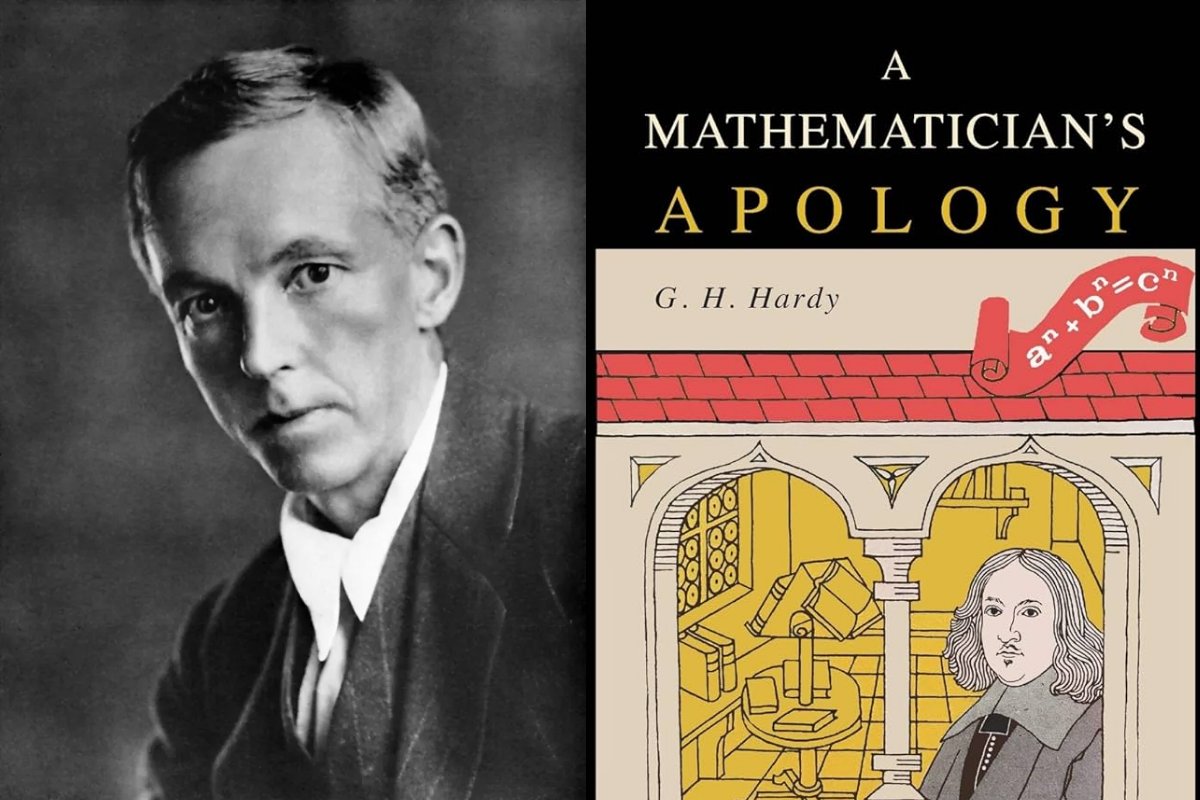
The greatest mathematician in England wrote a small book at 62 confessing that mathematics had always been art, never science, and the most painful part of the book is the man writing it knew he would never make another piece of it again.
His name was G.H. Hardy. The book is called "A Mathematician's Apology"
He was a professor at Cambridge and Oxford. He spent his career working on number theory and mathematical analysis, almost entirely with one collaborator named John Edensor Littlewood.
In his prime, between 1910 and 1930, he was considered the finest pure mathematician working in the English-speaking world. He published over 350 papers. He produced foundational results that mathematicians still use today.
In 1939, at the age of 62, he had a heart attack.
He survived it. But something inside him had been broken that did not heal. He could feel his mathematical powers leaving him. The same brain that had spent 40 years effortlessly producing original work now felt slow. Heavy. He kept trying to do new mathematics and kept producing nothing he was proud of.
He understood, with a clarity that almost no creative person ever wants to face, that the part of him that had made him who he was had quietly finished its work without telling him.
So he sat down to write a different kind of book.
It is called A Mathematician's Apology. It was published in 1940 by Cambridge University Press. It is about 90 pages long. You can finish it in two hours.
The word "apology" in the title does not mean an apology in the modern sense. It is used in the old Greek sense, the way Plato used it for the Apology of Socrates. An apology is a formal defense. Hardy is defending his life.
The book is sad in a way that almost no other book about mathematics has ever been.
Hardy writes that exposition, criticism, and appreciation are work for second-rate minds. He says this on the second page. He is telling the reader that the act of writing the book they are now reading is itself proof that his real work is over.
The first-rate mind produces new mathematics. The second-rate mind explains old mathematics to other people. Hardy is consciously demoting himself in print, on page two, as part of the price of writing the book at all.
Then he makes the argument that has been quoted for 85 years.
He writes that a mathematician, like a painter or a poet, is a maker of patterns. If a mathematician's patterns are more permanent than the painter's or the poet's, it is because they are made with ideas. Ideas, Hardy argues, do not fade the way colors fade or the way words go out of fashion. A theorem proved in ancient Greece is still true today. A poem written in ancient Greece is now stiff and remote.
A painting from ancient Greece is now a shadow of itself. Only mathematics survives the centuries intact, because mathematics is made out of the only material that does not decay.
This is the part of the book where Hardy stops sounding like a scientist and starts sounding like an artist who has been arguing his whole career that what he does is real work.
He pushes the argument further. He says the best mathematics is the most useless. He means this as a compliment of the highest possible order.
Useful mathematics, the math you would use to build a bridge or balance a budget, is dull. It is craft, not art. It is downstream of the real thing. The real thing, what he calls pure mathematics, exists for no reason except its own beauty. It does not solve any problem anyone has. It does not produce any product anyone needs. It exists because some human being, somewhere, looked at a pattern in the structure of numbers and decided the pattern was beautiful enough to spend a life chasing.
The other artists of his time agreed with him. Graham Greene reviewed the book and said it was, alongside the notebooks of Henry James, the best account ever written of what it feels like to be a creative artist.
Then Hardy gets to the most personal part of the book.
He writes about Ramanujan.
Srinivasa Ramanujan was a self-taught mathematician from a small town in southern India. He had no formal university training. He had read a single elementary mathematics textbook in his childhood and worked everything else out himself. In 1913 he wrote Hardy a letter at Cambridge containing dozens of strange formulas.
Two other mathematicians had already dismissed the letter as the work of a crank. Hardy read it, recognized what was actually inside, and arranged for Ramanujan to be brought to England.
For five years they worked together. Then Ramanujan got sick in the cold English winter, his health collapsed, and he was sent home to India where he died in 1920 at the age of 32.
Hardy never recovered from it.
In the Apology he writes that his greatest contribution to mathematics was not any theorem he ever proved. It was discovering Ramanujan. He gives a list of mathematicians he has known personally, ranked on a scale of one to one hundred.
He rates himself a 25. He rates his lifelong collaborator Littlewood a 30. He rates David Hilbert, the most respected German mathematician of the era, an 80. The only person he gives a 100 is Ramanujan. He had known one true genius in his life, and that genius had died in his early 30s, and the loss is sitting under every paragraph of the book even when Hardy is not writing about him directly.
The deepest irony in the Apology is the one Hardy could not have predicted.
He spent the whole book arguing that the best mathematics was the most useless. He used number theory, his own field, as the cleanest example. He wrote that nobody had ever found a useful application for the theory of prime numbers and that this was a feature, not a flaw. The work was pure. The work was art. The work was untouched by industry.
Five years after Hardy's death, the world's first computers were being designed using mathematical ideas from his field. Twenty years after his death, code-breakers at Bletchley Park were using number theory to crack the Enigma machine.
Forty years after his death, modern cryptography was being built on the prime number theorems Hardy had said could never be made useful. Every secure transaction you make on the internet today, every encrypted message you send, every banking app you open, runs on the math Hardy spent his life calling beautifully useless.
He was right that the math was beautiful. He was wrong that it was useless. The two things turned out to be the same thing seen from different angles in time.
The other part of the book that still hits readers hard is the ending.
Hardy quietly writes that he has had a good life. He has had Cambridge. He has had cricket. He has had Littlewood. He has had Ramanujan, briefly, and that brief possession of a true genius was worth more to him than all the rest. He has had a small place in the long history of pure mathematics. He says, in plain English, that this is enough.
Then he writes the closing line. He writes that the case for his life cannot be made any more. The verdict, he says, will rest where it falls.
Six years later he tried to kill himself by overdosing on sleeping pills. The attempt failed. He died in his bed of natural causes a few months later, in December 1947, at the age of 70.
The book has stayed in print for 85 years. Mathematicians still read it as a kind of secret confession. Artists read it because Hardy understood something most artists struggle to articulate. The act of making something beautiful is its own justification. You do not need a useful purpose for your work. You do not need the world to applaud it. You do not need it to fit in any system.
You only need the pattern itself to be true, and the pattern to be yours, and the work to have meant something to you while you were doing it.
The hardest part of the book is the part Hardy never says directly.
The act of writing it was itself the proof he was done.
He could no longer make the patterns. He could only tell other people what it had felt like to make them. The Apology is not a book about mathematics. It is a man saying goodbye to the part of himself that had been worth knowing.
Most of you reading this are still in the part of your life where you can make the patterns.
Don't waste it explaining them.
Make them.
TN has a bigger economy than Karnataka , the mystery is why does it collect less? It had not collected its budgeted taxes for last 3 years but shown huge growth in GDP! Are they counting GDP correctly?
Statewise IGST collection is also not shared by GOI, so large manufacturing investments in TN for exports like Foxconn or Tata also do not reflect in GST collections -
There is no mystery. Just understanding on how GST works is enough.
Of course i believe Chartered Accountants to understand these basics.
GST is paid by the buyer, not the seller. If a car is made in Chennai but sold in Patna, the GST goes to Bihar, not Tamil Nadu. The state that makes goods earns GDP. The state that buys goods pays GST. Two different things.
Now apply this to TN:
1. TN makes and exports. Cars, phones, textiles, leather. When TN sells to other states, those states get the tax. When TN exports abroad, GST is zero. So TN's factories grow its GDP but the GST shows up elsewhere or not at all.
2. This chart shows where companies are REGISTERED, not where tax finally belongs. Big companies sitting in Bengaluru and Mumbai bill for all India work from one office. So Karnataka and Maharashtra numbers look fat. After final settlement between states, the real picture is very different.
3. Farming, exports and government work add to GDP but have no GST on them. So GDP can grow fast while GST grows slow. Completely normal.
High GDP with lower GST is not a sign of wrong counting. It is the sign of a state that produces more than it consumes.
TN is not cooking its GDP. This post is just reading the wrong number.
@TVMohandasPai
https://t.co/RLqcTLhl6m
There was a lot of concern when we had filed the DRHP as to why we are investing in additional capacity already. Back then, we were at 30-40% utilization, and investing in capacity which would 2x or 3x that, seemed like a crazy idea.
Fast forward to today:
we've crossed 90% utilization and will have to try and find ways to go above 100% in the coming weeks!
The new factory can't go live fast enough!
Excited about Factory 3.0 at Chhatrapati Sambhajinagar now
This is part of his initiation rituals. You have to make the newbie perform the most embarrassing clownery, the likes of which would absolutely destroy any last semblance of dignity he might have possessed in a past life. Amazing what people do for some proximity to power.