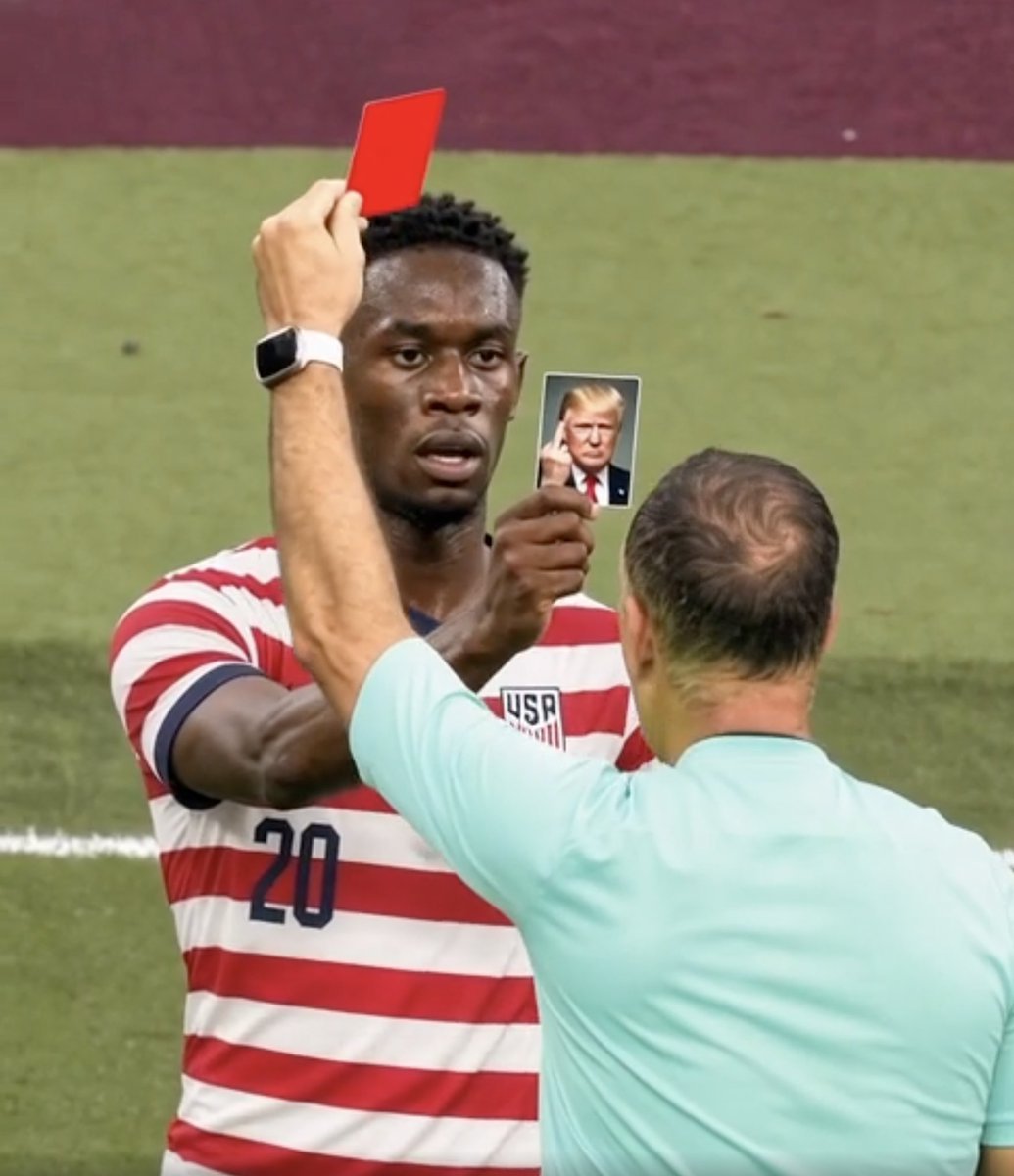
Our guy got special treatment, so let’s retrofit a civilizational theory around it.
That is all this argument is.
This was never just about whether Balogun’s red card was harsh. The issue is that the president of a World Cup co-host nation confirmed he personally asked FIFA’s president to review a suspension affecting his own team. ABC quotes him: “So yes, I asked for a review by FIFA.” ABC also reports FIFA had earlier said the referee’s call was final and not able to be overturned or appealed. FIFA then used Article 27 to suspend the automatic one-match ban before Belgium, and Trump thanked FIFA for “reversing a great injustice.” [1][2][3][4]
That is not “Americans refuse injustice.” That is access.
Claim: “In America, we simply can’t accept a wrong left unrighted.”
False. The U.S. lives very comfortably with wrongs and injustices when they are private, low-value, non-viral, unpopular, or trapped behind arbitration. CFPB found arbitration clauses limit consumer relief by blocking class actions while very few consumers individually pursue arbitration or federal court. Congress then killed the CFPB rule that would have restricted that practice. [5][6]
So the U.S. model is often not “every wrong gets righted.” It is: make the harm big enough for a lawsuit, a regulator, a PR crisis, or a viral backlash. Otherwise, good luck.
Claim: “Flight attendant sneezed? 15,000 miles.”
This is almost perfectly backwards. DOT says U.S. airlines are generally not required to compensate domestic passengers for delayed or canceled flights, except in overbooking/bumping cases. DOT’s own dashboard shows major U.S. airlines do not commit to cash compensation for a three-hour controllable delay. [7][8]
In the EU, air passenger compensation is not a loyalty-point pity coupon. It is a legal framework: covered delays, cancellations and denied boarding can mean €250, €400 or €600. [9]
Claim: “Didn’t like your appetizer? Replacement and the course comes off the bill.”
That is not consumer justice. That is a manager comping something at their discretion. The U.S. consumer often gets “check the store policy.” The FTC tells consumers to look for return policies, deadlines, and whether the business offers refund, exchange, or store credit. [10]
The EU is far more universal: online/off-premises purchases generally have a 14-day withdrawal right, faulty or misdescribed goods carry a minimum two-year legal guarantee, and consumers must get clear information about price, product/service and remedies when things go wrong. [11][12][13]
Claim: “Fine print.”
Again, wrong target. EU law says unfair contract terms are not binding on consumers. The “you didn’t read the fine print” caricature is weaker in a system that actually invalidates unfair fine print. [14]
Claim: “The train is late, Europeans just complain over apéro.”
No. EU rail passengers can be legally entitled to compensation: 25% of the ticket price for a one-to-two-hour delay and 50% for two hours or more. [15]
A congressional hearing is not a remedy available to an ordinary traveler. A statutory compensation claim is.
Claim: “Trial lawyer billboards.”
That proves the opposite. If the route to a remedy is “hope a lawyer can monetize this,” that is not universal justice. It is privatized enforcement. The whole point of broad EU consumer rights is that you should not need a public-interest case, a class action, or a powerful friend to make a company obey baseline rules.
Claim: “Closed pharmacies” and “union smoke breaks.”
That is just tourist annoyance dressed up as political philosophy. Opening hours are not consumer law, and worker breaks are not proof that Europeans love unfairness. EU working-time rules require rest breaks after more than six hours, daily rest and weekly rest. Calling that “the customer is always wrong” is just treating workers’ rights as a personal inconvenience. [16]
Claim: “Who cares that FIFA used a little-used reversal?”
Everyone should. A bad red card is a football problem. A host-country president intervening with FIFA, followed by a bespoke disciplinary escape hatch for his own national team, is a governance problem.
If Belgium’s prime minister had called Infantino and FIFA had cleared a Belgian star right before playing the U.S., nobody would write essays about Belgian moral courage. They would call it rigged.
Claim: “FIFA is corrupt anyway.”
Exactly why this is worse. The U.S. Justice Department has already charged FIFA officials and executives in a corruption case involving racketeering, wire fraud, money laundering and well over $150 million in alleged bribes and kickbacks. [17]
“FIFA is corrupt, so our side gets to pressure FIFA too” is not an argument. It is a confession.
The divide here is not America vs Europe. It is rights vs access.
Europe built many boring, universal consumer remedies so ordinary people do not have to beg a company, a regulator, a class-action lawyer, a news cycle, or a president with FIFA on speed dial.
What happened here was not justice. It was access. And confusing access with justice is how corrupt systems defend themselves.
Sources in reply.
@elonmusk@PeterDiamandis lol you think people doesn't see the endgame here...? the threat of AI being used by hackers is the perfect selling point for AI spending as a cibersecurity tool... it's a feedback loop for the sole profit of the handful of AI companies broligarchs like you are vested in.
@LeeringObserver@Bitfinexed What if you also bought 1 BTC in 2025 for $120K? would you still be making any money if you were to sell both at current prices around $60K? No, you'd be at a loss.
In 1825, a rich Welsh industrialist bought an entire American town to prove that socialism could work.
He had the money, the buildings, the theory, and hundreds of eager followers waiting to move in.
Two years later, it was over. 🧵
Has Elon Musk ever walked the hallways of Congress and seen all the dozens of Israeli flags outside the literal government offices of elected members of Congress? Of course he has - but he conveniently has nothing to say about that ‘treason’.
@LeeringObserver@Bitfinexed Whatever creative accounting magic you want to use, 1 BTC bought in 2020 is no different from 1 BTC bought in mid-2025. Both are currently worth $60K.