In what will certainly become one of the most fundamental speeches of his pontificate, Pope Leo XIV told the Spanish Parliament, before receiving a 7-minute standing ovation: "The defense of human life is neither a partisan issue nor a confessional interest: it is a goal of civilization."
"If life ceases to be recognized as a fundamental value, what future can our societies have?" he said, speaking to a gathering of politicians, many supporting abortion and euthanasia.
"Can a community that casts into the shadows the unborn child, the elderly, the sick, those who suffer in silence, or those who depend entirely on the care of others be called fully just?"
"Every human life must be recognized and safeguarded from conception to its natural end, in every circumstance of its existence. When this certainty is obscured, the most vulnerable are the first victims, and the law loses its deepest meaning: to serve and protect every person."
"For this reason, the moral greatness of a nation is manifested, above all, in its capacity to accompany, protect and love those lives that are most fragile," he said, repeating what John Paul II emphasized decades ago.
Starting his speech he commented that Church's is the "message offered in the spirit of service to the human person."
"When the Church addresses anything concerning public life, she does so while respecting the proper mission of institutions and the legitimate responsibility of those who have received the mandate to legislate," Pope Leo said, emphasizing "the Church offers a reflection born of the desire to serve the common good."
He hailed Spain as country that "has known how to view the human being as more than just a cog in the social, economic or political order. It has recognized the human being as a creature open to truth, endowed with freedom, and driven by a thirst for eternity that no temporal reality can quench -- in a word, as someone whose dignity takes precedence over all utility and to whose service legislative action is subject."
He said it was Catholic orders that "helped to shape a legal and moral consciousness capable of remembering that authority always entails responsibility and that every human being must be recognized as a subject of rights and duties."
"That aspiration continues to resonate today: that dignity, justice and the common good should be the measure of social relations, both at the national and international levels."
Referring multiple times to his "Magnifica Humanitas" encyclical, he said: "When the common good ceases to be a shared horizon, public action runs the risk of fragmenting into partial interests, incapable of safeguarding what belongs to all."
"In this context, the family — the primary human reality and the natural foundation of the community — takes on particular importance," Pope Leo said.
"The family will always be the first school of humanity, where one learns, before anywhere else, the basic grammar of living together: welcoming life, caring for others, forgiving, serving and belonging."
"Human life can never be treated as a commodity," the pope said.
"A law does not attain its true greatness merely by having been formally enacted; it attains it when, in addition to being valid in form, it can stand before the dignity of the person and pass that test without shame."
"I invite you, then, to lift your gaze to the world around you, not to turn away from reality, but to remember that every decision by public authorities affects real people, especially those who have less power to make their voices heard."
"The expanse of one’s vision consists precisely in looking more deeply at what is at stake in every public decision. This is why, alongside technical solutions and legal reforms, a moral renewal is also needed."
Video: Vatican Media
(fragment of speech follows)
the pope and anthropic's co-founder just stood together at the vatican to release "magnifica humanitas," the first ever catholic teaching on AI
yes, you read that right. the full ceremony was 2 hours.
here's the most interesting things for you to know:
1. this is the biggest religious response to AI in history. popes only put out a handful of these huge official letters in their entire time as pope. the fact that one of them is about AI tells you how seriously the church is taking what's coming.
2. small detail with massive meaning: this pope picked the name "leo XIV" on purpose. the last pope named leo was leo XIII back in 1891, and his most famous act was writing the church's response to the industrial revolution. picking the same name is a deliberate signal. this pope sees AI as the new industrial revolution.
3. the catholic church does this every time a major technology reshapes humanity. they wrote "rerum novarum" in 1891 to respond to the industrial revolution. when nuclear weapons threatened the world in the 1960s, they wrote "pacem in terris." climate change and runaway tech got "laudato si" in 2015. now AI gets "magnifica humanitas." they don't issue these often.
4. the pope's main line: "AI needs to be disarmed." he literally compared AI to nuclear weapons. he said the church spent decades pushing for nuclear disarmament because the technology was too dangerous to leave in the hands of a few. he says AI is now in that same category.
5. anthropic co-founder christopher olah told the pope, on stage at the vatican, that anthropic's own research team keeps finding things inside their AI models that "mirror joy, satisfaction, fear, grief, and unease."
6. olah's reframe of what AI actually is: these things are grown. they're trained on a structure roughly modeled after the human brain and fed everything humans have ever written. in his own words: "they are made from us, from our words." he said even the people building them don't fully understand what's happening inside.
7. olah publicly admitted that every AI lab, including his own, faces pressure that can conflict with doing the right thing. commercial pressure to keep shipping, competitive pressure from other labs, plus the older pressures of pride and ambition. his solution: we desperately need outside critics with no skin in the game who will tell the labs when they're failing.
8. olah says there are 3 giant questions the AI labs cannot answer alone and the world needs religion and philosophy to step in on:
> how do we make sure poor countries actually benefit from AI?
> what does human flourishing even look like in this new world?
> and what are these things we're actually building?
9. one of the sharpest lines in the whole encyclical: "the promise of automatic general prosperity often proves illusory." translation: the idea that AI will just make everyone rich on its own is a fantasy. someone has to actually design the system so the benefits get shared.
10. the pope also pulled out a 100-year-old quote: "contemporary man has not been trained to use power well." said by a theologian back in the 1920s. the whole encyclical is basically a long argument that we need to learn how to use this kind of power before it uses us.
11. the pope kept stressing that he doesn't have the technical answers. but he says the church has thousands of years of wisdom on what it means to be human, and that wisdom is exactly what's missing from how we're building AI right now. his closing line: this technology should serve "human flourishing and human dignity, not control consciences."
Alzheimer's disease drug development pipeline: 2026 published today! The 2026 AD drug development pipeline includes 158 unique therapies in 192 trials, marking continued growth in disease-modifying agents, with 35% being repurposed drugs. Thanks @DrJeffCummings@NIHAging@TheADDF
“A whole civilization will die tonight, never to be brought back again.”
These are the words of the president of the United States, today.
The president speaks genocide. And so we too must speak. Not only about crimes, but about their legal punishment.
https://t.co/6oIvY6RILc
We don’t know what will happen tonight: if Trump will back down or commit war crimes.
But I do know that Congress has the power to stop this.
Republican Leader John Thune must call the Senate back into session immediately.
And Congress needs to vote to stop Trump’s war NOW.
"Our Santa Fe River has been doing river cleanups since its inception—it's very important that somebody picks up the trash.... anybody!" https://t.co/MnjHBtNByM
Technology ought to enhance our lives—not control our lives, nor supplant the human experience. The AI Bill of Rights defends consumers, medical patients, and families in Florida from the potential harms of artificial intelligence applications. It is especially important that we protect the most vulnerable among us: our children.
Today, I announced that I am directing our state agencies to work with the Future of Life Institute and experts who study AI-human interactions to improve our understanding of AI harm to children. Through this collaboration, the state will develop a crisis counselor training curriculum to navigate AI-related mental health, as well as an AI Harms Reporting Form.
The Florida Senate passed the AI Bill of Rights, but Florida House leadership is blocking it. It is incumbent on the Legislature to act in the best interests of the people who elected them and defend the rights of all Floridians, especially children.
It is hard to communicate how much programming has changed due to AI in the last 2 months: not gradually and over time in the "progress as usual" way, but specifically this last December. There are a number of asterisks but imo coding agents basically didn’t work before December and basically work since - the models have significantly higher quality, long-term coherence and tenacity and they can power through large and long tasks, well past enough that it is extremely disruptive to the default programming workflow.
Just to give an example, over the weekend I was building a local video analysis dashboard for the cameras of my home so I wrote: “Here is the local IP and username/password of my DGX Spark. Log in, set up ssh keys, set up vLLM, download and bench Qwen3-VL, set up a server endpoint to inference videos, a basic web ui dashboard, test everything, set it up with systemd, record memory notes for yourself and write up a markdown report for me”. The agent went off for ~30 minutes, ran into multiple issues, researched solutions online, resolved them one by one, wrote the code, tested it, debugged it, set up the services, and came back with the report and it was just done. I didn’t touch anything. All of this could easily have been a weekend project just 3 months ago but today it’s something you kick off and forget about for 30 minutes.
As a result, programming is becoming unrecognizable. You’re not typing computer code into an editor like the way things were since computers were invented, that era is over. You're spinning up AI agents, giving them tasks *in English* and managing and reviewing their work in parallel. The biggest prize is in figuring out how you can keep ascending the layers of abstraction to set up long-running orchestrator Claws with all of the right tools, memory and instructions that productively manage multiple parallel Code instances for you. The leverage achievable via top tier "agentic engineering" feels very high right now.
It’s not perfect, it needs high-level direction, judgement, taste, oversight, iteration and hints and ideas. It works a lot better in some scenarios than others (e.g. especially for tasks that are well-specified and where you can verify/test functionality). The key is to build intuition to decompose the task just right to hand off the parts that work and help out around the edges. But imo, this is nowhere near "business as usual" time in software.
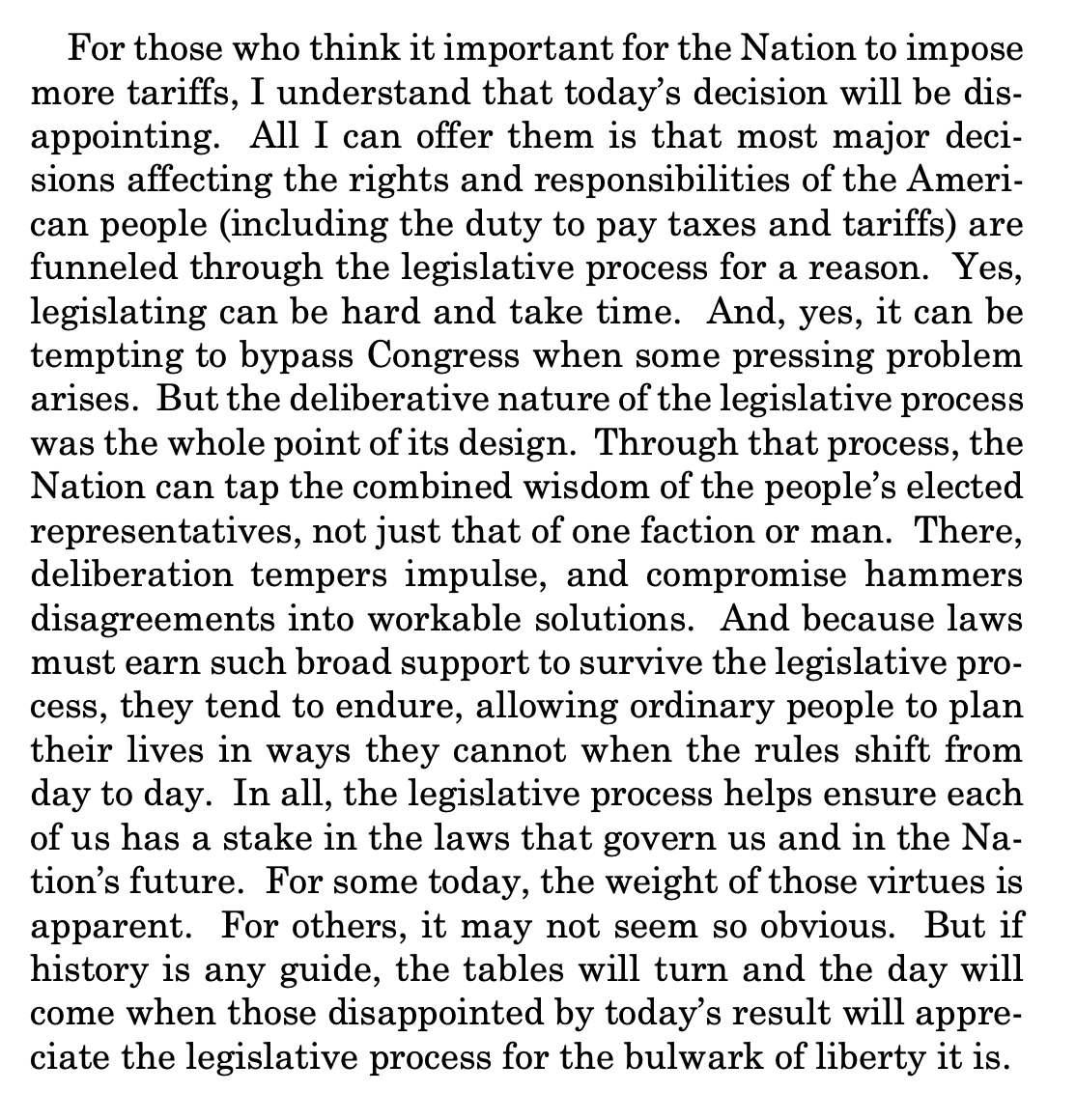
For anyone putting loyalty to a person above loyalty to the Constitution, Justice Gorsuch’s remarks should be required reading. His words are a reminder that our highest duty is to the rule of law and the founding principles that define America.
When healthcare feels overwhelming, look for one concrete thing you can do.
Right now, the Department of Education has opened a public comment period on a proposed rule that would remove nursing from the “professional degree” classification.
That sounds technical. It isn’t.
If this change goes through, nurses and advanced practice providers could lose access to certain federal loan programs that make advanced training financially possible. That affects who can afford to become a nurse practitioner. It affects who stays in the workforce. It affects access to care.
As a reconstructive microsurgeon, I cannot care for the volume of women I serve without the nurses and nurse practitioners on my team. They are not assistants. They are licensed, credentialed professionals practicing at the highest level of their training. They are the backbone of American healthcare.
If you care about access to safe, high quality care, this matters.
The public comment period is open and closes on March 2nd.
Here is how to leave a comment. It takes five minutes:
1. Go to https://t.co/hyJpnuZYJh
2. Type into search “reimagining and improving student education”
3. Click “Submit a Formal Comment”
4. Write a short statement. It can be simple. For example:
“I support recognizing nursing as a professional degree. Limiting access to federal loan programs will worsen workforce shortages and reduce access to care.”
5. Enter your information and click submit
You do not need to be a doctor or a nurse to comment. You just need to care.
Small actions matter. Words matter. Please take a few minutes to support recognizing nursing for what it is: a profession.
It’s becoming increasingly clear that AI is going to kick millions of knowledge workers to the curb and our political class won’t do a damn thing while our way of life gets changed forever.
In a roundtable with AI researcher Max Tegmark (@tegmark), Florida Governor Ron DeSantis (@GovRonDeSantis) says the potential harms from AI are "really really serious" and we have to channel it in ways that are beneficial.
Tegmark argues that we can do this by regulating AI like every other industry.